
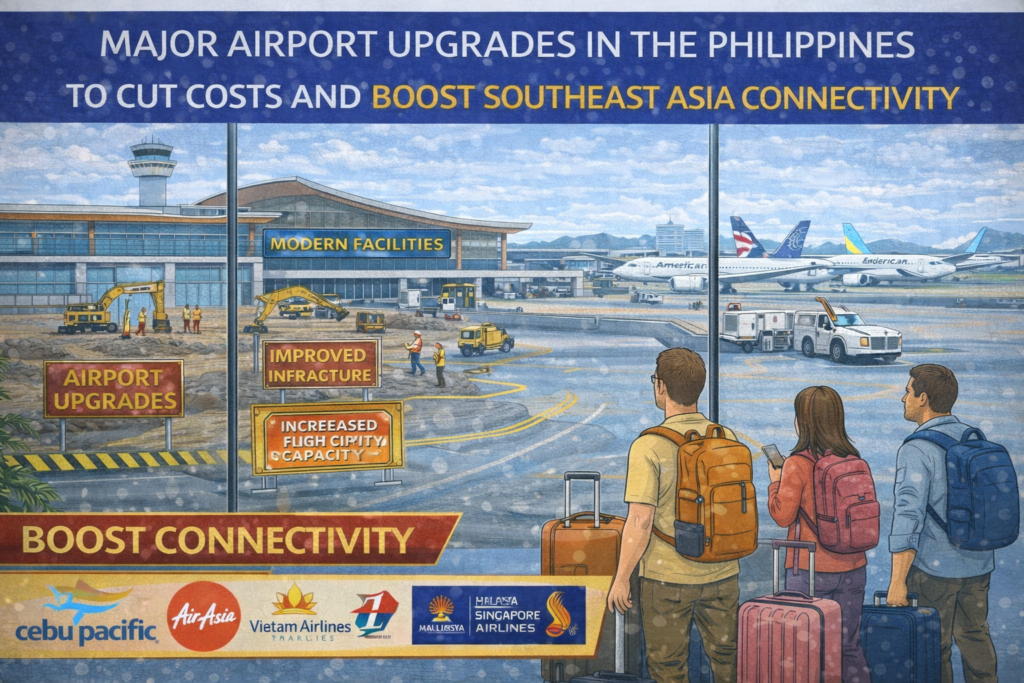
Philippines Airport Upgrades to Lower Airfare and Improve Southeast Asia Connectivity
The Philippines is preparing for major aviation upgrades aimed at reducing domestic flight costs and improving connectivity across the archipelago and the wider Southeast Asian region.
In 2026, the Department of Transportation and the Civil Aviation Authority of the Philippines will implement a series of airport development initiatives designed to expand capacity, support larger aircraft, and strengthen regional access.
The goal is clear: make air travel more affordable and accessible for Filipinos while boosting tourism, trade and regional mobility.
Why Affordable Air Travel Matters in the Philippines
As an archipelago of more than 7,000 islands, the Philippines relies heavily on air transport for domestic movement.
However, high ticket prices have long posed challenges for:
- Budget-conscious travelers
- Provincial communities
- Domestic tourism growth
- Inter-island business activity
Limited airport capacity, short runways and restricted operating hours have constrained airline competition on certain routes. The government’s new strategy focuses on infrastructure improvements that can lower airline operating costs and increase flight availability.
Key Airport Development Initiatives in 2026
1. Runway Extensions to Support Larger Jet Aircraft
A central element of the reform plan is extending runways at select airports to a minimum length of 2,100 meters, where feasible.
Transportation Secretary Giovanni Lopez has ordered that airports meet this standard, except where terrain or topographical constraints prevent expansion.
Longer runways will allow airports to:
- Accommodate larger commercial jets
- Increase passenger capacity per flight
- Improve fuel efficiency for airlines
- Expand route networks
According to CAAP, 28 of the country’s 48 commercially operated airports already meet the 2,100-meter runway requirement. These include:
- Nine international airports
- Ten principal Class 1 airports
- One principal Class 2 airport
In total, 29 airports are currently operating jet aircraft.
By enabling more airports to handle jets, airlines can achieve greater economies of scale and potentially pass cost savings on to passengers.
2. Expanding Night-Operation Capabilities
Another major focus is improving night-rating capability at more airports.
The CAAP is advancing infrastructure upgrades to allow safe night and early morning flight operations. Extended operating hours can:
- Reduce congestion during peak daytime periods
- Increase total daily flight capacity
- Provide more flexible scheduling options for travelers
- Improve aircraft utilization for airlines
At present, 23 airports are already night-capable.
Airports currently prioritized for upgrades include:
- Cauayan Airport
- Tuguegarao Airport
Next in the pipeline are:
- Busuanga Airport
- Siargao Airport
- Dipolog Airport
- Pagadian Airport
- Antique Airport
These improvements are expected to increase flight availability and improve regional connectivity.
3. Modernizing Regional Airports
Beyond runway extensions and night operations, the government is modernizing regional terminals and increasing passenger handling capacity.
Upgraded regional airports will:
- Ease congestion at larger hubs
- Encourage airlines to add more provincial routes
- Improve access to remote tourist destinations
- Stimulate local economies
Improved regional infrastructure is expected to balance traffic distribution across the country and reduce pressure on major gateways.
Expected Impact on Travelers
Lower Domestic Airfares
As more airports become jet-capable and operate longer hours, airlines will gain greater flexibility in route planning and fleet deployment.
Increased competition on underserved routes may lead to:
- Lower ticket prices
- More seat availability
- Expanded route networks
CAAP Director General Retired Lt. Gen. Raul Del Rosario said the upgrades will expand airport capacity and flight availability while encouraging competition that directly benefits Filipinos through safer and more affordable air travel.
Better Regional Access
Travelers can expect:
- More direct flights between provinces
- Shorter travel times between islands
- Improved access to tourism destinations
Stronger inter-island connectivity supports both domestic tourism and international visitors seeking multi-destination itineraries.
More Flexible Flight Schedules
With additional night-capable airports, airlines can schedule early morning and late evening flights. This may help:
- Spread passenger demand across the day
- Reduce peak-hour congestion
- Improve on-time performance
For travelers, that translates to more booking options and potentially smoother airport experiences.
Strengthening the Philippines’ Aviation Future
The CAAP reaffirmed its commitment to modernizing airport infrastructure in coordination with the Department of Transportation and other agencies.
These upgrades represent a long-term investment in:
- Transportation infrastructure
- Tourism growth
- Regional economic development
- Competitive air travel markets
By improving airport capacity and supporting airline competition, the Philippines aims to create a more resilient and cost-efficient aviation sector.
Outlook for Air Travel in the Philippines
With runway extensions, expanded night operations and regional airport modernization underway, the Philippine aviation industry is positioned for significant transformation.
For travelers, the changes could mean:
- More affordable domestic flights
- Expanded route options
- Improved connectivity across Southeast Asia
- Greater access to the country’s islands and cities
As these infrastructure projects roll out in 2026, the Philippines is moving toward a more accessible, competitive and traveler-friendly air transport system.