Wally Funk, Aviation Pioneer and Record-Setting Space Traveler, Dies at 87
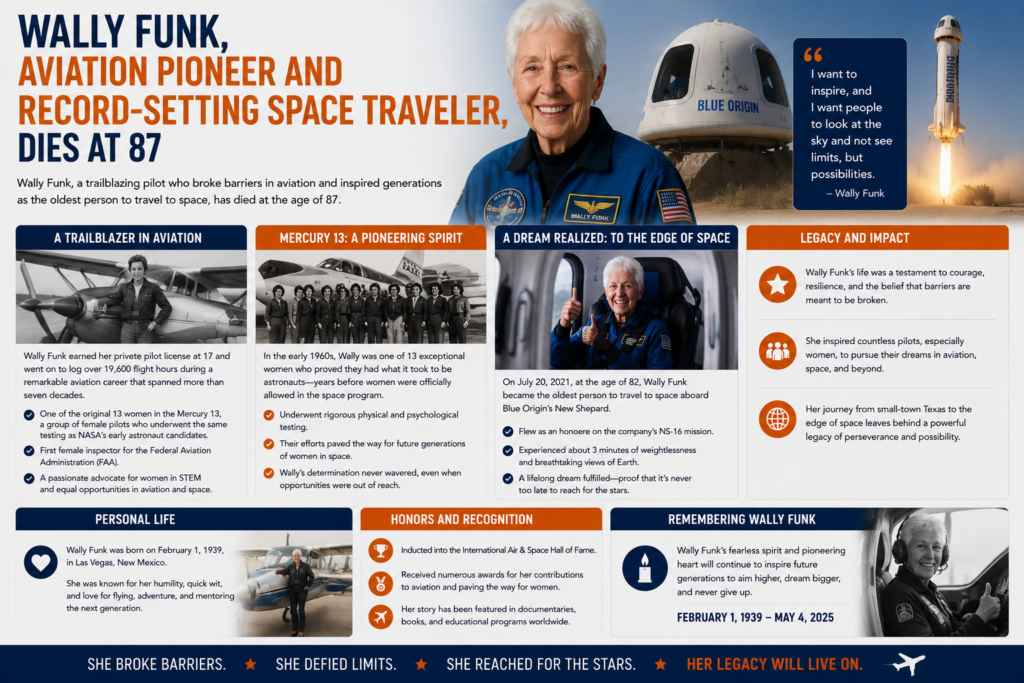
Wally Funk, a pioneering aviator who spent decades breaking barriers in aviation and later became the oldest person to travel to space, has died at the age of 87.
Funk’s career spanned more than six decades and included achievements in flight instruction, aviation safety and space exploration. She became widely recognized not only for her historic spaceflight but also for her determination to pursue opportunities in an industry where women faced significant barriers.
A Lifelong Passion for Aviation
Born Mary Wallace “Wally” Funk on February 1, 1939, in New Mexico, Funk developed an interest in aviation at an early age.
She learned to fly as a teenager and later trained as a professional pilot. Her aviation career included work as a flight instructor, where she helped teach others to fly and encouraged broader participation in aviation.
Funk became one of the few women to participate in the early stages of U.S. space exploration training.
The Mercury 13 and Early Space Aspirations
In the early 1960s, Funk became part of a privately funded initiative known as the Women in Space Program, later commonly referred to as the “Mercury 13.”
The program involved women pilots undergoing medical and physical tests similar to those used in astronaut selection programs during the Mercury era.
Funk and the other participants successfully completed many of the same types of evaluations used to assess astronaut candidates. However, the program was not an official NASA astronaut selection effort, and none of the women were selected for NASA’s Mercury missions.
At the time, NASA’s astronaut corps was limited to military test pilots, a requirement that excluded many highly skilled civilian pilots, including Funk.
The Mercury 13 became an important part of the history of women in aviation and space exploration, highlighting debates about opportunity and representation in the early space program.
A Career Dedicated to Flying
After her involvement in the women’s astronaut testing program, Funk continued building her aviation career.
She became a flight instructor and worked in aviation safety roles, including with the Federal Aviation Administration (FAA).
Throughout her career, she accumulated thousands of hours of flight experience and trained numerous pilots.
Funk was known for her enthusiasm for aviation and her willingness to continue pursuing new challenges throughout her life.
Achieving Spaceflight at Age 82
Decades after her early astronaut ambitions, Funk finally reached space in 2021.
She flew aboard Blue Origin’s New Shepard spacecraft during the company’s first crewed suborbital flight.
The mission launched from West Texas and carried Funk along with company founder Jeff Bezos, his brother Mark Bezos and teenager Oliver Daemen.
At the age of 82, Funk became the oldest person to travel to space, surpassing the previous record held by astronaut John Glenn, who was 77 when he flew aboard the Space Shuttle Discovery in 1998.
Funk’s achievement came nearly 60 years after she had first undergone astronaut-style testing.
A Symbol of Persistence in Aerospace
Funk’s spaceflight was widely viewed as a milestone representing perseverance and the changing role of women in aerospace.
Her journey demonstrated how aviation and space exploration opportunities evolved over generations.
When Funk began her aviation career, women faced significant limitations in many professional flying roles. By the time she reached space, commercial spaceflight had created new opportunities outside traditional government astronaut programs.
Her story connected several eras of aviation history — from early space exploration to modern private spaceflight.
Commercial Spaceflight and a New Era
Funk’s flight took place during a period of rapid development in commercial human spaceflight.
Companies including Blue Origin, SpaceX and Virgin Galactic have worked to expand private access to space through different types of spacecraft and missions.
Unlike government astronaut programs, commercial spaceflight allows private passengers to participate in space missions, although access remains limited due to cost, availability and technical requirements.
Funk’s flight represented one example of how the definition of a space traveler has expanded beyond professional astronauts.
Recognition and Legacy
Over her lifetime, Funk received recognition for her contributions to aviation and her role in advancing the visibility of women in flight.
She became an inspiration for many aspiring pilots and space enthusiasts.
Her career also reflected a broader history of women who contributed to aviation but often received limited recognition during earlier decades.
The Mercury 13 participants, including Funk, are now recognized as important figures in the story of women’s participation in aerospace.
The Importance of Representation in Aviation
Funk’s life highlighted the impact of representation in traditionally male-dominated fields.
Aviation and aerospace have historically faced challenges in achieving broader participation among women and underrepresented groups.
Programs, organizations and industry efforts continue working to expand opportunities in pilot training, engineering and space careers.
Stories like Funk’s are often cited as examples of how determination and access to opportunity can influence future generations.
Remembering Wally Funk
Wally Funk’s legacy extends beyond her record-setting spaceflight.
She was a pilot, instructor, aviation professional and lifelong advocate for exploration.
Her journey from a young aviation enthusiast to a record-holding space traveler reflected decades of commitment to flight.
Although she reached space later in life, Funk achieved a goal that had been part of her ambitions since the beginning of the space age.
Her career remains a reminder that milestones in exploration are often shaped not only by technology but also by individuals willing to continue pursuing possibilities despite obstacles.
Final Thoughts
Wally Funk’s life represented a remarkable chapter in aviation and space history.
From her early participation in astronaut testing programs to her historic commercial spaceflight decades later, she remained connected to the world of exploration she had always admired.
Her record as the oldest person to travel to space was only one part of her story. Her broader legacy lies in a lifetime spent flying, teaching and encouraging others to look toward the possibilities of aviation and space.