
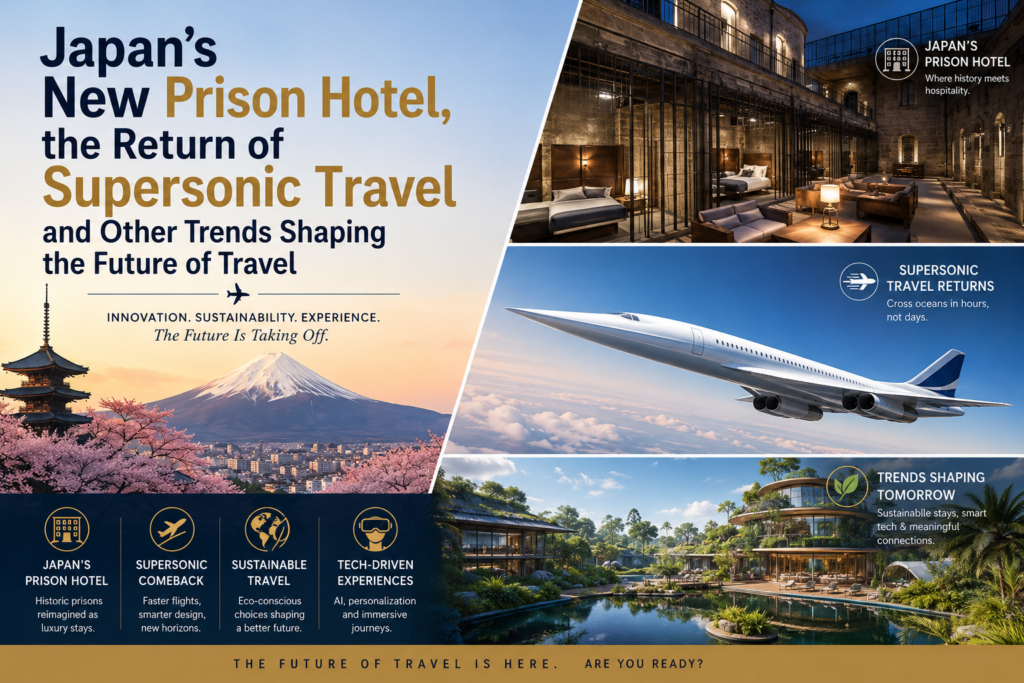
Japan’s New Prison Hotel, the Return of Supersonic Travel and Other Trends Shaping the Future of Travel
The travel industry is entering a period of transformation, with new accommodation concepts, advances in aviation technology and changing traveler expectations reshaping how people explore the world.
Recent developments highlighted by travel industry coverage include Japan’s conversion of a historic prison into a luxury hotel, renewed efforts to bring back commercial supersonic flight and continued investment in faster, more technology-driven travel experiences.
While some innovations are already available to travelers, others remain under development and could take years before becoming widely accessible.
Japan Turns a Historic Prison Into a Luxury Hotel
One of the most unusual new accommodation projects is HOSHINOYA Nara Prison, a hotel created from the former Nara Prison in Japan.
The historic red-brick complex, originally completed in 1908 during Japan’s Meiji era, served as a prison and later as a juvenile correctional facility before closing in 2017. After restoration work, the property was transformed into a luxury hotel while preserving elements of the original architecture.
The property features 48 suites created from former prison spaces. According to reports, multiple former cells were combined to create guest rooms, with designers attempting to reinterpret the building’s history through architecture and hospitality rather than simply erase its past.
The project reflects a broader global trend of adaptive reuse, where historic or unused buildings are converted into hotels, cultural spaces and tourist attractions.
The Growing Trend of Adaptive-Reuse Hotels
Converting historic structures into hotels has become increasingly popular among travelers looking for experiences that go beyond traditional accommodation.
Examples around the world include hotels created from:
- Former government buildings.
- Historic factories.
- Railway stations.
- Monasteries.
- Prisons.
These properties often appeal to visitors because the building itself becomes part of the travel experience.
Instead of staying in a standardized hotel room, guests are offered a connection to local history and architecture.
However, projects involving former prisons and other sensitive sites also require careful consideration of historical interpretation. Developers must balance preserving heritage with creating a comfortable environment for visitors.
Why Unique Hotels Are Becoming More Popular
The rise of unconventional hotels reflects a shift in traveler preferences.
Many travelers are increasingly interested in:
Experiences rather than just accommodation
A hotel can become a destination itself, offering history, design and cultural value.
Authentic connections
Visitors often seek places that reflect local identity rather than identical rooms found around the world.
Story-driven travel
Properties with unusual histories can provide memorable experiences that become part of the journey.
The popularity of converted historic buildings shows that accommodation is becoming an important part of the overall travel experience.
The Possible Return of Supersonic Passenger Travel
Another major development in aviation is the renewed effort to bring back commercial supersonic flight.
Commercial supersonic travel previously existed through Concorde, which operated transatlantic flights from 1976 until its retirement in 2003.
The aircraft significantly reduced travel times but faced challenges including high operating costs, limited passenger capacity, fuel consumption concerns and restrictions related to sonic boom noise.
New aerospace companies are now developing aircraft designed to address some of these challenges.
New Generation Supersonic Aircraft
Companies including Boom Supersonic are working on new aircraft concepts intended to make high-speed passenger travel commercially possible.
Boom’s planned Overture aircraft is designed to operate at supersonic speeds and has attracted interest from airlines and aviation companies. The company has promoted technologies intended to improve efficiency and reduce environmental impact compared with earlier supersonic aircraft.
However, the return of commercial supersonic travel is not yet a reality. Aircraft development, certification, infrastructure requirements and economic factors remain significant challenges.
Experts cited in travel industry discussions have suggested that future supersonic services may initially focus on premium travelers because of expected costs.
Why Supersonic Travel Matters
The main attraction of supersonic aircraft is time savings.
A future supersonic aircraft could potentially reduce the duration of long-haul flights significantly.
For business travelers, shorter flight times could change how international travel is planned. A journey that currently requires a full day of travel could become much shorter.
For leisure travelers, the impact would depend on ticket prices and availability.
Historically, supersonic travel was limited because operating costs made tickets expensive. Whether new technology can overcome those barriers remains one of the biggest questions facing the industry.
Environmental Challenges Remain
Speed is only one part of the aviation challenge.
The aviation industry is under pressure to reduce emissions, and faster aircraft must address questions about fuel efficiency and environmental impact.
Developers are exploring approaches such as:
- More efficient engines.
- Advanced materials.
- Sustainable aviation fuels.
- Improved aircraft designs.
However, aviation experts note that making supersonic travel economically and environmentally sustainable remains a complex engineering challenge.
Technology Is Changing the Future of Travel
Beyond hotels and aircraft speed, technology is influencing many parts of the travel journey.
Future travel developments being explored across the industry include:
- More automated airport processes.
- Artificial intelligence-assisted trip planning.
- Improved aircraft efficiency.
- New forms of transportation.
Some technologies are already being introduced, while others remain concepts that require further development.
Airports of the Future
Modern airports are also changing as operators look for ways to improve passenger experiences.
Potential developments include greater use of:
- Biometric identification.
- Digital travel documents.
- Automated check-in.
- Advanced security systems.
The goal is to reduce waiting times while maintaining security standards.
However, expanded use of biometric technology also raises questions about privacy, data protection and passenger choice.
A More Experience-Focused Travel Industry
The examples of Japan’s prison hotel and emerging supersonic aircraft highlight a larger trend: travelers are increasingly interested in experiences that feel unique.
The modern traveler may value:
- Staying in historically significant buildings.
- Reaching destinations faster.
- Using innovative travel technology.
- Discovering places through new perspectives.
Travel companies are responding by creating products that are not only functional but also memorable.
Challenges Facing Future Travel
Despite exciting developments, the travel industry continues facing challenges.
These include:
Cost
Many new travel experiences initially remain accessible mainly to higher-income travelers.
Sustainability
The industry must balance growth with environmental responsibility.
Infrastructure
New aircraft and transportation systems require major investment.
Accessibility
For innovations to transform travel broadly, they must eventually become available beyond niche markets.
What Travelers Can Expect Next
In the short term, travelers are likely to see continued growth in unique accommodations, technology-enabled airports and personalized travel services.
Longer-term developments such as commercial supersonic flights could reshape international travel if companies successfully overcome technical and economic challenges.
The future of travel will likely combine elements of the past and the future: historic buildings reimagined as hotels, faster aircraft connecting cities and technology making journeys more efficient.
Final Thoughts
From a century-old Japanese prison becoming a luxury hotel to renewed attempts at bringing back supersonic passenger travel, the travel industry is exploring new ways to attract and serve travelers.
Some innovations are already welcoming guests, while others remain ambitious projects under development.
The direction of travel is clear: future journeys will not only be about reaching destinations but also about creating distinctive experiences along the way.