
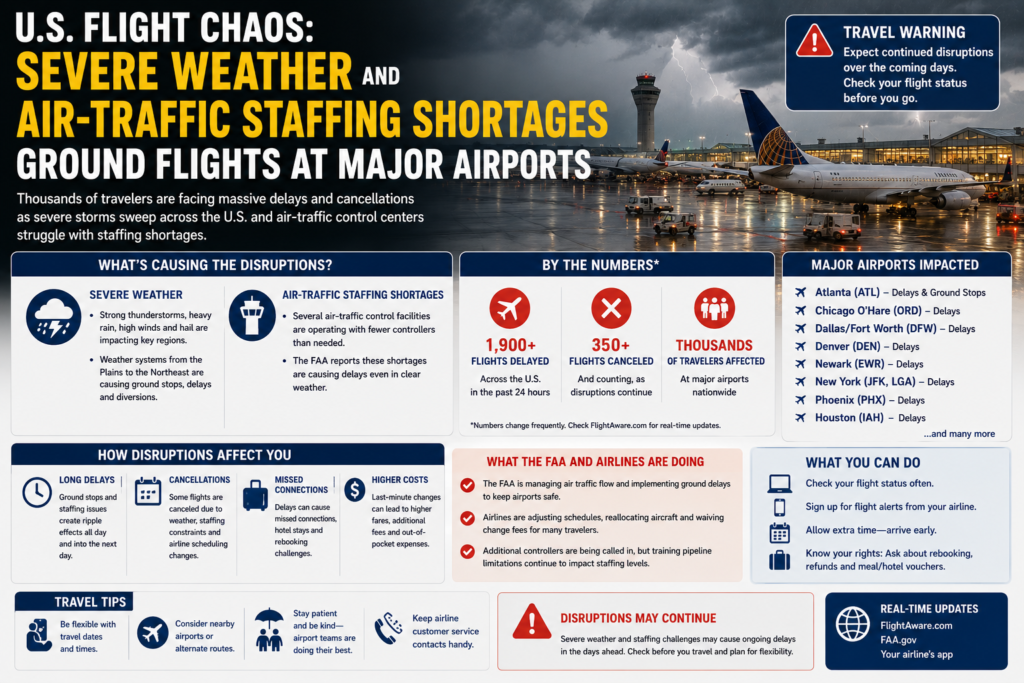
New York and Philadelphia airports faced widespread delays and cancellations after severe weather collided with an ongoing shortage of air-traffic controllers, leaving travelers facing long waits and disrupted itineraries.
Air travelers across the northeastern United States faced another difficult day of disruptions after severe weather and air-traffic-control staffing shortages forced the Federal Aviation Administration (FAA) to restrict flights at several major airports.
The disruption affected some of the country’s busiest aviation gateways, including John F. Kennedy International Airport, LaGuardia Airport, Newark Liberty International Airport and Philadelphia International Airport.
According to reporting by Reuters, the FAA slowed flights into the four airports on July 27, 2026, as thunderstorms and staffing constraints placed additional pressure on an already stretched air-traffic system. FlightAware data cited by Reuters showed that roughly 20% to 30% of flights were canceled at the four airports, while FAA data showed average ground delays ranging from 71 minutes to 149 minutes. Investing.com+1
The disruption demonstrates how quickly two separate problems—weather and a shortage of qualified air-traffic controllers—can combine to create a much larger problem for airlines and passengers.
For travelers, a delay at one major airport can quickly become a systemwide issue.
A flight arriving late at Newark can affect the same aircraft’s next departure. A delayed crew can miss its legally permitted duty window. A missed connection at JFK can leave passengers searching for another flight, while congestion at Philadelphia can affect flights elsewhere in the airline network.
The result can be cancellations long after the original weather problem has moved away.
What caused the latest flight disruption?
The immediate problem was a combination of severe weather and air-traffic-control staffing shortages.
The FAA said staffing issues at the New York Air Route Traffic Control Center were affecting flights serving JFK, LaGuardia and Newark.
At the same time, severe weather was affecting operations in the region, making it more difficult for controllers to safely manage the normal volume of aircraft.
When thunderstorms move through busy airspace, controllers may have to reroute aircraft around dangerous cells, increase spacing between planes or reduce the number of aircraft entering a particular area.
When fewer controllers are available at the same time, the system has even less capacity to absorb those disruptions.
That is what travelers experienced on July 27.
The FAA slowed traffic into the affected airports, creating a backlog that spread through airline schedules.
Four major airports were affected
The four airports directly identified in the FAA’s traffic restrictions were:
- John F. Kennedy International Airport (JFK)
- LaGuardia Airport (LGA)
- Newark Liberty International Airport (EWR)
- Philadelphia International Airport (PHL)
These airports are particularly important to the U.S. aviation network.
JFK is one of the country’s principal international gateways.
LaGuardia serves a huge volume of domestic traffic in the New York metropolitan area.
Newark is a major hub for United Airlines.
Philadelphia is a major hub for American Airlines.
Because of their importance, operational problems at these airports can affect passengers far beyond the New York and Philadelphia regions.
A traveler flying from Texas to Europe, for example, might never land at one of the affected airports but could still experience a delay if their aircraft, crew or connection is caught in the disruption.
Cancellations reached 20% to 30% at affected airports
The scale of the disruption was significant.
Reuters reported that FlightAware data showed between 20% and 30% of flights were canceled at the four affected airports. Investing.com
That does not mean that 20% to 30% of all flights nationwide were canceled.
The figure applied to the four airports experiencing the disruption.
Nevertheless, cancellations at that level can have a large effect because the airports handle enormous volumes of passengers every day.
When a carrier cancels a flight at a major hub, the airline must find another aircraft, seat or routing for the affected passengers.
During a busy travel period, there may not be enough empty seats on later flights.
That can force travelers to wait until the following day—or take a longer itinerary involving additional connections.
Ground delays reached nearly two and a half hours
Passengers were also dealing with substantial delays.
The FAA reported average ground delays ranging from 71 minutes to 149 minutes, according to Reuters. Investing.com
A ground delay does not necessarily mean that an aircraft is physically unable to move.
Instead, the FAA can use traffic-management measures to control when flights depart or arrive because the destination or surrounding airspace cannot safely accommodate normal traffic levels.
For passengers sitting at a gate, that can mean waiting for clearance to depart.
For aircraft already airborne, it can mean holding, rerouting or slowing down.
For airlines, it means aircraft and crews fall behind schedule.
Why weather can shut down a busy airport without closing the runway
Severe weather does not have to directly hit an airport’s runway to create major disruption.
Thunderstorms can affect approach and departure paths around an airport.
Commercial aircraft cannot simply fly through severe thunderstorm cells.
Instead, pilots and controllers must work around them.
That can significantly reduce the number of aircraft that can safely arrive or depart during a particular period.
If several storm cells cover multiple routes into an airport, the available airspace can become severely restricted.
The FAA then has to reduce traffic.
This is one reason a flight can be delayed even when conditions outside the terminal appear relatively normal.
A traveler may see blue skies at the airport while aircraft approaching from another direction are dealing with dangerous storms.
The staffing problem makes weather disruptions worse
Weather disruptions are a normal part of aviation.
The larger concern is what happens when severe weather hits a system that is already operating with limited staffing capacity.
Reuters reported that the number of certified air-traffic controllers at New York Area Terminal Radar Approach Control was only 57% of targeted levels. Investing.com+1
That shortage has consequences.
Air-traffic controllers have to maintain safe separation between aircraft.
They also have to coordinate arrivals and departures across multiple airports and surrounding sectors.
When staffing is below target, fewer aircraft can be handled at the same time.
The FAA can compensate by slowing traffic.
That may prevent an unsafe buildup of aircraft but creates delays for passengers.
Controllers have been working overtime
The staffing shortage is not simply a matter of having fewer people available.
Reuters reported that the shortage has forced controllers at many facilities to work mandatory overtime and six-day weeks. Fidelity
That is significant because air-traffic control is a highly specialized job.
Training new controllers takes time.
An airport cannot solve a shortage by simply hiring a large number of workers and putting them on the job immediately.
New controllers must complete extensive training and become certified for specific facilities and positions.
That makes staffing shortages particularly difficult to resolve quickly.
New York’s air-traffic system has been under pressure for years
The latest disruption is not an isolated problem.
New York’s airspace is among the busiest and most complicated in the United States.
The region includes several major airports located relatively close to one another.
JFK, LaGuardia and Newark operate in the same broad metropolitan aviation environment, meaning changes affecting one airport can influence traffic at the others.
The FAA has been working to address staffing shortages, but the problem has persisted.
The agency has also used flight restrictions and schedule limits to manage capacity at the busiest airports.
Newark has already been subject to flight limits
The Newark situation is particularly notable.
The FAA imposed significant flight reductions at Newark in May 2025 after a series of disruptions at the United Airlines hub.
Those events intensified concerns about the condition and staffing of the U.S. air-traffic-control system.
According to Reuters, the FAA has extended those Newark flight limits through October 2027. Fidelity
The agency has said that air-traffic-control staffing deficiencies at Newark are not expected to significantly improve before October 2027.
That means capacity restrictions could remain part of the Newark travel environment for years rather than months.
JFK and LaGuardia also face extended limits
The FAA has also extended flight limits affecting JFK and LaGuardia.
Reuters reported that the agency extended the limits at JFK and LaGuardia through late October 2028. Fidelity
These measures are designed to keep scheduled demand closer to what the air-traffic system can safely handle.
For airlines, however, fewer available slots can mean fewer flights.
For passengers, that can translate into higher fares, fewer schedule choices or reduced availability during peak travel periods.
Why one delay can become hundreds of cancellations
Airline schedules are interconnected.
A single aircraft may operate several flights during one day.
Imagine an aircraft scheduled to fly:
Newark → Chicago → Denver → San Francisco
If the aircraft is delayed leaving Newark because of weather and air-traffic restrictions, every subsequent flight can also be delayed.
If the delay becomes severe enough, the airline may have to cancel one or more later segments.
The same thing happens with crews.
Pilots and flight attendants are subject to strict work and rest regulations.
If a crew reaches its maximum permitted duty period, it cannot simply continue flying indefinitely because passengers are waiting.
The airline must find another qualified crew.
During widespread disruption, spare crews may already be assigned elsewhere.
That is how a weather problem in New York can eventually produce a cancellation in another state.
Connecting passengers face some of the biggest risks
Nonstop travelers may be inconvenienced by a delay, but passengers with connections face additional risks.
Consider a traveler flying:
Boston → Newark → London
If the Boston-to-Newark flight is delayed by two hours, the passenger may miss the London connection.
The airline then has to find another seat on a later flight.
For international routes, that can be especially difficult because there may be only one or two flights per day.
A missed connection can therefore turn a short delay into an overnight stay.
Why passengers should avoid extremely tight connections
The latest disruption is another reminder that connection time matters.
A 45-minute connection may look attractive when booking because it reduces total travel time.
But during severe weather or airport congestion, a short connection can quickly become impossible.
Passengers traveling through major hubs may want to consider longer connection windows when choosing between itineraries, particularly during periods of historically volatile weather.
A longer connection is not a guarantee against disruption.
It simply provides more time for the airline network to absorb a delay.
Travelers should monitor their flights before leaving home
One of the most useful steps passengers can take is to check their flight status before heading to the airport.
If an airline has already delayed a flight, passengers may be able to adjust their timing.
However, travelers should not assume that an early delay will remain unchanged.
Flight schedules can move forward or backward as conditions improve.
Passengers should therefore continue monitoring their airline’s official notifications.
What should you do if your flight is canceled?
If your flight is canceled, contact the airline as quickly as possible.
Many carriers provide self-service rebooking through their websites and mobile applications.
Using the app can sometimes be faster than waiting in a customer-service line.
Travelers should check:
- the next available flight;
- alternative airports;
- connecting options;
- same-day standby availability, if offered;
- baggage arrangements; and
- whether the airline has issued a weather waiver.
If thousands of passengers are affected simultaneously, seats on alternative flights can disappear quickly.
Weather cancellations are different from airline-controlled disruptions
Passengers should also understand that airlines do not control every cancellation.
A cancellation caused by severe weather or FAA traffic restrictions is different from a cancellation caused by an airline’s own operational decision.
Severe weather can be outside the carrier’s control.
The airline may have no choice but to cancel or delay a flight when the FAA restricts traffic or the weather makes operations unsafe.
That distinction can affect what assistance is available.
Passengers should ask the airline what caused the disruption and what options are being offered.
Why the phrase “staff skipped work” needs context
Some headlines describe the disruption as airport or aviation staff “skipping work.”
That wording can be misleading if taken literally.
The Reuters report identifies the issue as air-traffic-control staffing shortages, alongside severe weather.
The FAA’s problem is a shortage of certified controllers, rather than evidence that airport employees collectively decided not to report for work on July 27.
Reuters reported that staffing shortages have resulted in mandatory overtime and six-day workweeks for controllers at some facilities. Investing.com+1
The distinction matters.
Airport operations involve many different groups, including TSA officers, airline employees, baggage handlers, pilots, flight attendants, airport workers and air-traffic controllers.
A shortage in one part of that system can have consequences throughout the entire network.
The FAA’s role is critical
The FAA is responsible for managing the nation’s air-traffic system.
When weather or staffing limitations reduce the amount of traffic that can safely be handled, the agency can implement traffic-management initiatives.
These can include ground stops, ground delays and reduced arrival or departure rates.
The purpose is not to punish airlines or passengers.
It is to keep the airspace manageable and safe.
Unfortunately for travelers, these safety measures can create long waits.
A ground stop is not the same as an airport closure
Travelers sometimes interpret the word “grounded” to mean an airport has completely shut down.
That is not necessarily the case.
A ground stop generally means aircraft are temporarily prevented from departing toward a particular destination or area because of traffic-management restrictions.
Other flights may continue operating.
A ground stop can also be temporary.
Once conditions improve, the FAA can begin releasing flights.
However, the backlog created during the stop can take much longer to clear.
That is why passengers may continue experiencing delays even after the weather improves.
The backlog can last long after the storm passes
This is one of the most frustrating aspects of weather-related disruptions.
A thunderstorm might pass through an area in an hour.
But the aircraft that were delayed during that hour do not magically return to their original schedules.
Hundreds of aircraft may now be in the wrong locations.
Crews may be out of position.
Gates may be occupied.
Passengers may have missed connections.
Aircraft may require new departure slots.
As a result, the operational effects of a storm can continue for many hours.
Airlines may have to cancel flights to recover
Cancellation can sometimes be part of an airline’s recovery strategy.
If every delayed flight is allowed to continue, the schedule can become increasingly late.
By canceling selected flights, an airline may be able to free aircraft and crews and restore more of its schedule.
That does not make the cancellation less frustrating for the affected passengers.
But it explains why airlines sometimes cancel flights even after weather conditions have improved.
Summer travelers should pay attention
The July disruption is particularly relevant because summer is one of the busiest periods for U.S. air travel.
High passenger demand means flights are fuller and alternative seats can be harder to find.
Major airports also operate at high capacity.
When weather or staffing problems occur, there is less spare capacity available to absorb the shock.
Travelers planning summer trips through New York, Newark or Philadelphia should therefore pay close attention to weather forecasts and airline notifications.
What passengers can do to reduce disruption risk
No traveler can control severe weather.
But several choices can reduce the consequences of a disruption.
Book earlier flights when possible
Earlier flights often have more opportunities for rebooking later in the day if something goes wrong.
Avoid extremely short connections
A longer connection can provide additional protection against delays.
Keep essential items in your carry-on
Medication, important documents, chargers and basic necessities should not be placed exclusively in checked luggage.
Monitor airline notifications
Install the airline’s app and enable flight alerts.
Know your alternatives
Before a trip, identify whether other airlines or airports could provide backup options.
Consider travel insurance carefully
Coverage varies by policy, and travelers should understand the terms before purchasing.
What this means for travelers using Newark
Newark deserves particular attention because it is a major United Airlines hub and has already been affected by longer-term FAA capacity restrictions.
Passengers using Newark should allow additional flexibility when planning connections.
They should also check whether their itinerary passes through another airport affected by New York-area air-traffic restrictions.
A delay at Newark can quickly affect a connecting itinerary even when the passenger’s final destination is nowhere near New Jersey.
What this means for JFK travelers
JFK is one of the most important international gateways in the United States.
A disruption there can affect transatlantic and other long-haul flights.
International passengers should be particularly cautious about tight connections because missing one long-haul departure can result in a much longer wait for the next available seat.
Travelers should also confirm passport and entry-document requirements before making last-minute itinerary changes.
What this means for LaGuardia travelers
LaGuardia has a heavily domestic schedule.
Because many flights are short-haul, passengers may have more alternative flights than travelers on international routes.
However, the high frequency of operations also means disruptions can quickly spread through the airline’s network.
A delay at LaGuardia can affect aircraft that later operate flights to other major cities.
Philadelphia is also an important part of the network
Philadelphia International Airport is a major hub for American Airlines.
The FAA’s decision to slow traffic into Philadelphia alongside the New York-area airports meant that several major airline networks were dealing with restrictions at the same time.
That reduced the number of easy alternatives available to passengers.
Travelers whose original itinerary passed through Philadelphia could find that alternative flights through New York were also affected.
Why this problem could continue
The FAA’s staffing situation will not be solved overnight.
Reuters reported that the New York Area Terminal Radar Approach Control facility had certified staffing at only 57% of its target. Investing.com
The agency is working to increase staffing, but controller training and certification require time.
Meanwhile, demand for air travel remains strong.
That creates a difficult balancing act.
The FAA must maintain safe traffic levels while airlines want to operate schedules that meet passenger demand.
Weather can then reduce available capacity even further.
The bigger issue facing U.S. aviation
The latest disruption illustrates a broader challenge for the American aviation system.
Air travel depends on multiple systems working together.
Airlines need aircraft and crews.
Airports need gates, runways and ground staff.
The FAA needs enough trained controllers.
Passengers need functioning security and baggage systems.
Weather affects all of these operations.
When one component becomes constrained, the others can become overloaded.
The result is a system in which a disruption at one airport can quickly become a nationwide problem.
What travelers should remember
The most important lesson from the latest disruption is that weather and staffing problems can reinforce each other.
A thunderstorm by itself can cause delays.
A staffing shortage by itself can reduce airport capacity.
Put the two together at one of the busiest aviation corridors in the country, and the impact can be much larger.
The July 27 disruption affected JFK, LaGuardia, Newark and Philadelphia, with FlightAware reporting cancellation rates of approximately 20% to 30% at the four airports and FAA-reported ground delays ranging from 71 to 149 minutes. Investing.com+1
For passengers, that meant missed connections, rebooking problems and the possibility of overnight disruptions.
For airlines, it meant aircraft and crews falling out of position.
For the FAA, it meant reducing traffic to keep operations safe.
And for the broader U.S. aviation system, it was another reminder of how dependent the network is on adequate air-traffic-control staffing.
Final takeaway for U.S. air travelers
The latest flight disruption is not simply a story about bad weather.
It is a story about what happens when severe weather meets an already constrained air-traffic system.
The FAA had to slow flights into four major airports while controllers dealt with staffing limitations and severe weather.
At the same time, passengers encountered cancellations affecting a significant share of flights at the affected airports.
The problem can continue even after the skies clear because airlines then have to reposition aircraft, crews and passengers.
For travelers, preparation remains the best defense.
Check your flight before leaving home.
Give yourself enough time at the airport.
Avoid unnecessarily tight connections.
Keep essential items in your carry-on.
And if your flight is canceled or substantially delayed, contact the airline promptly and look for rebooking options.
The U.S. aviation system remains capable of handling enormous passenger volumes, but incidents like this show how quickly capacity can be tested when several problems occur at the same time.
As long as air-traffic-control staffing remains below target at key facilities and severe summer weather continues to affect the nation’s busiest airspace, passengers should be prepared for the possibility of additional disruptions.
Need help with your flight?
Customers who need assistance with booking, canceling, rebooking, rescheduling or upgrading a flight ticket can call:
1-877-730-2630
Customers who want to check flight status can also call the same toll-free number.
When calling, travelers should have their reservation reference, passenger name, flight number and travel date available.
Important: The number above is included based on the customer-service information supplied for this article. It is not represented as an official FAA, airport, airline or government telephone number.
For official flight information, passengers should also verify their itinerary directly with their airline.
Source Credit
Primary news source: TheTravel, whose report prompted this article and whose headline described the disruption involving U.S. airports, cancellations, grounded flights, staffing and severe weather.
Independent verification: Reuters, “FAA delaying flights at New York, Philadelphia airports,” published July 27, 2026. Reuters reported that the FAA slowed flights into JFK, LaGuardia, Newark and Philadelphia because of severe weather and air-traffic staffing shortages. FlightAware data cited by Reuters showed 20%–30% cancellations at the four airports, while FAA-reported ground delays averaged 71–149 minutes. Investing.com+1
Additional source: Reuters reporting also states that certified controllers at New York Area Terminal Radar Approach Control were at 57% of targeted levels and that the FAA has extended flight restrictions affecting Newark, JFK and LaGuardia. Fidelity
Editorial note: This article distinguishes between verified air-traffic-control staffing shortages and the stronger phrase “staff skip work” used in the supplied topic. The available reporting supports a staffing shortage, mandatory overtime and six-day workweeks; it does not establish that airport employees broadly “skipped work.” Flight conditions, cancellations, restrictions and airline policies can change rapidly, so travelers should verify the latest information before departure.