From crowded airports and flexible bookings to road trips, sustainable tourism and the return of travel advisors, the COVID-19 pandemic forced travelers to rethink how they move around the world. Here are eight changes experts predicted—and what has happened since.
Travel was once something many people could take for granted.
Book a flight, pack a suitcase, arrive at the airport and go.
Then the COVID-19 pandemic changed almost everything.
Borders closed. Flights disappeared from departure boards. Hotels emptied. Cruises stopped operating. Millions of travelers canceled vacations, postponed family visits and spent months or even years wondering when international travel would become normal again.
In October 2020, when much of the world was still dealing with restrictions and uncertainty, National Geographic published an article asking a question that was on the minds of travelers everywhere:
What would travel look like after the pandemic?
Writer Steve Brock spoke with travel authors, experts, bloggers and industry voices about how COVID-19 might permanently change the way people travel.
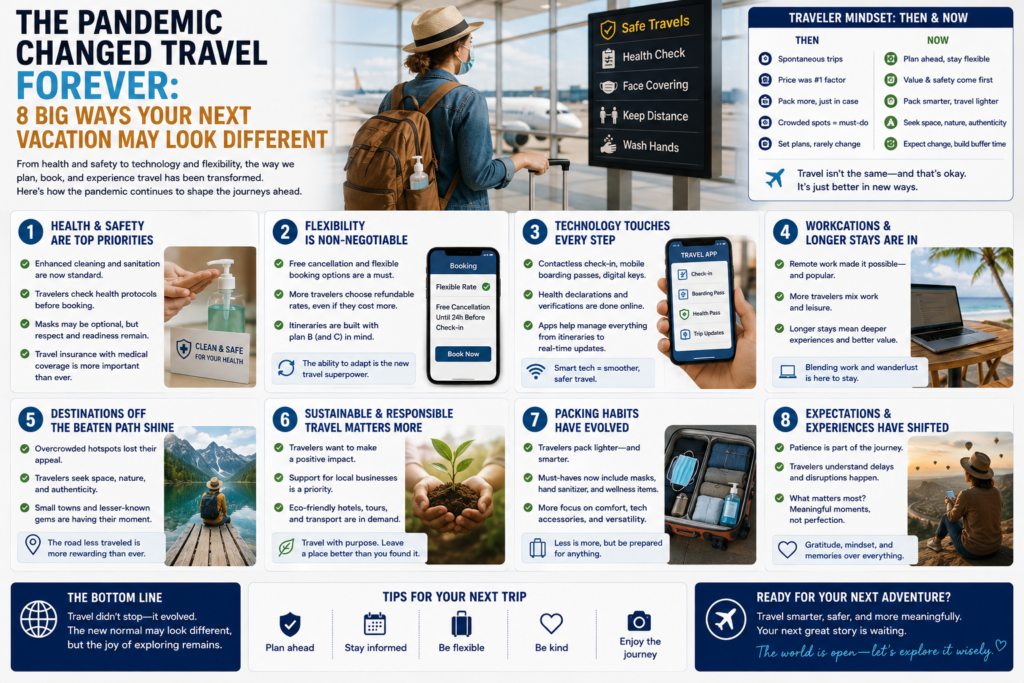
The resulting article, “Here are 8 ways travel will change after the pandemic,” outlined eight major predictions: sustainability would become more important, travelers would seek more meaningful experiences, small communities would gain greater importance, people would prioritize quality over quantity, the journey itself would become more important, travel advisors would become increasingly valuable, travelers would stay closer to home and trip planning would once again become something to look forward to. National Geographic
Some of those predictions sounded speculative in 2020.
Today, they offer an interesting look at how the travel industry has evolved.
Air travel has not merely returned to the way it was before COVID-19. Demand has rebounded strongly, while travelers and airlines have also had to adapt to new realities.
The International Air Transport Association reported that global passenger demand reached a record level in 2025, with total annual demand up 5.3% from 2024 and the global passenger load factor reaching a record 83.6%. International demand increased 7.1%. IATA
So, what actually changed?
Here are the eight major shifts identified in the National Geographic report—and why they still matter to travelers today.
1. Sustainable Travel Would Become More Important
One of the strongest themes identified in the 2020 National Geographic report was sustainability.
Before the pandemic, overtourism and the environmental impact of tourism were already major subjects of discussion.
Popular destinations were dealing with huge crowds.
Airlines were facing increasing pressure to reduce their environmental impact.
Travelers were beginning to ask whether visiting a destination should simply be about seeing the most famous attractions or whether tourism could benefit local communities and protect the places being visited.
The pandemic temporarily brought international tourism to an extraordinary halt.
That pause gave many people an opportunity to reconsider how and why they traveled.
Bruce Poon Tip, founder of G Adventures and author of Unlearn: The Year the Earth Stood Still, argued that the interruption could give travelers time to consider more conscious ways of traveling. National Geographic
The idea was not that people would stop traveling.
Instead, the prediction was that travelers might become more thoughtful about the impact of their trips.
That could mean supporting locally owned businesses, spending more time in a destination instead of rushing through several countries, choosing experiences that directly benefit communities and looking for tourism operators with stronger environmental practices.
Has this trend continued?
Sustainability remains a major issue for aviation and tourism.
The aviation industry continues to face pressure to reduce emissions while passenger demand keeps growing.
IATA’s 2026 assessment of 2025 travel noted that strong demand is bringing two major challenges into sharper focus: decarbonization and supply-chain constraints. The organization has called for faster development of sustainable aviation fuel production as part of aviation’s long-term growth strategy. IATA
That means the fundamental question raised in 2020 has not disappeared.
If anything, it has become more complicated.
Travelers want to explore the world.
Airlines want to meet that demand.
Governments and the industry also have to address aviation’s environmental impact.
The post-pandemic travel era therefore involves a continuing debate about how to make tourism more sustainable without eliminating the freedom and economic benefits that travel provides.
2. Road Trips Would Become More Popular
When international flights were restricted, Americans still wanted to travel.
The solution for many was simple:
Get in the car.
National Geographic highlighted the renewed popularity of road trips as one of the clearest changes emerging during the pandemic. With international borders restricted and air travel dramatically reduced, driving became one of the easiest ways for Americans to experience a change of scenery. National Geographic
But the significance of the road trip went beyond transportation.
Travelers discovered that the destination did not necessarily have to be a famous international city.
A national park, small town, scenic highway or remote outdoor destination could provide the feeling of escape people were looking for.
Gabby Beckford of Packs Light, quoted by National Geographic, described road-tripping as a way of rediscovering curiosity and wonder rather than simply traveling toward a particular destination. National Geographic
That concept has continued to influence travel behavior.
Americans increasingly have enormous choices when planning vacations.
A trip doesn’t have to begin with an international flight.
It could start with a drive.
A weekend getaway.
A national park.
A coastal road.
A mountain town.
Or a destination a few hours from home that a traveler had never previously considered.
Why road trips remain attractive
Road trips offer several advantages.
Travelers can control their schedule more easily.
They can make spontaneous stops.
They can carry more luggage.
Families can avoid some airport procedures.
And travelers can explore smaller communities along the way.
For families, road travel can also provide flexibility that is difficult to achieve with tightly scheduled flights.
A traveler can stop for lunch.
Visit an attraction.
Change the route.
Stay overnight somewhere unexpected.
The pandemic may have accelerated interest in this style of travel, but the basic appeal existed long before COVID-19.
3. Travelers Would Seek Quality Over Quantity
Another prediction from the National Geographic article was that travelers would begin thinking differently about how much they travel.
Instead of trying to visit as many destinations as possible, travelers could focus on making individual trips more meaningful.
The pandemic forced people to confront something that frequent travelers sometimes forget:
Travel is not guaranteed.
A vacation can be canceled.
A border can close.
A flight can disappear.
A hotel can shut down.
A major international event can change travel plans almost overnight.
That experience influenced how some travelers thought about future trips.
Instead of asking, “How many countries can I visit this year?” some began asking, “What kind of experience do I actually want?”
That shift can change the entire structure of a vacation.
A traveler might spend two weeks in one country instead of trying to visit five.
A family might choose a memorable national-park trip rather than several short weekend flights.
A couple might prioritize a special anniversary vacation.
A traveler might spend more on one meaningful experience rather than taking several inexpensive trips.
National Geographic quoted travel personality Erick Prince, known as The Minority Nomad, discussing how the pandemic gave him an opportunity to rethink why he traveled and to focus more on passion than simply traveling for work. National Geographic
The “quality over quantity” idea also affects spending
Travelers often have limited budgets.
A vacation budget can be divided between flights, hotels, food, transportation and activities.
A traveler who focuses on quality may choose to spend more on one element that matters most.
For one person, that could be a better hotel.
For another, it could be a premium cabin.
For another, it could be an unforgettable tour.
For a family, it might simply mean having enough time at the destination without rushing from attraction to attraction.
The pandemic did not eliminate budget travel.
Instead, it encouraged some travelers to think more carefully about what they actually value.
4. The Journey Itself Would Become More Important
Travel is often treated as a means of reaching a destination.
The flight gets you there.
The hotel gives you somewhere to sleep.
The attraction is the main event.
But one of the predictions in the National Geographic report was that travelers could become more interested in the journey itself.
That idea connects closely with the growth of road trips and slower forms of travel.
Consider two different vacations.
In the first, a traveler flies into a major city, spends two days seeing the biggest attractions and then immediately flies home.
In the second, the traveler drives through several small communities, stops at local restaurants, visits parks and spends time exploring places that were never part of the original plan.
The second trip may produce fewer social-media check-ins.
But it could create more memories.
The pandemic also changed how many people thought about time.
When movement was restricted, ordinary activities suddenly became meaningful.
Going to an airport felt exciting again.
Taking a train felt special.
Driving across state lines could feel like an adventure.
That psychological shift helped remind travelers that the experience of getting somewhere can itself be part of the vacation.
5. Travel Advisors Could Become More Valuable
Perhaps one of the most interesting predictions from the 2020 article involved travel advisors.
Before the pandemic, many travelers assumed that booking directly online was the easiest and most efficient approach.
Search for a flight.
Compare prices.
Click purchase.
Done.
Then COVID-19 happened.
Suddenly, travel became much more complicated.
Flights were canceled.
Borders changed their requirements.
Hotels modified policies.
Airlines changed schedules.
Travelers needed refunds, credits, rebookings and new itineraries.
A simple online booking could turn into a complicated problem.
That experience highlighted the potential value of having a person who understands the travel industry and can help when circumstances change.
Juliet Kinsman, sustainability editor at Condé Nast Traveller, told National Geographic that the expertise and financial protection associated with booking through a travel agent could outweigh the commission travelers pay. She also suggested that travelers could look for advisors who understand sustainability. National Geographic
Why this prediction still matters
Travel today can be extremely easy when everything works.
But when something goes wrong, the situation can become much more complicated.
A canceled flight may require rebooking.
A missed connection may require a new itinerary.
A family traveling together may need several seats on another flight.
A traveler may need to change the date of a trip.
An international journey may involve multiple airlines.
That is where assistance can become valuable.
Travel advisors and travel professionals can potentially help travelers navigate these situations, depending on their services and the terms of the booking.
Technology has also changed the role.
Travel advisors increasingly use digital tools and artificial intelligence to research routes, organize itineraries and communicate with customers. Recent reporting has found that some advisors are using AI to improve productivity while maintaining a human role in personalized trip planning. Business Insider
So the post-pandemic travel advisor may not look like the traditional travel agent of decades ago.
The modern advisor can combine human assistance with technology.
6. Travelers Would Stay Closer to Home
Another major prediction was that travelers would become more comfortable exploring destinations closer to home.
This was partly a practical response to pandemic restrictions.
International travel became difficult.
Domestic travel was often easier.
For Americans, that meant discovering destinations within the United States that might previously have been overlooked.
National parks.
Beaches.
Small towns.
Mountain destinations.
Scenic drives.
Regional cities.
Weekend destinations.
The pandemic effectively encouraged travelers to reconsider what counts as a vacation.
A trip doesn’t have to involve crossing an ocean.
It doesn’t even have to involve crossing a national border.
Domestic travel can also be simpler
International trips can involve passports, visas, customs, immigration procedures, foreign currencies and language differences.
Domestic trips generally involve fewer of those complications.
That doesn’t mean international travel has disappeared.
Far from it.
Global air travel has recovered strongly.
IATA reported that international passenger demand increased 7.1% in 2025, while total global passenger demand reached a record level. IATA
But the pandemic demonstrated that domestic travel can be a powerful alternative when international travel becomes difficult.
For North American travelers, this remains relevant.
The United States and Canada contain enormous geographic and cultural diversity.
Travelers can experience mountains, deserts, beaches, forests, major cities and historic communities without necessarily boarding an international flight.
7. Small Communities Could Play a Bigger Role
One of the most interesting implications of post-pandemic travel was the potential shift away from heavily crowded destinations.
Before COVID-19, major tourism centers were already dealing with overtourism.
Popular European cities could become overwhelmed during peak seasons.
Famous attractions could experience long lines.
Small communities sometimes struggled with the sudden influx of visitors.
The pandemic temporarily reversed that situation.
With international tourism collapsing, many destinations became quiet.
As travel returned, some travelers became more interested in less crowded places.
That created an opportunity for smaller communities.
Instead of staying in a major tourist center, visitors could choose a nearby town.
Instead of visiting the most famous attraction, they could explore a lesser-known one.
Instead of eating exclusively at international chains, they could support local restaurants.
Why local tourism matters
Tourism can provide significant economic benefits to communities.
Visitors spend money on hotels, restaurants, transportation, attractions, shopping and entertainment.
When tourism revenue reaches smaller communities, it can support businesses and jobs that might otherwise have fewer customers.
But there is also a balance to maintain.
A sudden increase in tourism can create pressure on housing, infrastructure and natural resources.
That brings the discussion back to sustainability.
The future of tourism may therefore involve not simply sending more travelers to smaller destinations, but finding ways to distribute tourism responsibly.
8. Planning a Trip Would Become Exciting Again
The final prediction in National Geographic’s eight-point list was perhaps the most emotional:
Travel planning would become something people looked forward to again.
During the pandemic, planning a vacation could feel almost pointless.
A traveler could research a destination for months only to discover that the border was closed.
A flight could be canceled.
A hotel could shut down.
A government could introduce a new restriction.
Nobody knew exactly when normal international travel would return.
That uncertainty made it difficult to plan.
But travel planning itself is part of the travel experience.
People look at photographs.
Research hotels.
Compare flights.
Build itineraries.
Watch videos.
Read restaurant reviews.
Talk about destinations with friends.
Dream about the trip.
The anticipation can be almost as enjoyable as the trip itself.
When travel began reopening, that anticipation returned.
People started planning future vacations even when they could not yet travel.
Travel planning has become even more digital
The tools available to travelers have changed dramatically.
Consumers can now compare flight schedules, hotels, attractions and transportation options from their phones.
Artificial intelligence is also increasingly being used to help construct itineraries.
Travel advisors are using technology to work faster.
Airlines are providing more digital tools.
Travelers can receive notifications about flight changes.
Mobile boarding passes have become standard across much of the industry.
In other words, the desire to plan travel returned—but the technology surrounding planning continued evolving.
What the Pandemic Ultimately Changed About Flying
The most important lesson may be that travel is resilient.
The pandemic produced an unprecedented collapse in global travel.
Yet people did not permanently abandon flying.
They came back.
And they came back in enormous numbers.
IATA’s 2025 figures show just how dramatic that recovery has been.
Global passenger demand rose 5.3% during 2025.
International demand increased 7.1%.
And the worldwide passenger load factor reached a record 83.6%. IATA
That means the post-pandemic travel industry is not simply a smaller version of the pre-pandemic industry.
It is operating at enormous scale again.
But it is also facing different challenges.
Planes Are Full Again – but Capacity Is Still a Problem
One of the most notable developments in the post-pandemic airline industry is that demand has returned faster than some parts of the aviation supply chain can accommodate it.
IATA said airlines continued dealing with aircraft and engine delivery delays, maintenance constraints and supply-chain problems in 2025.
Airlines responded by keeping aircraft in service longer and filling more seats.
The result was a record annual passenger load factor of 83.6%. IATA
For travelers, this can have an important consequence.
When flights are full, disruptions can be more difficult to resolve.
If a flight is canceled, there may be fewer empty seats available on the next departure.
If a traveler misses a connection, alternatives can be limited.
If an aircraft has a mechanical issue, moving hundreds of passengers to another flight can be challenging.
This makes flexibility and preparation increasingly important.
The New Travel Reality: Flexibility Matters
The pandemic taught travelers one lesson more clearly than almost anything else:
Plans can change.
That remains true today.
Weather can disrupt flights.
Airlines can change schedules.
Aircraft can be substituted.
Airports can become congested.
Geopolitical events can affect routes.
Unexpected events can force travelers to change dates.
That is why travelers should understand their ticket conditions before booking.
Depending on the fare and airline, a ticket may have specific rules concerning changes, cancellations, credits, refunds or rebooking.
Travelers should read those terms carefully.
What North American Travelers Should Know Before Booking
For travelers in the United States and Canada, the post-pandemic world offers more options than ever.
But more options also mean more decisions.
Before purchasing a ticket, travelers should consider:
Check the complete itinerary
A cheap ticket with multiple connections may not always be the best choice.
Understand the fare rules
Find out whether changes or cancellations are permitted and what charges may apply.
Leave enough time for connections
A short connection may save time when everything runs perfectly, but it offers little protection if the first flight is delayed.
Monitor flight status
Flight schedules can change after booking.
Keep your reservation information accessible
Confirmation numbers, flight numbers and travel dates can make it easier to resolve problems.
Consider flexibility for important trips
If the trip involves a wedding, cruise, international connection or major event, consider whether your itinerary provides enough backup time.
What Happens When a Flight Gets Canceled?
A canceled flight can transform a simple travel day into a complicated one.
Passengers may need to find another flight.
The next available departure may be full.
A connection may no longer work.
A traveler may need to change the entire itinerary.
If you’re dealing with a cancellation, it is important to understand the options available under your airline and fare rules.
Travelers who booked through a travel provider may also need to contact that provider.
The key is to act quickly while alternatives are still available.
What If You Need to Change Your Flight?
Post-pandemic travel has made flexibility especially valuable.
Maybe your vacation dates changed.
Maybe a work commitment moved.
Maybe a family emergency means you cannot travel as planned.
Maybe your original flight no longer fits your schedule.
Depending on your ticket conditions, you may have options to change or rebook the itinerary.
However, travelers should not assume every ticket can be changed for free.
Airline policies differ.
Fare conditions differ.
The cost can depend on the route, ticket type, availability and timing.
That is why checking the terms of the specific booking is important.
Flight Assistance for Travelers
If you are planning a trip in North America or need assistance with an existing flight reservation, help is available for common travel requirements.
Travelers can call:
1-877-730-2630
Assistance is available for:
- Booking flight tickets
- Canceling flight tickets
- Rebooking flights
- Rescheduling travel
- Changing flight arrangements
- Upgrading flight tickets
- Checking flight status
- Discussing travel requirements
If you need to check the status of your flight, call the toll-free number 1-877-730-2630.
Have your flight number, travel date and booking information available when calling so the relevant details can be reviewed.
Did the Pandemic Really Change Travel Forever?
The answer is complicated.
Some predictions from 2020 were clearly shaped by the extraordinary circumstances of the time.
For example, road trips became popular partly because international travel was restricted.
Some health-related travel procedures that seemed likely to become permanent eventually disappeared or became less prominent.
But other changes have proven more durable.
Travelers remain interested in meaningful experiences.
Sustainability remains a major industry issue.
Travel advisors continue to provide value for travelers dealing with complex itineraries.
Digital trip planning has become more sophisticated.
Domestic travel remains a major part of the market.
And the pandemic permanently demonstrated how quickly travel plans can change.
The industry has therefore not returned exactly to the world of 2019.
It has evolved.
Americans Are Traveling Again – But Differently
The resurgence in air travel demonstrates that the desire to explore remains strong.
People still want to visit family.
They want vacations.
They want international experiences.
They want to see new destinations.
They want to attend events.
They want to take cruises.
They want weekend getaways.
They want road trips.
The difference is that travelers now have a much greater awareness of risk and uncertainty.
A traveler who experienced a pandemic-era cancellation may pay more attention to cancellation policies.
Someone who was stranded abroad may think more carefully about connections.
A family that spent months unable to travel may place greater value on taking the vacation when the opportunity exists.
The pandemic changed the psychology of travel as much as it changed the mechanics.
The Biggest Lesson: Don’t Take Travel for Granted
Perhaps the most important takeaway from the National Geographic article is not one particular trend.
It is the idea that travel itself is valuable.
Before 2020, many travelers could assume that international flights would be available, borders would be open and vacations could be arranged whenever they wanted.
COVID-19 demonstrated that those assumptions could disappear almost overnight.
That experience changed how many people viewed travel.
A vacation became more than simply a line item in a household budget.
It became an opportunity that could not necessarily be taken for granted.
That is one reason the travel recovery has been so powerful.
Final Takeaway: The Post-Pandemic Traveler Is More Flexible, More Selective and More Prepared
The National Geographic article “Here are 8 ways travel will change after the pandemic” was published on October 5, 2020, at a time when international travel remained deeply restricted and the future of tourism was uncertain. National Geographic
Its eight predictions were:
- Sustainability would become a driving force.
- Road trips would become more popular.
- Travelers would seek quality over quantity.
- The journey itself would become more important.
- Travel advisors would become more valuable.
- People would appreciate destinations closer to home.
- Small communities would play a greater role.
- Planning trips would become exciting again.
Not every prediction should be treated as a proven fact.
They were expert predictions made during an extraordinary period.
But several of the underlying ideas remain highly relevant.
The global travel industry has recovered dramatically. IATA reported record passenger demand in 2025, with international demand growing 7.1% and the global passenger load factor reaching its highest annual level on record. IATA
At the same time, airlines continue to face capacity, aircraft-delivery and supply-chain challenges.
For travelers, that means preparation matters.
The modern traveler has more information and more booking options than ever.
But when a flight is canceled, delayed, rescheduled or changed, having access to reliable assistance can still be valuable.
If you need help with booking, cancellation, rebooking, rescheduling or upgrading a flight ticket, call:
📞 1-877-730-2630
For flight-status checks and travel requirements, travelers can call the same toll-free number.
Whether you’re planning a domestic U.S. vacation, a Canadian getaway, a family trip, an international holiday or a long-awaited return to a favorite destination, the biggest post-pandemic lesson is simple:
Travel is back—but the way we plan it has changed.
Original News Source & Credit
The core eight predictions discussed in this article are based on Steve Brock’s National Geographic article, published October 5, 2020:
“Here are 8 ways travel will change after the pandemic.” National Geographic
Read the original National Geographic article
Author: Steve Brock
Publication: National Geographic
Original publication date: October 5, 2020
Additional current aviation-demand information in this article is based on the International Air Transport Association (IATA), including its January 2026 report on full-year 2025 passenger demand. IATA
IATA — 2025 Passenger Demand Results
Important note for readers
The National Geographic article was written in 2020, when the COVID-19 pandemic was still disrupting international travel. Its eight points were expert predictions about how travel might change, not statements that every change would definitely occur. This article preserves that original meaning while adding current context so readers do not mistake a 2020 prediction for a current news report.
Need flight assistance? Call 1-877-730-2630 for booking, cancellation, rebooking, rescheduling, upgrades or flight-status inquiries.