
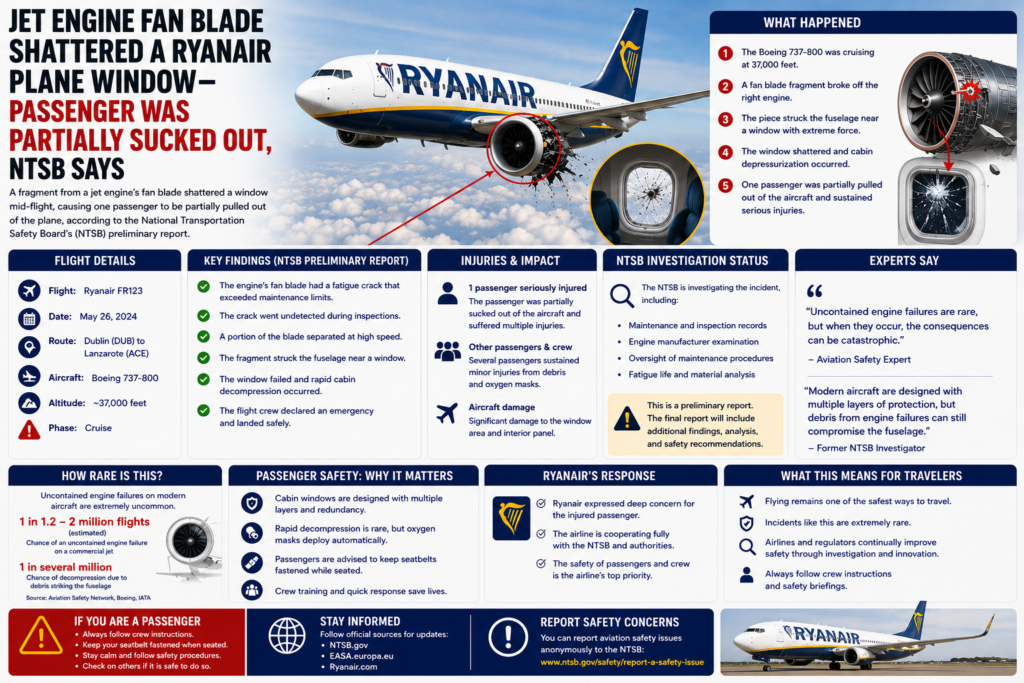
A terrifying July flight from Greece to Germany has raised fresh questions about Boeing 737 engine safety after broken engine components damaged the aircraft’s fuselage and shattered a passenger window. The NTSB says investigators found fractured fan blades and bird remains inside the engine, but the investigation has not yet determined exactly what caused the blade failure.
A routine European flight turned into a life-threatening emergency in July when a serious engine problem sent debris into the passenger cabin of a Boeing 737, shattered a window and partially pulled a passenger outside the aircraft.
The incident happened on July 10, 2026, shortly after a Ryanair-operated flight departed Thessaloniki, Greece, for Memmingen, Germany.
The aircraft was operated by Malta Air, a Ryanair Group airline, and was a Boeing 737-800. A 61-year-old Serbian passenger, Ljubisa Karovic, was seated near the damaged window when the window was breached. Fellow passengers managed to pull him back inside the aircraft.
The plane subsequently returned to Thessaloniki and landed safely.
Now, the U.S. National Transportation Safety Board (NTSB) is leading the investigation, and investigators have released important new information about what happened inside the aircraft’s engine.
According to reporting published August 13, investigators found fractured fan blades and three loose blade fragments in the affected engine. They also found bird remains in the engine, raising the possibility that bird strikes could have played a role. But investigators have not concluded that a bird strike caused the fan-blade failure. Reuters+1
That distinction is crucial.
The investigation is still underway, and the NTSB has not announced a final cause.
The Terrifying Sequence of Events
The flight was operating from Thessaloniki International Airport in Greece to Memmingen Airport in southern Germany.
Shortly after takeoff, the aircraft experienced a serious problem involving its right engine.
The cockpit voice recorder captured a loud bang approximately nine minutes into the flight, according to the latest reporting on the NTSB investigation. Investigators subsequently found fractured fan blades in the engine. Reuters
At approximately the same time, the aircraft suffered damage to the passenger cabin.
A piece or pieces of the engine assembly struck the fuselage.
A cabin window was shattered.
The aircraft experienced a rapid loss of cabin pressure.
And one passenger seated beside the damaged window was partially pulled through the opening.
The scene was chaotic.
Oxygen masks deployed as the aircraft dealt with the pressure loss, while passengers attempted to help the injured man.
According to reports, fellow passengers physically held onto Karovic and pulled him back into the cabin. His wife was among those who helped restrain him. AP News+1
The aircraft eventually returned to Thessaloniki.
Everyone aboard survived the incident.
But the passenger suffered serious injuries.
Who Was the Passenger?
The passenger was Ljubisa Karovic, a 61-year-old Serbian businessman.
His experience has since become one of the most disturbing aspects of the incident.
Karovic was seated close to the window that was damaged.
When the window broke, part of his body was pulled through the opening.
His wife and other passengers reacted immediately.
Later accounts said passengers grabbed his legs and helped pull him back into the cabin.
Karovic suffered injuries including trauma to his neck and shoulder as well as friction burns. He was hospitalized following the incident. AP News+1
After leaving the hospital, Karovic described the psychological impact of the experience.
In an interview reported by ITV News, he said that the event continued to affect him mentally and that the sound of an aircraft could trigger stress. ITVX
His message to other travelers has been straightforward:
Wear your seat belt.
That advice is particularly relevant in an incident involving sudden decompression or severe turbulence.
What Did the NTSB Find Inside the Engine?
The latest investigation update is significant because it provides more detail about the engine itself.
Investigators examined the aircraft’s No. 2 engine, the right-hand engine on the Boeing 737.
They found:
- Fractured fan blades
- Three loose fan-blade fragments
- Bird remains inside the engine
- Evidence of previous suspected bird-strike events involving the engine
According to Reuters, the engine had experienced four suspected bird strikes during the previous year.
Two of those earlier events had reportedly resulted in confirmed bird remains.
However, inspections following those events had not detected damage that would have explained the later failure. Reuters
That discovery has naturally attracted attention.
But it is important not to jump from “bird remains were found” to “a bird strike caused the accident.”
Those are two different conclusions.
The NTSB investigation is still determining how the fan blades fractured and whether a bird strike, previous damage, fatigue, maintenance or another factor contributed.
Bird Remains Don’t Automatically Prove a Bird Strike Caused the Failure
This is one of the most important facts for travelers to understand.
Finding bird remains inside an engine indicates that birds entered or struck the engine.
It does not automatically establish that a particular bird strike caused the fan blade to break.
Investigators have to establish a chain of events.
They need to determine:
- What caused the fan blade to fracture?
- Did a bird strike occur immediately before the failure?
- Could an earlier bird strike have weakened a component?
- Did the blade break first and cause subsequent damage?
- Did another component fail first?
- How did engine debris reach the fuselage?
- Why did the debris damage the window?
- Were existing safety modifications sufficient?
- Did maintenance or inspection practices play any role?
Until those questions are answered, assigning a single cause would be premature.
The NTSB is specifically examining the sequence rather than simply accepting an early theory.
The Engine Had Been Inspected
Another important detail is that the engine had not simply been ignored.
The NTSB’s investigation found that the engine had undergone an inspection in May 2026, with no problems reported at that time.
The fan blades had also undergone ultrasonic inspections in 2025 and 2026, according to the latest reports. AP News
That raises a difficult aviation-safety question:
How can a component fail if it has recently been inspected?
The answer is that inspections reduce risk but cannot guarantee that every future failure will be prevented.
Aircraft engines contain thousands of components.
Some failures can develop after an inspection.
Some damage can be difficult to detect.
Some events—such as foreign-object strikes—can happen after an inspection has been completed.
That is why aviation regulators and manufacturers continually evaluate accidents and incidents to determine whether inspection intervals, designs or operating procedures should change.
The Boeing 737 Connection Has Raised Questions
The aircraft involved was a Boeing 737-800, part of the 737 Next Generation family.
That matters because there have been previous incidents involving 737 NG aircraft in which engine fan-blade failures resulted in damage to the engine cowling and, in some cases, the aircraft fuselage.
The most serious recent example occurred in 2018.
That incident involved Southwest Airlines Flight 1380, a Boeing 737-700.
A fan-blade failure caused the engine’s fan cowl to separate.
A piece of the engine structure struck the fuselage near a passenger window.
The window departed the aircraft, causing rapid depressurization.
One passenger died.
The NTSB’s investigation concluded that a fan blade had fractured because of a fatigue crack. The blade struck the fan case, broke into fragments and contributed to the separation of fan-cowl components. One fragment struck the fuselage and caused the window to depart. NNTSB+1
The similarities have naturally prompted investigators to compare the two events.
But officials have warned against assuming they are identical.
The FAA Had Already Ordered Changes After Earlier Accidents
Following the 2018 Southwest accident, U.S. aviation authorities took action concerning Boeing 737 NG fan-cowl structures.
The FAA issued requirements intended to strengthen components and reduce the possibility of an engine fan-blade failure causing dangerous secondary damage to the aircraft.
The compliance deadline extends into 2028.
According to Reuters, the FAA is now reassessing the response in light of the 2026 Ryanair incident. Reuters
FAA Administrator Bryan Bedford said it was too early to determine whether the new incident represented the same failure mechanism as the earlier Southwest accident.
That is an important distinction.
Two aircraft can experience superficially similar events while the underlying causes are completely different.
Why the 2026 Incident May Be Different
The 2018 Southwest accident involved a fan blade that investigators ultimately determined had developed a fatigue crack.
The current Ryanair incident has another potentially important factor:
bird remains were found inside the engine.
That doesn’t establish the cause, but it gives investigators another avenue to examine.
The current investigation must determine whether the fan blades failed because of:
- A bird strike
- Damage caused by an earlier bird strike
- Metal fatigue
- Another mechanical problem
- A combination of factors
- Or something investigators have not yet identified
The NTSB has not issued a final determination.
What Happened After the Window Broke?
The aircraft experienced rapid cabin depressurization.
Passengers were provided with oxygen masks.
The flight crew responded to the emergency and returned the aircraft to Thessaloniki.
According to reports, the aircraft landed safely approximately an hour after the engine problem developed. Reuters+1
The incident could have had a much worse outcome.
Instead, several safety layers worked together.
The flight crew responded.
The aircraft remained controllable.
Passengers assisted the injured man.
A doctor was reportedly among those aboard.
And the aircraft returned safely to the departure airport.
Why Did the Passenger Survive?
There is no single reason that can fully explain the passenger’s survival.
But several factors appear to have been important.
His seat belt
Karovic has emphasized the importance of wearing a seat belt.
Being restrained can prevent a passenger from being thrown around during sudden aircraft movements or decompression events.
Other passengers reacted quickly
Passengers immediately recognized that Karovic was in danger and physically pulled him back into the cabin.
The aircraft remained controllable
Despite the engine problem and cabin damage, the pilots were able to return to Thessaloniki.
The crew followed emergency procedures
The aircraft descended and landed safely after the emergency.
Aviation accidents often involve multiple layers of protection.
In this case, those layers helped prevent a catastrophic outcome.
Why Cabin Windows Matter
Commercial aircraft cabins are pressurized because airplanes fly at altitudes where the outside air pressure is far too low for normal human breathing.
The fuselage therefore acts as a pressure vessel.
Windows are designed to withstand the pressure difference.
That is why a damaged window can create a serious emergency.
When a window is suddenly removed, the pressure inside the cabin is higher than the pressure outside.
Air moves rapidly toward the lower-pressure environment.
That creates the danger associated with decompression.
But modern passenger aircraft are designed with multiple safety measures to manage decompression.
Oxygen masks deploy.
Pilots descend rapidly to an altitude where supplemental oxygen is no longer required in the same way.
The crew follows emergency procedures.
The aircraft can continue flying after many forms of cabin damage.
The Ryanair incident demonstrated the seriousness of a window breach while also showing that a modern airliner can remain controllable after major damage.
Is Flying on a Boeing 737-800 Safe?
A single incident does not mean that every Boeing 737-800 is unsafe.
The 737 NG family has been operating worldwide for decades and includes thousands of aircraft and enormous numbers of flights.
Aviation safety is based on identifying individual risks and addressing them through design changes, inspections, maintenance requirements and operational procedures.
When an unusual failure occurs, regulators investigate whether the event indicates a broader problem.
That process is already happening here.
The NTSB is leading the investigation, and U.S. aviation authorities are examining whether existing requirements adequately address the risk.
The Role of CFM International
The Boeing 737 involved in the incident uses a CFM56 engine.
CFM International is a joint venture involving GE Aerospace and Safran Aircraft Engines.
The CFM56 is one of the world’s most widely used commercial jet engines.
That means the investigation could have implications beyond one aircraft if investigators discover a broader technical issue.
However, there is currently no evidence that this incident means the entire CFM56 fleet has a systemic problem.
The investigation has to establish the cause first.
What About the Aircraft’s Age?
The aircraft was approximately 18 years old.
That fact has received considerable attention because aircraft age can become relevant when investigators examine structural integrity, maintenance history and component life.
But an aircraft being 18 years old does not, by itself, mean that it is unsafe.
Commercial aircraft are designed to remain in service for many years.
Maintenance programs are specifically designed to inspect and replace components throughout an aircraft’s operating life.
The NTSB is nevertheless considering whether aircraft age or maintenance history played any role in the incident.
At this stage, it would be incorrect to say that the aircraft’s age caused the accident.
Ryanair’s Position
Ryanair executives have previously suggested that the incident may have involved foreign-object damage to the engine.
But investigators have emphasized that the cause has not yet been established.
The NTSB has also objected to public statements that could be interpreted as presenting a preliminary theory as a confirmed finding.
That is understandable.
Investigators need to examine physical evidence before reaching conclusions.
Aviation accident investigations are deliberately methodical because their findings can affect:
- Airlines
- Aircraft manufacturers
- Engine manufacturers
- Regulators
- Maintenance organizations
- Future aircraft designs
- Safety requirements
A premature conclusion can potentially send the investigation in the wrong direction.
The Investigation Is Still Open
This is perhaps the most important point in the entire story.
There is no final NTSB determination yet.
The latest evidence tells investigators what happened in several stages:
- The aircraft experienced an engine event.
- Fan blades fractured.
- Engine components separated.
- Debris struck the aircraft.
- A passenger window was damaged.
- The cabin depressurized.
- A passenger was partially pulled through the opening.
- The aircraft returned safely to Thessaloniki.
- Investigators found bird remains in the engine.
- Investigators are now determining how all those events were connected.
The missing piece is the definitive explanation for why the fan blade failed and exactly how the resulting debris traveled into the fuselage.
Could a Bird Strike Cause This?
Potentially, yes.
Bird ingestion is a known aviation hazard.
Jet engines are specifically tested to withstand bird ingestion within regulatory requirements.
But “bird strike” is not automatically synonymous with “engine failure.”
Modern aircraft engines are designed with containment and certification standards intended to prevent catastrophic consequences when components fail.
Investigators will therefore need to determine:
Did birds cause the fan blade to fail?
And if so:
Was the resulting damage within the range that the aircraft and engine were supposed to withstand?
Those are much more complicated questions.
Four Suspected Bird Strikes Were Previously Recorded
The latest NTSB information makes the bird-strike question especially interesting.
Investigators found that the affected engine had been involved in four suspected bird-strike events during the previous year.
Two had confirmed bird remains.
But previous inspections did not identify damage.
That creates several possible scenarios.
One possibility is that a later bird strike caused the fan blade failure.
Another is that an earlier strike caused damage that eventually contributed to the failure.
Another is that the bird remains are unrelated to the specific blade fracture.
And there could be another mechanical cause altogether.
The investigation must distinguish among those possibilities.
Why Previous Inspections Matter
Aviation maintenance operates on the principle that aircraft components must be inspected at prescribed intervals.
But inspection is not the same as permanent certification that a component can never fail.
A fan blade can be inspected on one day and experience an unexpected event later.
Some forms of damage may also be difficult to identify without the appropriate inspection technique.
That is why the investigation will likely examine:
- Maintenance records
- Inspection records
- Engine history
- Fan-blade history
- Previous bird-strike reports
- Engine operating data
- Flight-data recorder information
- Cockpit voice recorder data
- Physical damage patterns
- Manufacturer requirements
- Regulatory requirements
The goal is to reconstruct exactly what happened.
The Southwest 2018 Accident Remains an Important Reference Point
The 2018 Southwest accident is particularly relevant because it also involved a Boeing 737 NG, a fan-blade failure and a damaged passenger window.
The NTSB’s final findings were detailed.
The fan blade developed a fatigue crack.
The blade separated.
It struck the fan case.
The impact caused the blade to fracture into fragments.
Those fragments contributed to damage to the fan-cowl structure.
A piece of the fan-cowl assembly struck the fuselage near a window.
The window departed.
The cabin rapidly depressurized.
One passenger died.
The NTSB subsequently issued safety recommendations concerning fan-cowl design and inspection. NNTSB+1
The 2026 Ryanair incident therefore deserves serious attention.
But again, similarity does not prove identical causation.
The FAA Is Reconsidering the Bigger Safety Question
Reuters reported that FAA Administrator Bryan Bedford said the agency is reevaluating its response to the earlier Southwest accident in light of the new Ryanair event. Reuters
That does not mean the FAA has determined that existing regulations are inadequate.
It means regulators are asking whether the latest incident reveals something they did not previously understand.
That is exactly what aviation safety systems are designed to do.
A new incident provides new evidence.
Regulators analyze that evidence.
If necessary, they revise requirements.
What Does This Mean for Passengers?
For the average traveler, the incident is frightening.
But it does not mean passengers should stop flying Boeing 737-800 aircraft.
Commercial aviation remains one of the safest forms of transportation.
At the same time, the incident highlights several practical things travelers can do.
Keep your seat belt fastened
Even when the seat-belt sign is off, wearing the belt while seated can reduce the risk of serious injury during unexpected turbulence or aircraft movement.
Pay attention to the safety briefing
The information may seem familiar, but it explains where emergency exits and oxygen equipment are located.
Follow crew instructions
During an emergency, passengers should follow the instructions of flight attendants and pilots.
Don’t panic during unusual noises
Aircraft can make many sounds during normal operation.
If an emergency occurs, the crew is trained to respond.
Keep your attention on the cabin environment
If oxygen masks deploy or the crew instructs passengers to brace, follow the instructions immediately.
Does This Mean Passengers Should Avoid Window Seats?
No.
There is no general aviation rule telling passengers to avoid window seats because of this incident.
Window seats remain a normal and safe choice for millions of travelers.
The Ryanair event was exceptionally unusual.
Passengers should not assume that sitting next to a window creates a meaningful everyday risk of being pulled outside an aircraft.
The much more practical safety lesson is to keep your seat belt fastened when seated.
What Happens Next?
Investigators are expected to continue examining the engine and aircraft.
The investigation may ultimately answer several questions:
- Why did the fan blades fracture?
- Was there a bird strike immediately before the failure?
- Did earlier bird strikes damage the engine?
- Was there metal fatigue?
- Did maintenance contribute?
- Did the existing engine containment system perform as expected?
- Why did debris reach the fuselage?
- Were the existing Boeing 737 NG structural modifications sufficient?
- Should regulators require additional changes?
Until those questions are answered, speculation should be treated carefully.
What Travelers Should Know About Future Flight Safety
The aviation industry learns from accidents and serious incidents.
The 2018 Southwest accident resulted in changes to aircraft requirements.
The 2026 Ryanair incident is now being investigated partly in the context of those earlier changes.
If investigators find a previously unrecognized hazard, regulators can issue additional requirements.
That might involve:
- New inspections
- Shorter inspection intervals
- Structural modifications
- Engine component requirements
- Maintenance changes
- Additional testing
- Changes to aircraft operating procedures
That process is one of the reasons commercial aviation safety has improved over time.
This Was Not a Normal Engine Failure
It is important to distinguish a normal engine failure from what happened here.
Modern twin-engine aircraft are designed to continue flying after the loss of one engine.
Pilots train extensively for engine failures.
An engine shutting down does not automatically mean an aircraft is going to crash.
The extraordinary part of this incident was the secondary damage.
Engine components apparently struck the aircraft’s fuselage and damaged a passenger window.
That led to cabin depressurization and the passenger being partially pulled through the opening.
The investigation is therefore not simply about why an engine stopped working.
It is about how the engine failure produced damage beyond the engine itself.
Why the NTSB Investigation Matters Internationally
The incident happened in Greece.
The airline group is European.
The aircraft is Boeing.
The engine is manufactured by CFM International.
And the investigation is being led by the U.S. NTSB.
That reflects the international nature of modern aviation.
Aircraft and engines are manufactured across borders.
Airlines operate internationally.
Passengers come from multiple countries.
Safety standards are therefore often developed and enforced through cooperation among national authorities.
The findings from one serious incident can eventually influence aircraft flying around the world.
The Bigger Story for American Travelers
For travelers in North America, the incident may feel geographically distant.
But the aircraft involved is part of a family widely used around the world.
The Boeing 737 NG remains a major part of commercial aviation fleets.
The CFM56 engine family is also extremely widespread.
That means investigators are looking not only at what happened to one passenger, but whether the incident reveals a broader safety lesson.
At present, there is no finding that all Boeing 737-800 aircraft or all CFM56 engines face the same problem.
Travelers should wait for official safety findings rather than drawing conclusions from one incident.
Need to Check or Change Your Flight?
News of a serious aviation incident can understandably cause travelers to look more closely at their upcoming itineraries.
If you need assistance with a flight reservation, you can call:
📞 1-877-730-2630
The customer-service number provided for this article can be used for assistance with:
- Flight bookings
- Flight cancellations
- Rebooking
- Rescheduling
- Flight ticket changes
- Upgrade requests
- Flight-status inquiries
- Other travel requirements
If you are calling to check a flight’s status, keep your flight number, travel date and booking information available.
Important: The number above is the customer-service contact supplied for this article. It is not represented as the official telephone number of Ryanair, Malta Air, Boeing, CFM International or the NTSB.
For official safety information and investigation updates, travelers should consult the relevant government and airline sources.
Final Takeaway: The Engine Blade, the Broken Window and the NTSB Questions Still Unanswered
The July 10 Ryanair/Malta Air incident was one of the most frightening aviation events reported this summer.
A Boeing 737-800 flying from Thessaloniki to Memmingen suffered a serious right-engine problem.
Investigators found fractured fan blades.
Engine debris damaged the aircraft.
A passenger window was shattered.
The cabin lost pressure.
A passenger was partially pulled through the opening.
And fellow passengers helped pull him back inside.
The aircraft returned safely to Thessaloniki.
The passenger survived, although he suffered significant physical and psychological injuries. AP News+1
The newest investigation information adds another important piece to the puzzle: bird remains were found inside the affected engine, and investigators learned that the engine had experienced several suspected bird strikes during the previous year. Reuters
But that is not the same thing as a final finding that a bird strike caused the fan blade to break.
The NTSB is still investigating.
That distinction is essential.
The 2026 incident also has echoes of the 2018 Southwest Airlines Flight 1380 accident, in which a Boeing 737 fan-blade failure ultimately caused damage to a passenger window and resulted in a fatality. The NTSB’s findings from that accident led to safety recommendations and subsequent regulatory action. NNTSB+1
The FAA is now considering whether the latest incident provides information that should influence those earlier safety measures. Reuters
For passengers, the practical lesson is not to panic about flying.
It is to understand that aviation safety is a continuous process.
Serious incidents are investigated.
Evidence is collected.
Manufacturers and regulators examine what went wrong.
And when necessary, requirements are changed.
For now, the most important fact is simple:
The NTSB has identified fractured fan blades and bird remains, but the investigation has not yet established the definitive cause of the engine failure or the full sequence that caused the window breach.
Travelers should therefore be cautious about headlines that present an early theory as a final conclusion.
Original News Source & Credit
The latest reporting behind this article comes primarily from Reuters, which reported on August 13, 2026, that NTSB investigators found bird remains in the engine of the Ryanair-operated Boeing 737 involved in the July incident. The report also details the fractured fan blades, previous suspected bird strikes and the comparison with the 2018 Southwest incident. Reuters
Read the Reuters report: “Bird remains found aboard 737 engine from Ryanair Greek incident”
Additional reporting from The Associated Press describes the July 10 incident, the passenger’s injuries, the engine failure and the investigation into possible bird-strike involvement. AP News
Read the Associated Press report
The NTSB’s previous official investigation into Southwest Airlines Flight 1380 is also relevant background for understanding why investigators are examining the relationship between fan-blade failures, engine-cowl components and fuselage/window damage. NNTSB+1
NTSB — Southwest Airlines Flight 1380 investigation
Editorial accuracy note
This article preserves the distinction between confirmed findings and investigative possibilities. The NTSB has found fractured fan blades and bird remains, but finding bird remains does not by itself prove that a bird strike caused the fan-blade failure. The investigation remains ongoing, and no final cause should be stated until investigators establish it.