
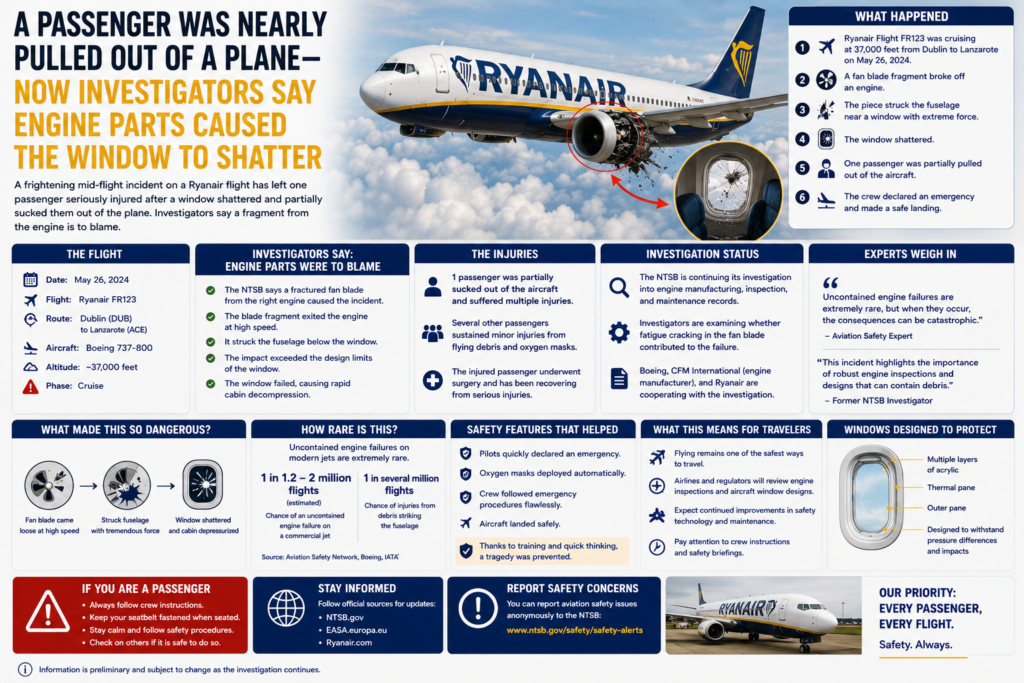
A terrifying Ryanair flight from Greece to Germany took a dramatic turn after a fan blade broke apart inside the aircraft’s right engine. Engine fragments struck the fuselage and shattered a passenger window, causing a 61-year-old man’s head to be pulled through the opening. A new NTSB preliminary report now reveals what investigators found inside the engine—and why bird strikes are being examined as a possible factor.
A routine European flight became a life-threatening emergency on July 10 when pieces of a Boeing 737-800’s engine broke loose shortly after takeoff from Greece and struck the aircraft’s fuselage.
One of those fragments shattered a passenger window.
The sudden opening caused cabin pressure to fall, and a 61-year-old passenger sitting beside the window was partially pulled outside the aircraft before fellow passengers managed to drag him back into the cabin.
Now, investigators have provided a much clearer picture of how the terrifying sequence unfolded.
According to a preliminary report from the U.S. National Transportation Safety Board (NTSB), a fan blade in the aircraft’s right engine broke loose. Fragments from the engine traveled outward and struck the aircraft, damaging the fuselage in multiple locations and breaking the passenger window. AP News+1
Investigators also found bird remains inside the engine, raising the possibility that bird ingestion or a bird strike may have played a role.
But there is an important caveat:
The NTSB has not yet determined the definitive cause of the fan-blade failure.
That distinction matters because the presence of bird remains does not, by itself, prove that a bird strike caused the blade to break.
The investigation is continuing.
What Happened on the Ryanair Flight?
The incident occurred on July 10, 2026, shortly after a Ryanair-operated flight departed Thessaloniki International Airport in northern Greece for Memmingen, Germany.
The aircraft was a Boeing 737-800 operated by Malta Air, part of the Ryanair Group.
During the climb, the aircraft experienced a serious problem with its right engine.
The NTSB’s preliminary findings indicate that a fan blade broke loose.
The resulting fragments traveled out of the engine and struck the aircraft.
One of those pieces shattered a passenger window.
The damage created a hole in the fuselage.
Because the cabin is pressurized while the aircraft is flying at altitude, the sudden breach caused air to rush outward.
A passenger seated in the affected window seat was partially pulled through the opening.
Other passengers reacted quickly and pulled him back inside.
The aircraft then returned to Thessaloniki and landed safely. AP News+1
A Passenger’s Head Was Pulled Through the Window
The most disturbing part of the incident involved 61-year-old Ljubisa Karovic, who was seated near the damaged window.
When the window was broken, the sudden pressure difference pulled his head through the opening.
He was not completely ejected from the aircraft.
Instead, his head and part of his body were pulled toward and through the opening before other passengers intervened.
According to the AP report, Karovic suffered neck and shoulder injuries and friction burns.
His fellow passengers helped pull him back into the cabin. AP News+1
His wife was among those who helped him.
The event was undoubtedly terrifying for everyone aboard.
But the quick response from passengers and crew was crucial.
The Cabin Suddenly Became a Scene of Chaos
The NTSB’s preliminary account provides insight into what passengers experienced.
Flight attendants reported hearing and feeling loud, continuous vibration.
They also observed smoke or fog inside the cabin.
Then the oxygen masks deployed.
Passengers began reacting to the emergency.
One flight attendant noticed passengers standing and calling for help.
The problem was immediately apparent: a passenger sitting in approximately row 11 had been pulled into the damaged window area.
Other passengers rushed to assist.
They pulled the man back into the cabin.
The aircraft’s crew then dealt with the loss of cabin pressure and engine emergency.
The incident was frightening, but the aircraft remained flyable.
What Did Investigators Find in the Engine?
The NTSB’s preliminary investigation found that the right engine had suffered a fan-blade failure.
Investigators recovered evidence of fractured fan blades and three loose blade fragments.
They also found bird remains inside the engine.
That finding is particularly significant because investigators learned that the engine had experienced several suspected bird-strike events before the July incident.
According to Reuters, the engine had recorded four suspected bird strikes during the previous year.
Two of those incidents had confirmed bird remains.
However, inspections following those earlier events reportedly did not identify damage that would have explained the later failure. Reuters
So investigators now have a major question to answer:
Did a bird strike cause the fan blade to fail, or did something else cause the failure?
Bird Remains Were Found – but That Doesn’t Prove the Cause
This is perhaps the most important qualification in the latest report.
Finding bird remains inside a jet engine demonstrates that birds entered or struck the engine.
It does not automatically establish that the birds caused the fan blade to break.
Investigators must determine the precise sequence.
There are several possibilities.
A bird could have struck the engine shortly before the fan blade fractured.
An earlier bird strike could potentially have damaged a component.
The bird remains could be unrelated to the particular failure.
Or the blade could have failed for another reason, with bird remains present because of a separate event.
At this stage, the NTSB has not selected a final explanation.
Reuters reported that Ryanair and Boeing declined to comment on the cause while the investigation continues. Reuters
The Loud Bang Came About Nine Minutes Into the Flight
The cockpit voice recorder provided investigators with another important clue.
According to Reuters’ report on the NTSB findings, the cockpit recording captured a loud bang approximately nine minutes after departure.
The engine then exhibited serious problems, including vibration.
The timing gives investigators a reference point for reconstructing the event.
They can compare the cockpit recording with:
- Flight-data recorder information
- Engine data
- Aircraft damage
- Fan-blade fragments
- Fuselage impact marks
- Maintenance records
- Bird-strike history
By combining those sources, investigators can determine the sequence of events with much greater precision. Reuters
The Engine Had Passed an Inspection in May
One detail that is likely to attract attention from travelers is the aircraft’s maintenance history.
According to Reuters, the affected engine had undergone an inspection in May 2026, with no problems reported at that time. Reuters
That doesn’t necessarily mean that an inspection failed.
Aircraft inspections are designed to identify particular forms of damage or deterioration, but they cannot guarantee that a component will never fail afterward.
A component can pass an inspection and later experience:
- A foreign-object strike
- A crack developing after inspection
- Unexpected mechanical damage
- Another failure mechanism
The NTSB will therefore examine not only whether the engine was inspected, but whether the inspection was appropriate, whether it was performed correctly and whether any damage should reasonably have been detected.
The Fan Blades Had Also Been Examined
The investigation has found that the engine’s fan blades underwent ultrasonic inspections in 2025 and 2026, according to AP’s reporting.
Those inspections are significant because ultrasonic techniques can detect certain forms of internal or near-surface damage that may not be visible during an ordinary visual examination. AP News
The investigators therefore have another major question:
Was there a defect that existed before the flight but was not detected?
Or did the damage happen during the flight?
That distinction could have major implications for maintenance requirements and aviation safety.
Why the Engine Debris Was So Dangerous
A fan blade is a substantial component inside a jet engine.
The engine’s fan rotates at very high speed.
If a blade breaks loose while the engine is operating, the resulting energy can be enormous.
The preferred safety scenario is for the engine’s containment structure to keep the failed component from escaping.
But the July incident demonstrates why secondary damage is such an important consideration.
The problem wasn’t limited to the engine.
Fragments apparently traveled outward and damaged the aircraft’s fuselage.
The NTSB says the debris struck the aircraft in several locations and shattered the window. AP News
That transformed an engine problem into a cabin emergency.
The Passenger Was Sitting Near the Damaged Window
The location of the passenger was critical.
He was seated in a window seat close to where the engine debris struck the fuselage.
When the window was destroyed, the cabin pressure differential immediately became relevant.
At cruising or climbing altitude, the air pressure inside a commercial aircraft cabin is considerably greater than the pressure outside.
When a large opening suddenly appears, air moves rapidly toward the outside.
That is why the passenger was pulled toward the opening.
It was not the aircraft “sucking” him out in the way the phrase is sometimes used casually.
The physical cause was the pressure difference between the pressurized cabin and the outside atmosphere.
Oxygen Masks Dropped From the Ceiling
The window breach resulted in a loss of cabin pressure.
The aircraft’s oxygen masks automatically deployed.
Passengers were instructed to use them as part of the emergency response.
This is one reason passengers are told during every safety briefing to pay attention to the oxygen-mask instructions.
The procedure is simple:
- Pull the mask toward you.
- Place it over your nose and mouth.
- Secure it.
- Breathe normally.
- Help others only after securing your own oxygen supply.
The July incident demonstrates why those instructions exist.
A sudden depressurization can happen quickly.
How Did the Pilots Respond?
The flight crew experienced the engine problem during the climb.
The aircraft developed significant vibration.
The pilots responded to the emergency and returned toward Thessaloniki.
The aircraft ultimately landed safely approximately an hour after departure. AP News
This is another important aspect of the incident.
The aircraft did not crash.
The crew retained control.
The emergency procedures worked.
And the passengers survived the event.
Was the Aircraft Still Able to Fly With the Engine Damaged?
Yes.
Commercial twin-engine aircraft are designed and certified to continue flying after the loss of one engine.
Pilots train extensively for engine failures.
An engine failure can be a serious emergency without necessarily being a catastrophic event.
The unusual aspect here was the additional fuselage and cabin damage caused by engine fragments.
That secondary damage is what made the incident particularly serious.
The Boeing 737-800 Connection
The aircraft involved was a Boeing 737-800, part of the 737 Next Generation family.
The aircraft is not the same model as the 737 MAX.
That distinction is important because many travelers use the broad term “Boeing 737” without distinguishing among generations.
The 737-800 has been in widespread commercial service for many years.
Thousands of flights are operated by 737-family aircraft around the world.
One incident does not establish that the entire 737-800 fleet is unsafe.
However, investigators are examining whether the event has similarities to previous fan-blade incidents involving 737 aircraft.
The 2018 Southwest Accident Is a Major Comparison
The new Ryanair incident has drawn attention partly because of similarities to the 2018 Southwest Airlines Flight 1380 accident.
That flight involved a Boeing 737-700.
A fan blade broke apart in the engine.
The resulting damage caused parts of the engine’s fan cowl to separate.
A piece struck the fuselage near a passenger window.
The window departed the aircraft.
The cabin depressurized.
One passenger died.
The NTSB conducted an extensive investigation into that accident.
The board ultimately determined that the fan blade had developed a low-cycle fatigue crack in the blade dovetail, causing the blade to separate. The separated blade then struck the engine fan case and contributed to damage that allowed fan-cowl components to depart the aircraft. NNTSB
That previous accident is one reason investigators are taking the latest incident seriously.
But investigators have not said that the two events had the same cause.
Why the 2018 Accident Changed Aviation Requirements
The Southwest accident exposed weaknesses in how certain engine-fan failures could produce secondary damage to an aircraft.
The NTSB found that the fan-blade fragments and resulting structural deformation contributed to the separation of engine components.
The board also noted that the trajectory of the fragments and the resulting inlet damage were more severe than what had been observed during earlier certification testing. NNTSB
That investigation led to safety recommendations and subsequent regulatory action.
The purpose was not simply to prevent fan blades from failing.
It was also to reduce the chance that a fan-blade failure could cause dangerous damage to the aircraft.
The 2026 Incident Raises a New Question
The latest incident could force regulators to ask whether those existing measures are enough.
According to AP, the aircraft involved in the Ryanair event had not yet received certain modifications related to engine housing that had been required under FAA directives, with the compliance deadline extending into 2028. AP News
That doesn’t mean the aircraft was operating illegally or improperly.
The important point is that the modification schedule had not yet reached its deadline.
The FAA is now considering whether the latest incident should change that timetable.
Why Was the Modification Deadline So Far Away?
Aircraft modifications are not necessarily performed overnight.
Airlines operate fleets containing hundreds of aircraft.
A major modification can require:
- Engineering planning
- Parts availability
- Maintenance capacity
- Aircraft downtime
- Scheduling
- Regulatory compliance
- Documentation
Regulators therefore establish compliance deadlines.
Operators may complete modifications during scheduled maintenance visits.
That means an aircraft can legally operate before a modification deadline expires.
The question following this incident is whether regulators should accelerate that process.
The FAA Is Reviewing the Situation
FAA Administrator Bryan Bedford has indicated that the agency is examining the latest incident.
However, officials have also cautioned against assuming that it is identical to the Southwest event.
That is an important point.
The 2018 accident involved fatigue cracking.
The 2026 Ryanair investigation includes evidence of bird remains.
The two events may ultimately have different causes.
Until the NTSB completes its investigation, there is no basis for saying that one is simply a repeat of the other.
What Role Could Birds Have Played?
Bird strikes are a known hazard in aviation.
Airports are often located in areas where birds are present, and aircraft can encounter birds particularly during takeoff and landing.
Jet engines are designed and certified to withstand specified bird-ingestion scenarios.
But bird strikes can still cause serious damage.
The current investigation is unusual because investigators found bird remains in the affected engine and identified multiple previous suspected bird strikes involving the same engine. Reuters
The key question is whether those events weakened or damaged the fan blades.
Four Suspected Bird Strikes Were Recorded
Reuters reported that the engine had experienced four suspected bird strikes during the previous year.
Two reportedly involved confirmed bird remains.
Yet inspections after those events did not detect damage that would explain the eventual failure. Reuters
This is now a significant area of investigation.
Aviation investigators will want to establish:
- When each bird strike occurred
- Which engine components were affected
- What inspections were performed afterward
- What the inspections found
- Whether the fan blades showed any damage
- Whether the eventual fracture pattern is consistent with bird impact
- Whether the bird remains found after the incident came from the same event
These details could take considerable time to analyze.
Does Finding Bird Remains Mean a Bird Caused the Accident?
No.
It would be inaccurate to state that as a fact.
The current evidence supports saying:
Bird remains were found inside the engine, and investigators are examining whether bird activity contributed to the fan-blade failure.
It does not yet support saying:
A bird strike caused the fan blade to break.
That conclusion requires additional evidence.
News readers should be especially cautious about headlines that turn preliminary evidence into a definitive cause.
What Investigators Will Examine Next
The NTSB’s investigation is likely to involve extensive technical analysis.
Investigators will examine:
The broken fan blades
Engineers can analyze the fracture surfaces to determine how the metal failed.
The recovered fragments
Their size, shape and location can help reconstruct the trajectory.
The engine
Investigators can inspect the fan case, inlet and surrounding components.
The aircraft fuselage
Damage patterns can reveal the direction and energy of impacts.
The broken window
The window and surrounding structure may help investigators determine exactly what struck it.
Flight recorder data
The aircraft’s recorded data can show engine parameters and aircraft behavior.
Cockpit voice recordings
The timing of sounds and crew actions can establish the sequence.
Maintenance records
Investigators can determine what inspections were performed and when.
Bird-strike history
Previous reports could reveal whether the engine experienced cumulative damage.
Why the Damage Pattern Matters
Investigators don’t simply look at a broken part and guess what happened.
They examine the damage scientifically.
For example, the direction of scratches, dents, fractures and impact marks can reveal the direction in which a component traveled.
If a fragment struck the fuselage from a particular angle, investigators can work backward to estimate where it originated.
That information can then be compared with the engine’s geometry.
This is particularly important in an uncontained fan-blade event.
The investigators need to know not only that the blade broke, but how the broken pieces escaped and reached the fuselage.
What Does “Uncontained Engine Failure” Mean?
An engine is designed to contain certain internal failures.
When a fan blade or other component breaks loose and penetrates the engine casing or exits the engine, it may be described as an uncontained failure.
The danger comes from the energy carried by the escaping component.
A piece traveling at high velocity can damage:
- The engine
- The nacelle
- The wing
- The fuselage
- Windows
- Fuel systems
- Other aircraft components
This is why containment is such a major part of engine certification.
Why Engine Cowlings and Nacelles Matter
The engine isn’t simply the cylindrical core visible beneath the wing.
It sits inside a larger aerodynamic structure known as the nacelle.
The nacelle includes components such as:
- Engine cowls
- Inlet structures
- Fan-cowl components
- Other surrounding structures
These components help protect the engine and manage airflow.
But they also have to be designed so that if an internal engine failure occurs, pieces don’t create unacceptable secondary damage.
The FAA has noted in its engineering guidance that departing engine nacelle components can damage the aircraft’s fuselage and cabin windows, potentially causing depressurization. Federal Aviation Administration
That is precisely the type of secondary risk that investigators are examining in this incident.
Could the Passenger Have Been Killed?
The incident could have had a much more serious outcome.
The passenger was partially pulled through the window but was recovered by people inside the cabin.
He survived.
He suffered injuries, including trauma to the neck and shoulder and friction burns. ABC11 Raleigh-Durham
The actions of other passengers were therefore extremely important.
The crew also managed the aircraft emergency and returned safely.
Aviation safety often depends on several layers working together.
In this case, those layers included:
- Aircraft structural design
- Engine containment
- Pilot training
- Cabin-crew response
- Passenger cooperation
- Oxygen equipment
- Emergency procedures
- The aircraft’s ability to continue flying
Why Seat Belts Still Matter
The incident also highlights one of the simplest pieces of airline safety advice:
Keep your seat belt fastened while seated.
The passenger involved was sitting at the window when the incident occurred.
Although a seat belt could not prevent the window from being broken, restraint can help reduce injuries during sudden aircraft movements.
The same principle applies to turbulence.
Passengers don’t need to wait for the seat-belt sign to be illuminated before fastening their belts.
Keeping the belt loosely fastened while seated is a practical precaution.
Is It Still Safe to Fly on a Boeing 737-800?
The short answer is that passengers should not interpret this single incident as evidence that all Boeing 737-800 aircraft are unsafe.
The 737-800 is one of the world’s most widely operated commercial aircraft.
The investigation concerns a specific aircraft, a specific engine and a specific failure sequence.
Regulators will determine whether the event indicates a broader problem.
If they find a systemic safety concern, they can require corrective action.
That is how aviation safety regulation works.
What About Ryanair?
The aircraft was operated by Malta Air, a Ryanair Group airline.
Ryanair has said previously that its aircraft are safe and that it would cooperate with investigators.
The airline’s Group Chief Financial Officer, Neil Sorahan, previously praised the crew’s response and said the company’s customer-care team had been in contact with the affected family.
Ryanair has also welcomed the NTSB’s involvement in the investigation.
The airline has not been identified by investigators as having caused the fan-blade failure.
It is important not to confuse an aircraft operator with the cause of a mechanical failure.
What About Boeing?
Boeing manufactured the aircraft.
But the fact that a Boeing 737-800 was involved does not automatically mean Boeing caused the incident.
The engine was manufactured by CFM International, a joint venture between GE Aerospace and Safran Aircraft Engines.
The investigation therefore involves multiple parties.
Investigators may ultimately examine:
- Aircraft design
- Engine design
- Engine maintenance
- Fan-blade manufacturing
- Inspection procedures
- Airline maintenance
- Bird-strike history
- Regulatory requirements
The final report will determine what, if anything, needs to change.
What About CFM56 Engines?
The Boeing 737-800 involved in this incident uses the CFM56-7B engine family.
The CFM56 family is one of the most widely used commercial jet-engine families in aviation history.
That means any confirmed systemic issue could have implications for a large fleet.
But there is currently no evidence that the entire CFM56 fleet has a problem.
The investigation must first establish the specific cause of this fan-blade failure.
Why the NTSB Is Leading the Investigation
The incident happened in Greece, but the investigation is being led by the U.S. NTSB under international aviation-investigation arrangements.
The NTSB has extensive experience investigating major engine failures and aircraft accidents.
That includes the Southwest Airlines Flight 1380 investigation.
The agency’s role is to determine what happened and make safety recommendations—not simply to assign blame.
That distinction is important.
Aviation investigations are designed to identify causes and prevent future incidents.
The 2018 Southwest Case Offers a Warning
The Southwest case shows why investigators are looking beyond the immediate mechanical failure.
In that accident, the NTSB determined that a fatigue crack caused a fan blade to separate.
But the investigation also examined how the resulting energy damaged the engine’s fan case, fan cowl and aircraft structure.
The board concluded that the fan-cowl design and certification assumptions played a role in the severity of the accident. NNTSB
That means an aviation investigation doesn’t stop at:
“Why did the blade break?”
It also asks:
“What happened after it broke?”
That second question is particularly relevant here.
What Could Change After This Investigation?
Depending on the final findings, regulators could potentially consider:
- Additional fan-blade inspections
- Changes to inspection intervals
- Structural modifications
- Changes to engine containment
- Additional nacelle protection
- Changes to bird-strike inspection procedures
- Earlier compliance deadlines
- Additional testing requirements
But none of those changes should be assumed before the investigation is complete.
What Travelers Need to Know Right Now
For passengers planning flights, there is no current basis to conclude that Boeing 737-800 flights should generally be avoided because of this incident.
Instead, travelers should remember a few practical safety points.
Keep your seat belt fastened
Especially while seated.
Listen to cabin crew
If an emergency occurs, flight attendants are trained to manage it.
Pay attention to safety briefings
Even frequent flyers can benefit from knowing where exits and oxygen masks are located.
Don’t panic if an engine fails
Twin-engine aircraft are designed to continue flying after an engine failure.
Follow oxygen-mask instructions
If cabin pressure drops, use your mask immediately.
Need to Check Your Flight or Make a Travel Change?
If this story has you checking an upcoming itinerary, remember that flight schedules and operating aircraft can change.
If you need assistance with your travel plans, you can call:
📞 1-877-730-2630
Assistance is available for:
- Booking flights
- Canceling flight tickets
- Rebooking
- Rescheduling
- Flight changes
- Upgrade requests
- Checking flight status
- Other travel-related requirements
If you’re calling to check a flight, have your flight number, travel date and reservation details available.
Important: The number above is the customer-service number supplied for this article. It is not represented as the official telephone number of Ryanair, Malta Air, Boeing, CFM International, the FAA or the NTSB.
For official airline information, travelers should use the airline’s official channels.
The Biggest Question Is Still Unanswered
The latest NTSB findings answer one major question:
How did engine debris reach the passenger window?
The answer appears to be that a fan blade broke loose and fragments traveled out of the engine, damaging the fuselage and shattering the window. AP News
But investigators still need to answer another, potentially more important question:
Why did the fan blade break?
That answer could determine whether the incident was an isolated event, a bird-strike-related failure, a maintenance issue, a component problem or something else.
The presence of bird remains provides investigators with an important clue.
It is not yet a final explanation.
The Timeline of the Terrifying Flight
Here’s how the incident unfolded based on the preliminary findings and current reporting:
July 10, 2026 — Departure
The Boeing 737-800 departed Thessaloniki, Greece, for Memmingen, Germany.
During the climb
The aircraft reached roughly the altitude at which the engine problem occurred, with reports placing the event around 16,000 feet.
Approximately nine minutes after departure
The cockpit voice recorder captured a loud bang.
Engine problem
A fan blade in the right engine broke loose.
Engine debris escaped
Fragments struck the aircraft and damaged the fuselage.
Passenger window shattered
One of the engine fragments struck a cabin window.
Cabin pressure dropped
Oxygen masks deployed.
Passenger pulled through opening
A 61-year-old man seated beside the window was partially pulled outside.
Passengers intervened
Other passengers pulled him back into the cabin.
Emergency response
The flight crew managed the engine and depressurization emergency.
Return to Thessaloniki
The aircraft safely returned to its departure airport.
Investigation begins
The NTSB took the lead and began examining the aircraft and engine.
August 13, 2026
The NTSB’s preliminary findings became public, revealing the broken fan blades, loose fragments and bird remains.
What the Preliminary Report Does – and Doesn’t – Tell Us
A preliminary aviation report should be read carefully.
It provides investigators’ early factual findings.
It can identify:
- Physical damage
- Recorder information
- Witness observations
- Recovered components
- Initial inspection results
But it is not necessarily the final explanation.
Investigators may discover additional evidence later.
They may revise their understanding of the sequence.
They may rule out theories that initially seemed plausible.
That is normal.
Therefore, today’s most accurate conclusion is:
The engine fan blade failed, fragments damaged the fuselage and shattered a window, and bird remains were found in the engine. The definitive cause of the fan-blade failure remains under investigation.
Final Takeaway: The Engine Broke Apart – and the Debris Reached the Cabin
The Ryanair incident is a terrifying reminder of how quickly an aviation emergency can develop.
A passenger flight departed Greece normally.
Minutes later, a loud bang came from the aircraft’s right engine.
A fan blade broke loose.
Fragments escaped.
The fuselage was struck.
A passenger window shattered.
The cabin depressurized.
A passenger was partially pulled through the opening.
And other passengers rushed to save him.
The aircraft ultimately returned safely to Thessaloniki. AP News+1
The latest NTSB findings provide an important new clue: bird remains were found inside the damaged engine, and investigators discovered that the engine had experienced several suspected bird strikes during the previous year. Reuters
But the investigation has not concluded that birds caused the fan-blade failure.
That question remains open.
The incident also brings renewed attention to the 2018 Southwest Airlines Flight 1380 accident, which involved another Boeing 737 NG and a fan-blade failure that ultimately caused a fatal cabin-window breach. The NTSB’s investigation into that accident found a fatigue crack in a fan blade and identified issues involving the consequences of the resulting engine failure. NNTSB
The key difference is that investigators must determine whether the 2026 Ryanair event resulted from the same mechanism.
For travelers, the incident is certainly unsettling.
But it should not be interpreted as proof that Boeing 737-800 aircraft are broadly unsafe.
Commercial aviation safety depends on investigating exactly these kinds of incidents.
If investigators find a previously unrecognized risk, regulators can require new inspections, modifications or other corrective measures.
For now, the most important fact is that the NTSB investigation is still ongoing.
The broken window has been explained.
The passenger’s terrifying experience has been documented.
The engine fragments have been recovered.
Bird remains have been found.
But the ultimate reason the fan blade failed remains the critical unanswered question.
News Source & Credit
This article is based primarily on reporting by The Associated Press, which reported on August 13, 2026, that the NTSB determined broken engine parts shattered the Ryanair aircraft’s window and caused the passenger’s head to be pulled through the opening. AP also reported the passenger’s injuries, the fan-blade failure and the discovery of bird remains. AP News
Read the Associated Press report
Additional reporting from Reuters provides details about the bird remains, the four suspected previous bird strikes, the loud bang recorded about nine minutes into the flight and the engine’s inspection history. Reuters
Read the Reuters report
For background on the earlier Southwest Airlines Flight 1380 accident and the NTSB’s findings concerning fan-blade failure and secondary aircraft damage:
NTSB — Southwest Airlines Flight 1380 Investigation
Editorial accuracy note
This article intentionally distinguishes confirmed findings from theories still being investigated. The NTSB has reported fractured fan blades, loose blade fragments and bird remains in the affected engine. However, the presence of bird remains does not by itself establish that a bird strike caused the fan-blade failure. The final cause remains subject to the ongoing investigation.