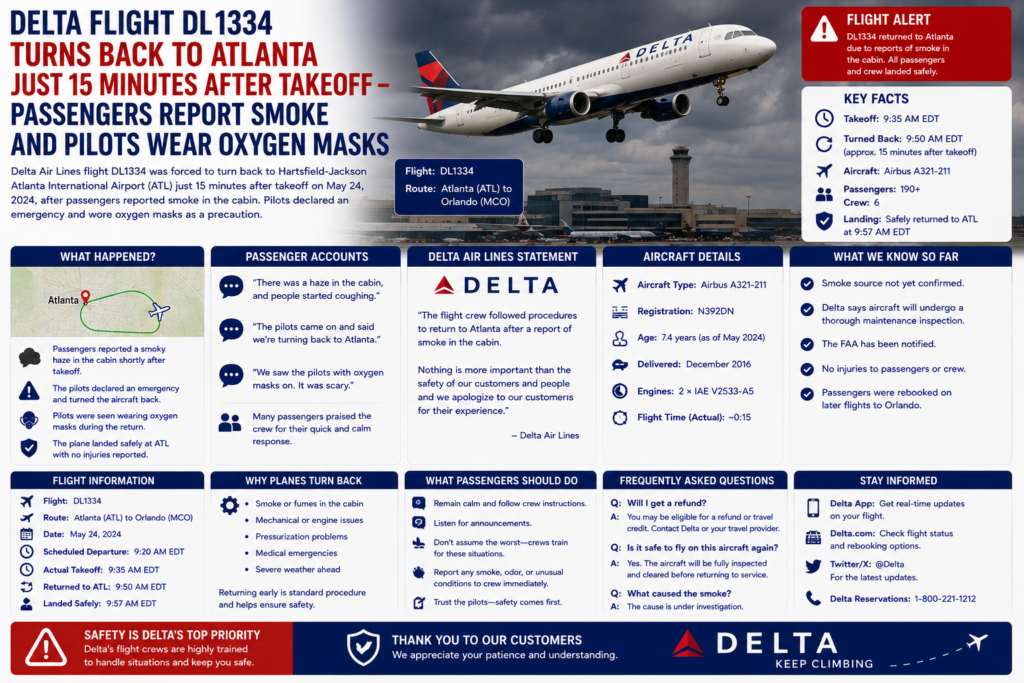
A Delta Air Lines flight bound for Fort Lauderdale made an emergency return to Atlanta only about 15 minutes after departure on August 13, 2026. The Airbus A321 was reportedly experiencing a smoky odor onboard, prompting the crew to stop its climb, declare an emergency and return to Hartsfield-Jackson Atlanta International Airport. The aircraft landed safely, and no injuries were reported.
A routine morning flight from Atlanta to South Florida suddenly became an emergency on Thursday when Delta Air Lines Flight DL1334 turned around shortly after takeoff.
The aircraft, an Airbus A321-200 registered N363DN, had departed Hartsfield-Jackson Atlanta International Airport for Fort Lauderdale-Hollywood International Airport (FLL).
But the flight did not get far.
According to aviation news outlet AIRLIVE, the crew halted the aircraft’s climb at approximately 5,900 feet after encountering an undisclosed technical issue. The pilots then transmitted the internationally recognized emergency transponder code 7700 and requested priority to return to Atlanta. The aircraft landed safely back at Atlanta approximately 15 minutes after takeoff. AIRLIVE
AIRLIVE subsequently updated its report to say that smoke was reported onboard and that the pilots had to wear oxygen masks. AIRLIVE
Other reporting, including the New York Post, described the problem as a smoky odor detected on the aircraft and reported that Delta said the crew followed established procedures and that the landing occurred without incident or injuries. New York Post
The incident is likely to concern travelers because it comes only days after another Delta flight also returned to Atlanta following a smoke or fumes report.
However, there is currently no evidence that Flight DL1334 suffered an uncontrolled fire, crashed or experienced a loss of aircraft control.
The aircraft returned to the airport safely.
What Happened to Delta Flight DL1334?
Delta Flight 1334 was scheduled to operate from Atlanta (ATL) to Fort Lauderdale (FLL) on Thursday morning, August 13, 2026.
The flight departed from Atlanta at approximately 7 a.m. local time.
The aircraft was an Airbus A321-200, registration N363DN.
According to AIRLIVE’s account, the aircraft pushed back from Gate D1A and departed from Runway 27R.
The initial part of the flight appeared normal.
But shortly after takeoff, something went wrong.
The crew stopped the aircraft’s climb at approximately 5,900 feet.
Rather than continuing toward Florida, the pilots requested permission to return to Atlanta.
The aircraft’s transponder was set to 7700, the standard code used to alert air traffic control that an aircraft is experiencing a general emergency.
Controllers gave the flight priority handling.
The aircraft turned back toward Atlanta.
It landed on Runway 27R, the same runway from which it had departed, about 15 minutes after takeoff. AIRLIVE
Why Did the Delta Plane Return?
The initial report described the reason as a technical issue.
AIRLIVE later updated its report to say that smoke was reported onboard and that the pilots wore oxygen masks. AIRLIVE
The New York Post reported that passengers and crew detected a smoky odor shortly after departure. The exact source of that odor had not been confirmed in the reporting available at publication time. New York Post
That distinction is important.
A report of smoke or a smoky odor does not automatically mean that there was a confirmed fire.
Aircraft crews are trained to treat smoke and unusual odors seriously because an unidentified source could potentially involve an electrical problem, mechanical problem, fire or another issue affecting the aircraft.
When something like that occurs shortly after takeoff, returning to the departure airport can be the safest option.
Why Would Pilots Wear Oxygen Masks?
The reports that the pilots wore oxygen masks may sound alarming to passengers.
But wearing an oxygen mask in response to smoke or suspected fumes is a precautionary safety measure.
The flight crew sits at the front of the aircraft and needs to remain capable of controlling the airplane and communicating with air traffic control.
If smoke or an unknown airborne contaminant is present in the cockpit, pilots can use their oxygen equipment to protect themselves while they work through emergency procedures.
That does not necessarily mean the pilots were unable to breathe or that the cockpit was engulfed in smoke.
It means they were taking a precaution appropriate to the situation.
The same general principle applies to many aviation emergencies:
The crew is trained to respond to the possibility of a serious problem before it becomes a serious problem.
What Does Squawk 7700 Mean?
One detail that stands out in the DL1334 incident is the use of 7700.
Many passengers may see reports about a flight “squawking 7700” and assume that this means the aircraft was about to crash.
It doesn’t.
7700 is an internationally recognized general emergency transponder code.
When pilots select it, air traffic control systems can identify the aircraft as experiencing an emergency and provide appropriate priority.
The crew can still communicate with controllers normally.
In the case of DL1334, the code indicated that the pilots needed priority handling as they returned to Atlanta.
AIRLIVE reported that the crew transmitted 7700 and requested a priority return. AIRLIVE
The procedure is designed to make the aviation system respond quickly.
Why Return to Atlanta Instead of Continuing to Florida?
The flight was headed to Fort Lauderdale, Florida.
Atlanta was immediately behind the aircraft.
Once a technical issue and smoke report occurred shortly after takeoff, returning to the departure airport made practical sense.
Atlanta has extensive emergency-response capabilities and is Delta’s largest hub.
The airport also has multiple runways and substantial maintenance infrastructure.
For a crew dealing with an uncertain technical problem, returning to a major airport can provide access to:
- Fire and rescue services
- Maintenance personnel
- Replacement aircraft
- Ground support
- Medical services
- Additional airline staff
- Rebooking options
Rather than flying for roughly another hour or more toward Florida with an unresolved problem, the crew returned to Atlanta.
Airport Fire and Rescue Crews Were Waiting
After the emergency declaration, airport emergency services were deployed.
AIRLIVE reported that fire and rescue personnel were sent to inspect the aircraft after it landed. AIRLIVE
This is a standard precaution.
When an aircraft reports an emergency, airport rescue crews can be positioned nearby so they can respond immediately if the situation becomes more serious.
Their presence does not necessarily mean the airplane was on fire.
In fact, having emergency crews standing by is part of the safety system that makes modern aviation so resilient.
The aircraft landed safely and vacated the runway under its own power. AIRLIVE
Were There Any Injuries?
The available reports indicate no injuries were reported from the DL1334 incident.
The New York Post reported that Delta said the crew followed standard procedures and that the aircraft landed without incident or injuries. New York Post
That is an important part of the story.
Although the word “emergency” naturally sounds frightening, an emergency declaration is not synonymous with an accident.
Pilots may declare an emergency precisely because they want additional assistance and priority handling while the aircraft remains fully controllable.
In this case, the aircraft returned to Atlanta and landed safely.
What Happened to the Passengers?
Passengers who expected to fly directly to Fort Lauderdale instead found themselves back at Atlanta.
That meant their travel plans were disrupted.
AIRLIVE reported that Delta was expected to make alternative arrangements for passengers traveling to South Florida. AIRLIVE
The New York Post reported that the flight was delayed and that passengers were expected to depart later on another aircraft. New York Post
For travelers, the operational consequences can sometimes be almost as frustrating as the original incident.
A passenger may have:
- A hotel check-in scheduled
- A cruise departure
- A rental car reservation
- A connecting flight
- A business appointment
- A family event
- A return ticket
- A time-sensitive travel arrangement
A delay of several hours can therefore create additional problems even when the aircraft itself lands safely.
Was the Flight Canceled?
The initial reporting described the flight as delayed, with Delta making alternative arrangements for passengers.
AIRLIVE’s update specifically said the airline was confirming that the flight was delayed. AIRLIVE
Travelers should therefore avoid assuming that a particular replacement flight, departure time or aircraft is guaranteed unless confirmed directly with the airline or their booking provider.
Flight operations can change rapidly after an aircraft returns unexpectedly.
Passengers should check their reservation and flight status before heading to the airport.
What Caused the Smoke?
This is one of the questions that remains unanswered.
The reports available at the time of writing do not establish a definitive technical cause for the smoky odor on DL1334.
Possible sources of smoke or unusual odors on aircraft can include different systems or components, but it would be irresponsible to claim that one specific system caused this particular event without confirmation from Delta, investigators or maintenance personnel.
The important facts currently available are:
- The aircraft experienced a technical problem.
- Smoke or a smoky odor was reported.
- The crew returned to Atlanta.
- The pilots used oxygen masks as a precaution.
- The aircraft landed safely.
- Emergency personnel inspected the aircraft.
- No injuries were reported.
- The exact cause had not been publicly established in the available reports.
Those facts should be kept separate from speculation.
Is This Related to Delta Flight 2204?
The timing of the incident is notable because another Delta aircraft returned to Atlanta only a few days earlier after a smoke or fumes emergency.
On August 8, 2026, Delta Flight 2204, a Boeing 757-200 traveling from Atlanta to Orlando, returned to Atlanta after the crew reported fumes or smoke.
That incident became more serious after landing, when passengers were evacuated using emergency slides.
People reported that the aircraft carried roughly 200 passengers and six crew members, and one passenger and one crew member required medical attention. People.com
The similarity has naturally attracted attention.
However, there is no confirmed evidence that the two Delta incidents were connected.
They involved different aircraft types and separate flights.
Flight DL1334 involved an Airbus A321.
Flight DL2204 involved a Boeing 757-200.
Until investigators or Delta establish a connection, the two incidents should be treated as separate events.
Why Smoke Reports Are Taken Seriously in Aviation
Smoke inside an aircraft is one of the situations crews are trained to take seriously.
There can be multiple potential causes.
For example, smoke or an unusual smell could theoretically be associated with:
- Electrical equipment
- Wiring
- Mechanical components
- Heating equipment
- Galley equipment
- Cabin systems
- Engine-related systems
- Environmental-control systems
- Other onboard equipment
But the smell alone cannot establish the source.
The crew’s job is not to diagnose the aircraft like a mechanic while flying.
Their immediate responsibilities are to protect passengers, maintain control, communicate with air traffic control and land safely when appropriate.
Why the First 15 Minutes Matter
The timing of DL1334’s return is significant.
The aircraft was only about 15 minutes into the flight when it landed back at Atlanta.
That means the crew had an enormous operational advantage: they were still very close to the airport from which they had departed.
When an aircraft experiences an unexpected problem shortly after departure, crews have to quickly assess:
- What is happening?
- Is the aircraft controllable?
- Is the problem getting worse?
- Is there smoke?
- Is there fire?
- Is cabin pressure affected?
- Can the aircraft safely continue?
- Where is the nearest suitable airport?
- Should emergency services be notified?
In this case, the answer was to return to Atlanta.
Why Atlanta Is Particularly Important for Delta
Hartsfield-Jackson Atlanta International Airport is the center of Delta’s extensive hub operation.
For Delta passengers, Atlanta is one of the most important connection points in the airline’s network.
That makes a return to Atlanta operationally easier than an emergency landing at a smaller airport in many situations.
The airport has extensive facilities and Delta has a substantial operational presence there.
For passengers, that can mean better access to replacement aircraft and rebooking options after an unexpected aircraft return.
Should Passengers Be Worried About Flying on Delta?
There is no basis from this incident alone to conclude that Delta flights are generally unsafe.
Airline operations involve thousands of flights and millions of passengers.
Mechanical and technical issues can occur even in highly regulated aviation.
What matters is how those issues are handled.
In this case, the crew recognized a problem.
They stopped climbing.
They declared an emergency.
They requested priority handling.
They returned to Atlanta.
The aircraft landed safely.
Emergency personnel inspected the aircraft.
And no injuries were reported.
Those actions are examples of the aviation safety system working as designed.
Why an Emergency Landing Doesn’t Mean a Crash Was Imminent
The word “emergency” can be misleading when used without context.
In aviation terminology, an emergency declaration means the crew needs priority assistance because the situation requires immediate or special handling.
It doesn’t necessarily mean the aircraft is about to crash.
A crew may declare an emergency because it wants:
- Priority landing
- Fire crews waiting
- Clear runway access
- Immediate ATC assistance
- Reduced delays
- Additional safety precautions
The goal is to reduce risk.
That appears to be what happened with DL1334.
What Passengers Should Do When a Flight Turns Around
If you’re ever aboard a flight that turns around unexpectedly, the most important thing is to follow the crew’s instructions.
Passengers should:
- Remain seated when instructed.
- Keep seat belts fastened.
- Listen carefully to announcements.
- Avoid crowding the aisles.
- Leave emergency equipment alone unless instructed.
- Follow evacuation instructions if an evacuation is ordered.
- Keep important documents and medication accessible.
- Wait for airline instructions after landing.
Most importantly, passengers should avoid spreading unverified information while the aircraft is still dealing with the emergency.
A smell of smoke does not automatically mean the aircraft is on fire.
A 7700 squawk does not automatically mean the aircraft is about to crash.
And an emergency landing does not necessarily mean an accident has occurred.
What Happens After an Aircraft Returns With a Technical Problem?
Once the aircraft lands, the airline’s maintenance team can inspect it.
Depending on what they discover, the aircraft may:
- Return to service
- Remain on the ground
- Require maintenance
- Be replaced by another aircraft
- Experience a longer delay
- Be removed from the day’s schedule
The decision depends on the technical findings.
The aircraft cannot simply be released for service because it landed safely.
Maintenance personnel have to determine whether the aircraft is fit to fly.
That process protects passengers on subsequent flights as well.
Why Passengers May See Fire Trucks After a Safe Landing
Seeing emergency vehicles around an aircraft can be alarming.
But fire and rescue crews being present doesn’t mean the airplane is necessarily burning.
When a flight declares an emergency, airport authorities may position emergency vehicles as a precaution.
If the plane lands normally, crews can inspect it and then leave.
This approach is based on preparation.
Aviation safety systems are designed around the principle that emergency responders should be ready before they are needed.
What Travelers Should Check After a Flight Disruption
If your flight is unexpectedly returned to its departure airport, check:
Your new flight number
The replacement aircraft may operate under the same or a different flight number.
Your departure time
An airline’s first estimated departure time can change.
Your gate
You may be moved to another concourse or gate.
Your baggage
Ask whether your checked baggage will remain on the aircraft or be transferred.
Your connections
A delay may cause you to miss another flight.
Your hotel or rental-car reservations
Contact other travel providers if your arrival time changes substantially.
Your return itinerary
A missed connection can sometimes affect later segments.
What If You Miss a Connection?
This is particularly important for North American travelers.
A short emergency return can turn into a much longer travel disruption if the passenger has a connecting flight.
For example, imagine traveling:
Atlanta → Fort Lauderdale → Caribbean destination
If DL1334 returns to Atlanta and the replacement flight departs hours later, the passenger may miss the second flight.
In that situation, travelers should contact the airline or their travel service as soon as possible.
Don’t wait until after the connection has already departed if you can see that the schedule no longer works.
Flight Status Can Change Quickly
The DL1334 incident demonstrates why flight status should be checked directly before traveling.
An aircraft can be:
- Delayed
- Returned to gate
- Reassigned
- Replaced
- Rerouted
- Canceled
- Rebooked
Passengers relying on an old departure time may arrive at the wrong time.
If you’re traveling today or tomorrow, verify the latest status using the airline’s official channels or your booking provider.
Need Help With a Delta or Other Airline Ticket?
Unexpected aircraft problems can create immediate travel questions.
If you need assistance with your travel arrangements, you can call:
📞 1-877-730-2630
The customer-support service advertised with this article can assist travelers with:
- Booking flight tickets
- Canceling tickets
- Rebooking flights
- Rescheduling travel
- Changing flight arrangements
- Requesting flight upgrades
- Checking flight status
- Other travel-related requirements
For flight-status inquiries, callers should have their airline, flight number, travel date and reservation information ready.
Important disclosure
1-877-730-2630 is the customer-service number supplied for this article. It is not represented as Delta Air Lines’ official telephone number.
For official Delta policies, reservations and airline information, travelers should use Delta’s official website and customer-service channels.
What About Refunds and Rebooking?
Travelers affected by a flight disruption should understand that rebooking and refunds can depend on the circumstances and the applicable airline policies.
A passenger who accepts an alternative flight may have a different set of options from someone who decides not to travel.
If your trip has been disrupted, ask the airline or booking provider specifically about:
- Rebooking
- Refund eligibility
- Alternative flights
- Same-day changes
- Hotel arrangements
- Meal assistance
- Missed connections
- Travel credits
Don’t assume that every passenger will automatically receive the same remedy.
The applicable rules can also differ depending on whether the itinerary is domestic or international.
Could DL1334 Have Continued to Florida?
We don’t know exactly what the crew would have faced had they continued, and it would be inappropriate to speculate.
What we do know is that the crew chose to return to Atlanta after the technical issue and smoke report.
That was a conservative decision.
Commercial pilots are trained to prioritize safety over schedule.
An airline would rather have an aircraft return to the airport and inconvenience passengers than have a crew continue with an unresolved problem unnecessarily.
The resulting delay is frustrating.
But the objective of aviation safety is to prevent a manageable problem from becoming a larger emergency.
Why Passengers Shouldn’t Blame the Crew for the Delay
Travelers who miss a connection or arrive hours late may understandably be frustrated.
But the crew is not responsible for the underlying mechanical or technical issue.
Their job is to make the safest decision possible.
Returning to Atlanta meant:
- The aircraft could be inspected.
- Emergency services could respond.
- Passengers could be transferred to another aircraft.
- The airline could investigate the problem.
- The flight could eventually continue safely.
From a passenger’s perspective, the delay is inconvenient.
From a safety perspective, returning was the appropriate priority.
What We Know vs. What We Don’t Know
It’s useful to separate confirmed information from speculation.
What we know
- Delta Flight DL1334 was flying from Atlanta to Fort Lauderdale.
- The aircraft was an Airbus A321-200.
- The registration was N363DN.
- The flight departed Atlanta on August 13, 2026.
- The aircraft encountered a technical issue shortly after departure.
- The climb was halted at approximately 5,900 feet.
- The crew declared an emergency.
- The aircraft used transponder code 7700.
- The aircraft returned to Atlanta.
- It landed approximately 15 minutes after takeoff.
- Smoke or a smoky odor was reported onboard.
- The pilots wore oxygen masks.
- Emergency personnel inspected the aircraft.
- No injuries were reported in the available reports. AIRLIVE+1
What remains unclear
- The precise source of the smoke or odor.
- The exact mechanical problem.
- Whether the incident was caused by an electrical, mechanical or environmental-control issue.
- How long the aircraft would remain out of service.
- Whether any component required replacement.
- Whether the event is connected to other recent Delta incidents.
Those unanswered questions should not be filled with speculation.
The Bigger Picture for Air Travelers
DL1334’s emergency return is another reminder that airline schedules are not immune to unexpected technical problems.
Modern commercial aircraft are extremely complex machines.
They contain:
- Multiple engines and propulsion systems
- Electrical systems
- Environmental-control systems
- Flight-control systems
- Navigation equipment
- Communications equipment
- Pressurization systems
- Cabin systems
- Emergency equipment
When something behaves unexpectedly, pilots and maintenance crews have procedures for dealing with it.
Passengers generally see only the final result:
The plane turns around.
Behind that decision is a structured process involving pilots, air traffic controllers, dispatchers, maintenance teams and airport emergency services.
Atlanta Passengers Should Watch for Further Updates
Because Atlanta is one of Delta’s biggest hubs, disruptions can affect more than the passengers on one aircraft.
A returned aircraft may have been scheduled for another flight later in the day.
If the aircraft remains out of service, the airline may have to:
- Substitute another plane
- Move passengers
- Adjust crews
- Change gate assignments
- Rebuild schedules
- Rebook connecting passengers
That means an aircraft problem can sometimes have consequences beyond the original flight.
The Most Important Fact: Everyone Landed Safely
For all the drama surrounding the incident, the central outcome is positive.
DL1334 returned to Atlanta safely.
The aircraft remained under the crew’s control.
The plane landed without an accident.
Airport emergency personnel were ready.
And the available reports indicate that no injuries were reported.
The passengers still had to deal with an unexpected delay, but the emergency itself was handled without reported injuries.
That is exactly what aviation emergency procedures are designed to accomplish.
Final Takeaway: Delta Flight DL1334’s Emergency Return Explained
Delta Flight DL1334 was supposed to be a straightforward trip from Atlanta to Fort Lauderdale.
Instead, approximately 15 minutes after departure, the aircraft turned around.
The Airbus A321-200 had encountered a technical problem, and reports later identified smoke or a smoky odor onboard. The pilots wore oxygen masks, stopped the aircraft’s climb, declared an emergency and requested priority handling from air traffic control. AIRLIVE+1
The aircraft landed safely back at Hartsfield-Jackson Atlanta International Airport.
Emergency crews were standing by as a precaution.
There were no reported injuries.
The precise cause of the smoke or odor had not been publicly established in the available reporting.
For passengers, however, the incident meant one thing immediately:
Their trip to Florida was going to be delayed.
Delta was expected to make alternative arrangements for the affected travelers, and later reporting indicated that passengers would continue their journey on another aircraft. New York Post
The incident also attracted additional attention because it occurred only five days after another Delta aircraft, Flight 2204, returned to Atlanta following a smoke/fumes report. That earlier incident resulted in an evacuation after landing. People.com
But the two incidents should not be treated as connected unless investigators or Delta establish such a connection.
For travelers, the lesson is straightforward.
An emergency declaration doesn’t automatically mean an aircraft is in danger of crashing. It often means the pilots are taking an unexpected problem seriously and requesting the additional support they need.
In DL1334’s case, the crew acted quickly.
They returned to Atlanta.
The aircraft landed safely.
And the passengers lived to continue their journey.
For anyone affected by a current flight disruption, checking the latest flight status and making timely rebooking arrangements can be just as important as following the news.
For assistance with booking, cancellation, rebooking, rescheduling, upgrades or flight-status inquiries, call 1-877-730-2630.
News Sources & Direct Links
Primary aviation report: AIRLIVE reported that Delta Flight DL1334, an Airbus A321-200 registered N363DN, returned to Atlanta approximately 15 minutes after departure following a technical issue. Its subsequent update reported smoke onboard and pilots wearing oxygen masks. AIRLIVE
Read the original AIRLIVE report on Delta DL1334
Additional news coverage: The New York Post reported that a smoky odor was detected on the Delta flight and that the aircraft made a precautionary emergency return to Atlanta without reported injuries. New York Post
Read the New York Post report
Additional aviation coverage: TheTravel also reported on the Delta A321’s return to Hartsfield-Jackson approximately 15 minutes after departure and the reported use of oxygen masks by the pilots. The Travel
Read TheTravel report
Editorial note
This article preserves the distinction between reported facts and unconfirmed causes. The available reporting establishes that DL1334 returned to Atlanta shortly after departure following a technical issue and a report of smoke or a smoky odor. It does not establish the precise mechanical source of the smoke, and this article does not speculate about a cause that has not been confirmed. AIRLIVE+1