
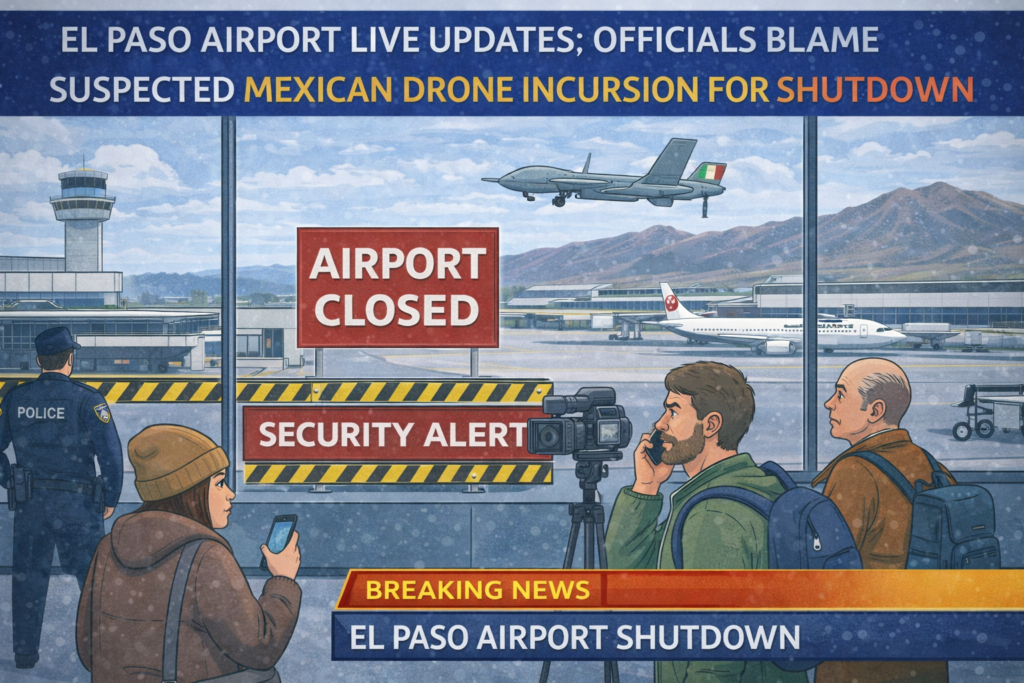
Mexican Cartel Drone Incursion Triggers Temporary Closure of Airspace Around El Paso Airport
WASHINGTON — A suspected Mexican cartel drone incursion led to the temporary closure of airspace around El Paso International Airport in Texas, according to the Trump administration. The restriction, which lasted for several hours, was lifted Wednesday morning.
Earlier, the Federal Aviation Administration (FAA) had announced a 10-day closure that grounded all flights to and from the airport.
Federal Response and Lifting of Restrictions
Transportation Secretary Sean Duffy said in a post on X that the FAA and the Department of Defense “acted swiftly to address a cartel drone incursion.” He added that “the threat has been neutralized and there is no danger to commercial travel in the region.”
Duffy confirmed that normal flight operations resumed Wednesday morning. However, he did not specify how many drones were involved or detail the actions taken to disable them.
The shutdown had been implemented “for special security reasons” and was expected to cause significant disruption due to its projected duration and the size of the surrounding metropolitan area. Texas Gov. Greg Abbott’s office referred inquiries to the FAA.
Ongoing Concerns About Cartel Drone Activity
Steven Willoughby, deputy director of the Department of Homeland Security’s counter-drone program, told lawmakers in July that drug cartels frequently use drones along the U.S.-Mexico border. According to his testimony, nearly every day drones are deployed to transport drugs and monitor Border Patrol agents.
Willoughby stated that more than 27,000 drones were detected within 500 meters (1,600 feet) of the southern border during the final six months of 2024, most operating late at night. Homeland Security officials have reported the seizure of thousands of pounds of methamphetamine, fentanyl, and other drugs in recent years that cartels attempted to transport via drones.
Impact on El Paso and Cross-Border Community
El Paso, which has a population of nearly 700,000 people, serves as a major hub for cross-border commerce alongside neighboring Ciudad Juárez, Mexico. The broader metropolitan area is even larger. The temporary airspace restriction did not extend into Mexican airspace.
Ciudad Juárez is home to approximately 1.5 million residents. Many residents are accustomed to using facilities, including airports, on both sides of the border. The city’s proximity to the United States has also made it a strategic location for drug cartels seeking control over smuggling routes for drugs and migrants heading north, as well as cash and firearms moving south.
Travelers Stranded as Flights Grounded
Following the FAA’s announcement, El Paso International Airport stated on Instagram that all flights — commercial, cargo, and general aviation — would be grounded through late Feb. 20.
Local news broadcasts showed travelers lined up at airline ticket counters and car rental desks hours after the grounding took effect. On Wednesday morning, the airport confirmed that operations had resumed and advised passengers to contact their airlines for updated flight information.
Mexican Officials to Meet U.S. Counterparts
Mexican President Claudia Sheinbaum said that Mexico’s defense and navy secretaries would travel to Washington on Wednesday to meet with U.S. Northern Command officials. Representatives from several other countries are also expected to attend.
Sheinbaum said Mexican officials would “listen” during the meeting. She added that her government would examine “the exact causes” of the airspace closure.
Responding to U.S. officials’ explanation, Sheinbaum said she had “no information about the use of drones on the border” and noted that if U.S. authorities possess additional information, they should share it with Mexico’s government.
Lawmakers Question Sudden Shutdown
Rep. Veronica Escobar, a Democrat whose district includes El Paso, called on the FAA to explain the abrupt closure and reopening of the airspace. She said neither her office, the city of El Paso, nor airport officials received advance notice.
“I believe the FAA owes the community and the country an explanation as to why this happened so suddenly and abruptly and was lifted so suddenly and abruptly,” Escobar said during a Wednesday morning news conference.
“The information coming from the federal government does not add up,” she added.
Escobar later stated that, based on information provided to members of Congress, she did not believe the shutdown was due to Mexican cartel drones operating in U.S. airspace.
Pentagon officials declined to comment when asked about Escobar’s remarks.
Additional Restrictions in New Mexico
El Paso International Airport describes itself as a gateway to west Texas, southern New Mexico, and northern Mexico. Major carriers operating at the airport include Southwest, United, American, and Delta.
As of Wednesday morning, a similar 10-day temporary flight restriction for special security reasons remained in effect around Santa Teresa, New Mexico, approximately 15 miles northwest of El Paso. FAA officials did not immediately explain why that restriction was still in place.
U.S. Sen. Ben Ray Lujan of New Mexico also called for clarification.
“Keeping our communities informed and safe is critical. I’m demanding answers from the FAA and the administration about why the airspace was closed in the first place without notifying appropriate officials, leaving travelers to deal with unnecessary chaos,” Lujan said in a statement.
Questions Remain
Although flight operations have resumed at El Paso International Airport, questions remain about the circumstances surrounding the airspace closure, the drone threat, and the communication between federal authorities and local officials.