Airport Security Lines Are Getting a High-Tech Makeover: These New Programs Could Change How Travelers Get to the Gate
Airport Travel & Security Update | August 11, 2026
For many air travelers, the most frustrating part of a trip does not begin when the aircraft takes off.
It begins much earlier.
It starts with the line.
Passengers arrive at the airport carrying suitcases, backpacks, laptops and travel documents. They check the departure board, find the security checkpoint and then look ahead to see a queue that can sometimes seem to stretch endlessly through the terminal.
During busy travel periods, security lines can become one of the biggest sources of anxiety for passengers. A traveler who arrived at the airport expecting to have plenty of time can suddenly find that much of that time has disappeared while waiting to reach the screening checkpoint.
But the traditional airport security experience is beginning to change.
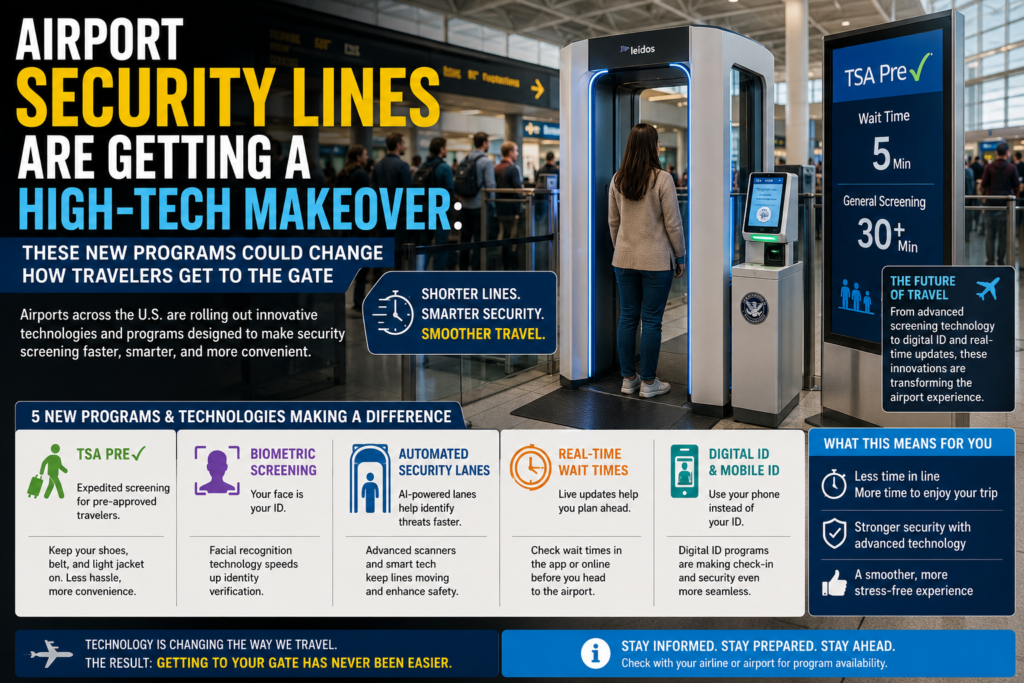
Across the United States, airports and federal authorities are introducing technologies and programs designed to make passenger processing faster and more streamlined. These include TSA PreCheck Touchless ID, facial-comparison technology, upgraded screening equipment and new options for touchless identity verification and baggage handling.
The objective is not to eliminate airport security.
Instead, the goal is to make the security process more efficient while maintaining the screening requirements that protect the traveling public.
One of the most significant developments is the expansion of TSA PreCheck Touchless ID, which allows eligible travelers to verify their identity through facial comparison technology rather than repeatedly presenting a physical identification document and boarding pass.
In June 2026, the Transportation Security Administration announced a partnership with Google Wallet that allows eligible travelers to opt into TSA PreCheck Touchless ID through Google Wallet. TSA said the system uses dedicated lanes and facial comparison technology to provide a more seamless identity-verification experience. PR Newswire
American Airlines has also expanded TSA PreCheck Touchless ID to all of its hub airports, including Charlotte, Chicago, Dallas-Fort Worth, Los Angeles, Miami, New York, Philadelphia, Phoenix and Washington, D.C. The airline said the program was also available at dozens of other U.S. airports where it operates. American Airlines Newsroom
For travelers, these changes could eventually mean less time spent standing in traditional identity-check lines and more time getting through the airport.
But the technology is not a magic solution.
Eligibility requirements apply, availability varies by airport and airline, and travelers should still plan enough time for the airport security process.
Customers who need help with booking, canceling, rebooking, rescheduling or upgrading a flight ticket can call:
1-877-730-2630
Customers can also call the same toll-free number to check flight status.
Why airport security lines can become so difficult
Airport security is a complicated process.
Every passenger must be screened according to applicable security requirements before entering the secure portion of the airport.
At the same time, airports have to process large numbers of people during concentrated periods.
Flights tend to depart in waves.
That means hundreds or thousands of passengers can arrive at security checkpoints within a relatively short period.
A checkpoint may be operating normally, yet a sudden increase in passengers can cause the queue to grow.
The challenge becomes even greater when staffing levels, equipment availability or airport infrastructure cannot keep pace with demand.
A traveler might therefore encounter a long line even when there is no unusual security event taking place.
The objective of newer technologies is to make some parts of that process more efficient.
The rise of Touchless ID
One of the most important changes in the U.S. airport security process is TSA PreCheck Touchless ID.
The program uses facial comparison technology to verify a traveler’s identity.
Instead of repeatedly presenting a physical ID to an officer, an eligible traveler can use a dedicated Touchless ID lane where a camera captures a live image and compares it against an image already associated with the traveler.
TSA describes the technology as a way to provide faster and more efficient identity verification. PR Newswire
The program is not available to everyone.
Travelers generally need to be enrolled in TSA PreCheck and meet the requirements for Touchless ID through a participating airline and airport.
The exact availability can vary.
That means passengers should not assume that simply having TSA PreCheck automatically guarantees access to a Touchless ID lane at every airport.
Facial recognition is becoming part of the airport experience
The use of facial comparison technology represents a broader shift in how airports handle passenger identity verification.
Traditionally, travelers have relied heavily on physical documents.
A passenger shows an identification document.
An officer checks the document.
The passenger proceeds.
Biometric systems attempt to streamline this process by using an image of the passenger to confirm identity.
The technology is already being deployed in different forms across U.S. airports.
TSA’s newer systems are designed to compare the traveler’s live image with an existing government-held photograph, such as an image associated with a passport or other eligible document. American Airlines says its Touchless ID system uses secure facial-matching technology for identity verification. American Airlines Newsroom
The intended benefit is speed.
If identity verification takes less time, the checkpoint can potentially process passengers more efficiently.
This is different from simply removing security
It is important to understand what Touchless ID does—and does not—do.
The program does not eliminate airport security screening.
It primarily changes the identity-verification portion of the process.
Passengers still have to comply with TSA screening requirements.
The purpose is to make the process of confirming who the passenger is more efficient.
That distinction matters because travelers sometimes interpret “touchless” as meaning they can simply walk through the airport without screening.
That is not the case.
Passengers still need to go through the appropriate security checkpoint and comply with TSA procedures.
New Orleans has already introduced upgraded technology
The changes are not limited to a handful of major hubs.
Louis Armstrong New Orleans International Airport introduced TSA technology intended to improve the passenger screening experience.
According to Axios, the airport added TSA PreCheck Touchless ID and upgraded screening lanes with technology that allows passengers to leave liquids and electronics inside their carry-on bags in those lanes. Axios
That kind of equipment can potentially save time because passengers do not have to perform as many preparation steps before their bags enter the screening system.
For a traveler, eliminating one or two repetitive steps may not sound dramatic.
But multiplied across thousands of passengers, small efficiency improvements can make a meaningful difference.
New screening machines could reduce some of the preparation passengers hate
Anyone who has flown regularly knows the routine.
Take off certain outer clothing.
Remove electronics.
Separate liquids.
Place items in bins.
Move through the scanner.
Collect everything on the other side.
Newer screening systems are designed to reduce some of those steps.
At airports where advanced computed-tomography screening equipment has been deployed, passengers may be permitted to leave certain electronics and liquids inside their bags, subject to the instructions of the particular checkpoint.
This can make the process more convenient.
But travelers should not assume the rules are identical at every airport.
The equipment and procedures at one checkpoint may differ from those at another.
Passengers should always follow the instructions provided by TSA officers and airport personnel.
Touchless technology is also reaching baggage drop
Security is not the only part of airport processing being changed.
Airports and airlines are experimenting with touchless baggage processes as well.
Denver International Airport and Southwest Airlines introduced a dedicated TSA PreCheck Touchless ID Bag Drop option for eligible Southwest passengers in April 2026.
The airport said the new system was intended to provide a more efficient bag-drop experience for participating passengers. Denver International Airport
The concept is straightforward.
If identity verification can be completed electronically, passengers may be able to reduce the amount of manual interaction required during certain airport processes.
That can potentially make the entire journey from curb to gate more efficient.
Why bag drop matters
For passengers traveling with only a carry-on bag, security is often the biggest processing hurdle.
For passengers checking luggage, however, the journey begins earlier.
They may have to:
- Find the airline’s check-in area.
- Print or access a boarding pass.
- Check their bag.
- Complete identity verification.
- Proceed to security.
- Find the gate.
Each additional queue adds time.
If airlines and airports can reduce the amount of time passengers spend waiting at the bag-drop area, the overall airport experience can improve.
That is why biometric and automated processing is being considered across multiple stages of the passenger journey.
American Airlines is expanding Touchless ID across its hubs
American Airlines’ expansion is particularly notable because of the number of major airports involved.
The airline said eligible AAdvantage members can use TSA PreCheck Touchless ID at all of its hub airports.
Those include:
- Charlotte;
- Chicago O’Hare;
- Dallas-Fort Worth;
- Los Angeles;
- Miami;
- New York’s JFK and LaGuardia;
- Philadelphia;
- Phoenix; and
- Washington, D.C.
American also said the technology is available at 60 additional U.S. airports where it operates. American Airlines Newsroom
For frequent travelers, the expansion means that Touchless ID is becoming less of a limited pilot and more of a recognizable part of the U.S. airport experience.
Google Wallet is now part of the process
The TSA’s June 2026 announcement involving Google Wallet adds another dimension to the development.
TSA announced that Google Wallet had become the first digital wallet to offer an opt-in experience for TSA PreCheck Touchless ID.
Eligible travelers can check in with a participating airline and add their boarding pass to Google Wallet before using the system. PR Newswire
The move is part of a larger shift toward digital travel credentials.
Instead of relying exclusively on physical documents, travelers increasingly use smartphones to store boarding passes and other travel information.
However, passengers should continue carrying their physical identification.
Technology can fail.
A phone can lose power.
A system can be temporarily unavailable.
A passenger may also encounter a checkpoint where the touchless system is not operating.
Having the appropriate physical ID available remains a sensible precaution.
San Jose has also introduced Touchless ID
San José Mineta International Airport introduced TSA PreCheck Touchless Identity Verification in January 2026.
The airport said eligible TSA PreCheck passengers who opt in can verify their identity at select checkpoints without presenting a physical ID. The system uses facial comparison technology. San José Mineta International Airport
The expansion of the technology to airports such as San José shows how the system is moving beyond a small number of experimental locations.
Travelers on the West Coast may encounter Touchless ID at an increasing number of airports.
Miami has joined the trend too
Miami International Airport introduced TSA PreCheck Touchless ID in February 2026.
The Miami Herald reported that the system allows eligible TSA PreCheck travelers to be identified without presenting a physical ID or boarding pass at the security checkpoint.
The report said TSA officials described the identity verification as taking less than four seconds in the system being introduced at Miami. Miami Herald
The potential benefit is obvious.
When identity verification takes seconds rather than requiring a longer document-checking interaction, a dedicated lane can potentially move more passengers through the checkpoint.
The programs are designed to improve efficiency – not just convenience
It is easy to think of these programs as luxury upgrades for frequent flyers.
But their larger purpose is operational.
Airports need to process enormous numbers of passengers while maintaining security standards.
If technology can reduce the amount of time spent on repetitive identity checks, personnel and infrastructure can potentially be used more efficiently.
The TSA has been developing digital identity and automated checkpoint capabilities as part of its broader modernization efforts.
Its capital investment planning has included projects involving digital identity, upgraded identity-authentication systems and automated checkpoint technologies. Transportation Security Administration
That suggests the movement toward biometric and digital processing is not simply a temporary travel trend.
It is part of a longer-term effort to modernize the airport checkpoint.
But technology cannot eliminate every airport line
This is one of the most important points for travelers.
A biometric identity check may be completed in seconds.
That does not mean the entire security process will take seconds.
Passengers still have to enter the appropriate queue.
Bags still need to be screened.
Security officers still have to resolve alarms or conduct additional inspections when required.
Crowded terminals can still produce congestion.
A flight wave can still send hundreds of passengers toward the checkpoint simultaneously.
And if staffing or equipment is limited, the line can remain long even when the identity-verification component is highly efficient.
Touchless technology is therefore one tool—not a complete solution.
TSA PreCheck remains central to the strategy
TSA PreCheck has already changed the airport experience for millions of eligible travelers.
The program provides expedited screening procedures at participating airports.
Depending on the checkpoint and applicable rules, PreCheck passengers generally do not have to follow all of the same preparation steps as travelers in standard screening lanes.
Touchless ID adds another layer.
Instead of simply receiving expedited screening, an eligible passenger can use facial comparison to make the identity-verification process more seamless.
That combination can make the airport experience significantly different from the traditional security queue.
CLEAR is another part of the changing airport landscape
Travelers may also encounter private biometric services such as CLEAR.
CLEAR uses biometric identity verification to help enrolled passengers move through an identity-check process before completing the required TSA security screening.
It is important not to confuse CLEAR with TSA PreCheck Touchless ID.
They are different programs.
A traveler can potentially use both, depending on eligibility and airport availability.
The broader trend, however, is similar: use technology to reduce the amount of time passengers spend in traditional identity-verification queues.
Why the distinction between identity verification and screening matters
Imagine a passenger standing in a long security line.
There are actually several processes taking place:
Queue management
Identity verification
Document inspection
Carry-on screening
Additional screening when necessary
Passenger flow into the secure area
A faster identity check can improve one part of this system.
It does not automatically solve every other part.
This is why airport operators continue investing in new screening equipment and checkpoint layouts in addition to biometric identity systems.
The goal is to improve the entire passenger flow.
Privacy remains an important question
Facial recognition technology naturally raises questions about privacy.
Travelers may wonder where their biometric information goes, how it is used and how long it is retained.
Those concerns are part of the public discussion surrounding biometric travel systems.
TSA has stated that its Touchless ID system is designed around identity verification and that biometric information is handled under its applicable privacy and security procedures.
Travelers who are uncomfortable with biometric processing should review the program’s participation and privacy information before opting in.
The technology is designed to be optional in the Touchless ID program.
That means passengers should understand what they are agreeing to rather than treating biometric processing as an unavoidable requirement for every traveler.
What happens if Touchless ID doesn’t work?
Technology is never perfect.
A camera may fail to capture an image properly.
The system may be temporarily unavailable.
A passenger’s information may not match as expected.
The checkpoint may not have an operating Touchless ID lane.
In those circumstances, the passenger may need to use the traditional identity-verification process.
That is another reason travelers should continue carrying an acceptable physical identification document.
A new digital system should be viewed as an additional option, not a guarantee that every airport process will be automated.
Travelers still need to arrive early
The introduction of faster technology should not encourage passengers to arrive at the airport at the last possible moment.
A short security line does not eliminate the possibility of:
- airline check-in delays;
- bag-drop queues;
- crowded airport roads;
- parking problems;
- terminal congestion;
- gate changes;
- long walks to the gate;
- additional screening; or
- weather-related disruptions.
Passengers should follow their airline’s recommended arrival time.
Travelers with international flights should be particularly cautious because international check-in and boarding procedures can involve additional requirements.
A faster security line doesn’t mean a faster flight
Another misconception is that faster airport processing solves airline delays.
It does not.
A passenger may clear security in five minutes and then spend an hour waiting because the aircraft is delayed.
Airline schedules can be affected by weather, aircraft availability, crew scheduling, air traffic control and airport congestion.
Security modernization addresses one part of the travel journey.
It cannot control everything that happens after the passenger reaches the gate.
Why these changes matter to families
Families can find airport security particularly challenging.
Parents may be traveling with young children, strollers, car seats, diaper bags and multiple pieces of carry-on luggage.
Every additional checkpoint procedure can make the process more difficult.
Faster identity verification can reduce one source of friction.
But families should still allow extra time because children’s travel needs can make airport processing unpredictable.
Parents should also check TSA and airline rules regarding children, identification and baggage before traveling.
Business travelers could benefit too
Frequent business travelers value predictability.
A 20-minute security line may not sound dramatic to someone on vacation.
For a traveler trying to reach a meeting immediately after landing, however, every minute matters.
Touchless identity verification and expedited screening could make airport travel more predictable for frequent flyers.
The greatest benefit may not be eliminating every wait.
It may be reducing uncertainty.
Knowing that there is a dedicated lane and a streamlined process can make it easier for travelers to plan their arrival at the airport.
What passengers can do today
Travelers do not have to wait for a completely redesigned airport to make their own trips easier.
There are several steps passengers can take now.
Consider TSA PreCheck
If you travel frequently within the United States, TSA PreCheck may be worth considering.
It provides access to expedited screening lanes at participating airports.
Check Touchless ID availability
If you already have PreCheck, determine whether your airline and airport support TSA PreCheck Touchless ID.
Complete the opt-in process before arriving
Touchless programs generally require travelers to complete certain steps before using the dedicated lane.
Do not wait until you reach the airport to discover that you are not enrolled.
Keep your physical ID
Even when using digital or biometric systems, carry your acceptable physical identification.
Check the airport’s current procedures
Different airports can use different equipment and checkpoint rules.
Leave enough time
Technology can reduce some waits, but it cannot eliminate airport uncertainty.
How Touchless ID works in practical terms
The basic process is designed to be straightforward.
An eligible traveler checks in for a flight with a participating airline.
The traveler has an active TSA PreCheck membership and has completed the necessary opt-in process.
At a participating airport, the traveler enters the designated Touchless ID lane.
A camera captures the traveler’s face.
The system compares the live image with an appropriate stored image.
Once identity is verified, the passenger continues through the TSA PreCheck screening process.
The objective is to remove some of the repetitive document handling associated with traditional screening.
What Touchless ID does not mean
It does not mean:
- every airport has a Touchless ID lane;
- every airline participates;
- every TSA PreCheck passenger automatically has access;
- travelers can leave their physical ID at home;
- passengers can skip TSA screening;
- security checks are optional; or
- airport lines will disappear completely.
Those distinctions are important.
The technology is designed to make a specific part of the airport experience more efficient.
The future may involve more digital identity
The current developments suggest that airport identity verification is moving increasingly toward digital systems.
The TSA has already invested in technologies designed to read digital identification and perform automated identity authentication. Its planning documents have included digital identity capabilities, upgraded CAT-2 units and automated checkpoint developments. TTransportation Security Administration
Airlines are also integrating identity technology into their customer journeys.
Google Wallet’s participation demonstrates how smartphones can become part of the process.
Airports are introducing touchless identity lanes.
Airlines are experimenting with biometric baggage handling.
Taken together, these developments point toward an airport experience in which passengers increasingly move through different stages using digital identity rather than repeatedly presenting paper or plastic documents.
But the traditional airport experience is not disappearing overnight
Millions of travelers will continue using standard security lanes.
Not every passenger has TSA PreCheck.
Not every airport has Touchless ID.
Not every traveler owns or wants to use a compatible smartphone.
Some passengers may prefer traditional document verification.
Others may not qualify for expedited programs.
Airport security therefore has to support multiple types of passengers simultaneously.
The transition will likely be gradual.
The biggest change may be invisible
One interesting aspect of airport automation is that the best technology may become almost invisible to passengers.
Instead of noticing a complicated new machine, travelers may simply notice that the line moves faster.
Instead of handing over a document several times, they may look at a camera.
Instead of waiting at a staffed bag-drop counter, they may use an automated system.
That is the broader objective of many of these initiatives.
Technology should ideally reduce friction without making the passenger think about the technology itself.
What this means for North American travelers
For travelers from the United States and Canada, the changes are particularly relevant because many trips involve U.S. airports with increasingly sophisticated screening systems.
A Canadian traveler connecting through a U.S. airport may encounter a different screening process from the one used at the departure airport.
A U.S. traveler flying between major hubs may find that one airport offers Touchless ID while another does not.
Passengers should therefore check the specific airport and airline rather than assuming that the same process exists everywhere.
What if your flight changes while you’re traveling?
Security technology can make the airport experience easier, but flight schedules can still change.
A flight can be delayed.
A departure gate can move.
A connection can be missed.
An airline can cancel a service.
If your travel plans change, you may need to rebook or reschedule.
Customers who need assistance with booking, canceling, rebooking, rescheduling or upgrading a flight ticket can call:
1-877-730-2630
Customers can also use the same toll-free number to check flight status.
Don’t let a shorter security line make you miss your flight
A common mistake is to calculate airport arrival time based only on security.
Even if you have Touchless ID and expect to clear security quickly, you still need time for:
- parking;
- airport transportation;
- airline check-in;
- baggage drop;
- security;
- walking to the gate;
- boarding.
Airports can also experience unexpected congestion.
A passenger who normally clears security in five minutes could encounter a completely different situation if the Touchless system is temporarily unavailable.
Planning for the full airport journey remains important.
Airport lines are changing—but patience is still part of travel
The traditional airport security line is unlikely to disappear immediately.
But the experience is changing.
TSA PreCheck has already created expedited lanes.
Touchless ID is adding biometric identity verification.
Advanced screening equipment can reduce the number of items passengers need to remove from bags.
Airlines and airports are experimenting with biometric baggage drop.
Digital wallets are increasingly becoming part of the travel experience.
Each development addresses a different piece of the passenger journey.
Together, they could make airports substantially more efficient.
The bottom line
Airport security lines have long been one of the most frustrating parts of air travel.
But new technology is beginning to change the experience.
The most important development is the expansion of TSA PreCheck Touchless ID, which uses facial comparison technology to verify the identity of eligible passengers in dedicated lanes.
The TSA announced a Google Wallet partnership in June 2026 that gives eligible travelers another way to opt into Touchless ID. PR Newswire
American Airlines has expanded Touchless ID to all of its major hub airports, including Chicago O’Hare, Dallas-Fort Worth, Miami, Los Angeles, Charlotte, Philadelphia and other hubs, along with dozens of additional airports. American Airlines Newsroom
Other airports are also introducing the technology.
San José Mineta International Airport launched TSA PreCheck Touchless ID in January, while Miami International Airport introduced the technology in February. SSan José Mineta International Airport+1
Denver International Airport and Southwest Airlines have also introduced a dedicated Touchless ID bag-drop option for eligible passengers. Denver International Airport
Meanwhile, airports are deploying upgraded screening equipment that can reduce some of the preparation passengers traditionally have to do with carry-on bags. Axios
The result is not an airport without security lines.
Instead, the industry is moving toward an airport where identity verification, screening and baggage processing can increasingly be automated and streamlined.
For travelers, that could eventually mean less time standing in queues and more time getting to the gate.
But passengers should still check the rules at their particular airport, confirm their eligibility for programs such as TSA PreCheck Touchless ID and carry an acceptable physical ID.
And technology should never be an excuse to arrive at the airport too late.
For passengers who need assistance with booking, canceling, rebooking, rescheduling or upgrading flight tickets, call:
1-877-730-2630
For flight-status assistance, customers can call the same toll-free number.
Source Credit
Primary topic/source: The New York Times, “Airport Lines Are Grueling. New Programs Aim to Change That.” The article’s subject concerns efforts to improve the airport passenger experience and reduce the burden of lengthy airport processing lines.
Because the New York Times page was not directly accessible for independent verification, this article does not reproduce or attribute specific NYT-only quotations or unpublished details. The factual discussion above has instead been cross-checked against current public information from the Transportation Security Administration, participating airlines and airports, including TSA’s June 2026 announcement concerning Google Wallet and Touchless ID, American Airlines’ expansion of Touchless ID, San José Mineta International Airport’s launch, Denver International Airport’s touchless bag-drop program and other current reporting. PR Newswire+3
Editorial note: Airport technology, Touchless ID availability, participating airlines and checkpoint procedures can change. Travelers should verify current eligibility and airport availability before relying on a particular expedited screening option.
Customer-service notice: The telephone number 1-877-730-2630 is included based on the customer-service information supplied for this article. It is not represented as an official telephone number for The New York Times, TSA, Google, an airline, an airport or any U.S. government agency.