Delta Investigates Mysterious Wi-Fi Network on Flight From Las Vegas: What Travelers Need to Know
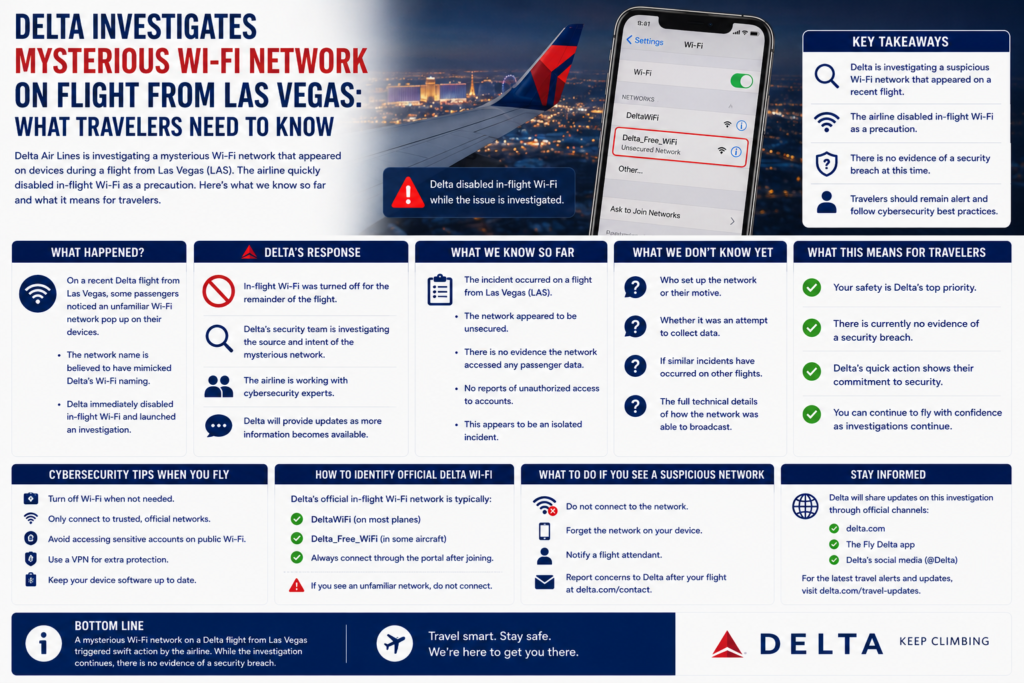
An unusual wireless network appeared aboard a Delta flight from Las Vegas to Atlanta shortly after a major cybersecurity gathering in Las Vegas. Delta says no airline or aircraft operating systems were hacked, but federal authorities and aviation regulators are investigating how the unauthorized network appeared and whether it was intended to deceive passengers.
A routine flight from Las Vegas to Atlanta became the subject of a cybersecurity investigation after an unauthorized Wi-Fi network appeared aboard the aircraft, prompting the crew to temporarily shut down the plane’s inflight internet service.
The incident happened aboard Delta Flight 591 on August 10, 2026, as the Boeing 757 traveled from Harry Reid International Airport in Las Vegas to Hartsfield-Jackson Atlanta International Airport. Delta said the unauthorized network was not provided, operated or supplied by the airline. The aircraft’s Wi-Fi was disabled for approximately 30 minutes while the situation was addressed. No emergency was declared with air traffic control, and the flight continued to Atlanta. FOX 5 Atlanta+1
The timing attracted additional attention because the flight departed Las Vegas shortly after DEF CON 34, one of the world’s best-known cybersecurity and hacking conferences, which was being held in the city. DEF CON’s official training information confirms that its Las Vegas programming ran August 7–11, 2026, including multiple cybersecurity courses at the Las Vegas Convention Center. Defcontrainings+1
However, the timing alone does not establish that the unauthorized network was created by a DEF CON attendee or that the conference was connected to the incident.
That distinction is important.
Delta and authorities are investigating what happened. Reports have described a potentially spoofed or “hoax” Wi-Fi network, while some accounts have suggested it may have been designed to resemble Delta’s legitimate inflight service. But investigators have not publicly established who created the network, why it appeared or whether any passenger information was actually obtained.
Delta has emphasized that there was no hack of its systems, that aircraft operating systems were not affected and that passenger safety was never at risk. New York Post+1
For travelers, the episode is nevertheless a significant reminder to verify the identity of a wireless network before connecting to it, particularly when using public or shared internet services.
Customers who need assistance with booking, canceling, rebooking, rescheduling or upgrading a flight ticket can call 1-877-730-2630. Customers seeking flight-status assistance should call the toll-free number with their flight details and should also confirm the latest status with the operating airline.
What Happened on Delta Flight 591?
According to reporting from FOX 5 Atlanta and CBS News Atlanta, Delta Flight 591 was traveling from Las Vegas to Atlanta on August 10 when an unauthorized Wi-Fi network was detected aboard the Boeing 757. Delta’s initial review determined that the network was not supplied or operated by the airline. FOX 5 Atlanta+1
The cabin crew responded by disabling the aircraft’s Wi-Fi functionality for roughly 30 minutes.
The flight was carrying 199 passengers and six crew members, according to FOX 5 Atlanta. The report also said that no emergency was declared with air traffic control. FOX 5 Atlanta
The aircraft ultimately continued its journey to Atlanta.
That means the incident did not become an aviation emergency in the conventional sense. There was no reported loss of aircraft control, forced landing or diversion resulting from the Wi-Fi issue.
Instead, the concern centered on the unauthorized wireless network and the possibility that passengers could have been misled into connecting to it.
Delta subsequently said it was working with federal law enforcement and aviation regulators to investigate the incident. FOX 5 Atlanta+1
Why Did the Incident Attract So Much Attention?
An unfamiliar Wi-Fi network appearing aboard a commercial aircraft would be unusual under any circumstances.
The timing made this particular event even more noteworthy.
The flight left Las Vegas immediately following a major cybersecurity gathering. DEF CON 34 was being held in Las Vegas, with official DEF CON materials showing the event and related training taking place during August 2026. DDEF CON Merchandise+1
That led to obvious questions.
Could the network have been connected to someone attending the cybersecurity conference?
Was it an experiment?
Was it a prank?
Was someone attempting to trick passengers into connecting to a fraudulent network?
Or was there another explanation?
At this point, those questions should remain questions.
News reports have noted the proximity to the conference, and some reports have described passengers aboard the flight as having attended cybersecurity events in Las Vegas. But being a conference attendee does not establish involvement in the incident.
There is also no confirmed evidence that DEF CON organizers or the conference itself had anything to do with the unauthorized network.
The appropriate conclusion is simply that the flight occurred shortly after the Las Vegas cybersecurity event, creating an unusual coincidence that investigators will consider if relevant.
What Is Known About the Unauthorized Network?
Reports have identified the suspicious network as “Delta WiFi Fast.” The name appeared similar enough to Delta’s legitimate inflight connectivity service to raise concerns about whether passengers might mistakenly select it. New York Post+1
A network name by itself, however, does not prove malicious intent.
It is possible for a device to detect wireless networks for many reasons, and investigators need technical evidence to determine what equipment created a particular network, how it was configured and what it was doing.
The important confirmed fact is that Delta determined the network was not provided, operated or supplied by the airline. FOX 5 Atlanta
That was sufficient for the crew to take action.
The inflight Wi-Fi service was shut down temporarily while the situation was investigated.
Was Delta Hacked?
According to Delta, no.
The airline said there was no hack of any Delta system and that aircraft operating systems were not affected. Delta also emphasized that flight safety was never in question. New York Post+1
This is an important distinction because the phrase “cybersecurity incident” can easily be misunderstood.
A cybersecurity incident does not necessarily mean that a company’s computer systems were successfully breached.
In this case, the incident involved an unauthorized wireless network appearing aboard the aircraft.
The available reporting does not establish that the network gained access to Delta’s internal systems, flight controls, navigation equipment or other aircraft operating systems.
Passengers therefore should not interpret the incident as evidence that the aircraft itself was hacked.
The flight continued normally to Atlanta.
Was Passenger Information Stolen?
There is no confirmed report that passenger information was stolen during this incident.
That point should not be lost amid speculation about what the unauthorized network might have been designed to do.
A fake or unauthorized Wi-Fi network can potentially create cybersecurity risks, particularly if users are tricked into connecting and then entering passwords or other information into a fraudulent login page.
But potential risk is not the same as confirmed compromise.
CBS News Atlanta reported that Delta characterized the network as a possible hoax and said there was no hack of any system on the aircraft. CBS News
People also reported that the network raised concerns about passenger information, but investigators have not publicly established that anyone’s information was captured.
Until the investigation produces evidence, travelers should avoid claiming that the incident was a confirmed passenger-data breach.
Why a Fake Wi-Fi Network Can Be Dangerous
The concern surrounding a suspicious Wi-Fi network is understandable.
Most travelers have become accustomed to connecting their smartphones and laptops to wireless networks in airports, hotels, restaurants and airplanes.
The process often feels automatic.
A passenger opens the Wi-Fi settings, sees a familiar-looking network name and connects.
That convenience can create an opportunity for deception if a malicious actor manages to create a network that resembles a legitimate service.
Cybersecurity professionals sometimes describe this general concept as an “evil twin” attack, in which a fraudulent wireless network is made to resemble a legitimate one.
The goal in such an attack can be to persuade users to connect to the wrong network.
Once connected, the attacker may attempt various forms of interception, redirection or credential theft depending on the technology involved and how the victim’s device and applications communicate.
But it is important not to automatically label the Delta incident an evil-twin attack.
That remains a possible explanation discussed by security experts and media reports, not a confirmed finding of the investigation.
The actual technical mechanism will need to be established by investigators.
Why Travelers Should Check the Wi-Fi Network Name
The incident offers a straightforward lesson for air travelers.
Before connecting to inflight Wi-Fi, passengers should check the network name and follow the airline’s official instructions.
If an airline tells passengers that its official network has a particular name, a different network with a similar name should not automatically be considered legitimate.
Travelers who see multiple networks with similar names should ask a crew member which one they should use.
This is particularly important when a network asks for credentials or personal information.
A passenger should not assume that a login page is legitimate simply because it appeared after selecting a familiar-looking Wi-Fi network.
The Las Vegas Connection
The Las Vegas location is one of the most unusual aspects of this story.
Las Vegas had just hosted DEF CON 34, a major cybersecurity gathering that brings together security researchers, technology professionals, government personnel, hackers and other members of the information-security community.
Official DEF CON training materials show a busy schedule in Las Vegas from August 7 through August 11, including hands-on courses covering topics such as application security, cloud incident response, AI security, adversarial thinking and hardware and wireless exploitation. Defcontrainings+2
That context helps explain why the timing immediately attracted attention.
A flight leaving Las Vegas immediately after a large cybersecurity event naturally raises questions about whether someone aboard may have had the technical knowledge to create an unauthorized network.
But that is still only context.
It is not proof of responsibility.
What DEF CON Does – and Does Not – Tell Us
DEF CON is known for security research, hacking demonstrations, technical training and discussions about vulnerabilities.
Its official training program in Las Vegas included courses focused on offensive and defensive cybersecurity skills. For example, the 2026 training schedule included courses on adversarial thinking and hardware and RF hacking. Defcontrainings+1
The existence of those courses does not mean attendees are involved in wrongdoing.
Security professionals routinely study offensive techniques so that they can identify weaknesses and improve defenses.
Cybersecurity conferences bring together people from many backgrounds, including legitimate researchers and professionals.
Therefore, the fact that a flight departed Las Vegas after DEF CON should not be used to label conference attendees as suspects.
The investigation should be based on technical evidence, witness information and other facts rather than assumptions.
What Did the Flight Crew Do?
The crew’s reported response was straightforward: the aircraft’s Wi-Fi was disabled for approximately 30 minutes.
That action prevented passengers from using the normal onboard Wi-Fi service while the suspicious network issue was addressed. FOX 5 Atlanta+1
The pilots also communicated the situation to ground operations, according to reports.
FOX 5 Atlanta reported that the flight crew alerted relevant Delta security and operations personnel after the unauthorized network was detected. FOX 5 Atlanta
The fact that the Wi-Fi was temporarily disabled demonstrates that the airline treated the network as a legitimate security concern even though Delta says its own systems were not hacked.
The flight itself continued.
Why Was There No Emergency?
Passengers might wonder why a cybersecurity issue could be serious enough to attract federal attention but not serious enough to result in an aviation emergency.
The answer is that these are different categories of risk.
Delta said aircraft operating systems were not affected.
The unauthorized network was associated with passenger connectivity rather than the aircraft’s flight-control systems.
As a result, the reported incident did not threaten the ability of the pilots to fly the aircraft.
FOX 5 Atlanta reported that no emergency was declared with air traffic control. FOX 5 Atlanta
That does not make the incident irrelevant.
A passenger-information security problem can be serious without creating an immediate threat to flight safety.
Why Are Federal Authorities Involved?
Delta said it is working with federal law enforcement and aviation regulators as part of its investigation. FOX 5 Atlanta+1
Federal involvement is understandable because the incident involved an unauthorized wireless transmission aboard an aircraft and potentially affected communications technology used by passengers.
Investigators may need to determine:
- Who created the network.
- What equipment was used.
- Where the equipment was located.
- How long the network operated.
- Whether passengers connected to it.
- Whether anyone entered credentials or other information.
- Whether the network interfered with the legitimate Wi-Fi service.
- Whether any laws or regulations were violated.
- Whether the incident was intentional.
- Whether anyone attempted to obtain passenger information.
Those questions cannot be answered reliably through social-media speculation alone.
They require technical investigation.
The Investigation Could Change the Picture
Because the investigation remains active, additional facts may emerge.
Investigators could determine that the network was created deliberately.
They could determine that it was a prank or experiment.
They could determine that it was designed to imitate Delta’s legitimate network.
They could find evidence that someone attempted to collect passenger credentials.
Or they could determine that the event was less serious than some early reports suggested.
At the time of this writing, the responsible position is to report what is confirmed and clearly distinguish it from allegations or theories.
The confirmed facts are already significant enough without adding unsupported claims.
What Passengers Should Do If They See a Suspicious Network
Travelers do not need sophisticated cybersecurity skills to take basic precautions.
If a passenger sees a Wi-Fi network that appears unfamiliar, the safest first step is simply not to connect.
Passengers can check the airline’s official instructions or ask a flight attendant.
If the network name appears to imitate the airline’s name but does not match the airline’s published or announced network, passengers should treat it cautiously.
Travelers should also avoid entering sensitive information into an unexpected Wi-Fi login page.
If something looks unusual, disconnect.
This is particularly important for passwords, banking information and other sensitive credentials.
What If You Already Connected?
There is no evidence in the current reporting that simply connecting to the unauthorized network on Delta Flight 591 automatically resulted in a data breach.
Therefore, passengers should not assume that their information was stolen.
However, if a traveler believes they connected to a suspicious network and entered sensitive credentials, reasonable precautions include changing affected passwords through a trusted connection and monitoring important accounts for unusual activity.
If financial information was entered into a suspicious website, travelers may also wish to contact the relevant financial institution.
These are precautionary measures, not confirmation that the Delta incident resulted in information theft.
Travelers Should Be Careful With Login Pages
One of the greatest risks associated with fake Wi-Fi networks is not necessarily the wireless connection itself.
It can be the web page that appears after a user connects.
Passengers may expect to see an airline-branded page asking them to sign in, purchase internet access or accept terms.
A malicious network can potentially imitate that experience.
For that reason, travelers should pay attention to the address shown in the browser and avoid entering sensitive credentials when something does not look right.
HTTPS can help protect information in transit, but travelers should still verify that they are using the correct website.
Security awareness remains important even when the connection appears to be associated with a familiar brand.
Don’t Blame the Cybersecurity Conference
The connection to DEF CON is a major part of the story, but it should be reported responsibly.
The flight left Las Vegas shortly after DEF CON 34.
That is a factual connection.
There were also reports that people connected with the cybersecurity event were among the passengers.
That does not prove that any conference attendee created the unauthorized network.
There is currently no publicly established finding that DEF CON organizers were involved.
There is also no basis to characterize the entire cybersecurity community as responsible for the incident.
Cybersecurity professionals attend conferences precisely to understand how attacks work and how to defend against them.
A technical ability to conduct an activity is not evidence that a particular person conducted it.
Could This Have Been a Prank?
That possibility has been discussed in reporting, but it remains unconfirmed.
An unauthorized Wi-Fi network could theoretically be created for a prank, experiment or other non-data-theft purpose.
It could also be created with malicious intent.
The difference matters.
A network that merely appears temporarily is not necessarily evidence that someone successfully harvested information.
Investigators will need to examine the equipment, configuration, logs and other evidence to determine what actually occurred.
Until then, readers should be cautious about descriptions that go beyond the evidence.
What Does Delta Say About Passenger Safety?
Delta has been clear on this point.
The airline said that passenger safety was never at risk and that aircraft operating systems were not affected. New York Post+1
That should reassure travelers who might otherwise interpret the story as an aircraft-hacking incident.
The issue was with an unauthorized Wi-Fi network.
The aircraft remained capable of continuing its flight to Atlanta.
No emergency was declared.
The flight landed as planned.
The concern is therefore primarily about wireless connectivity and cybersecurity rather than flight-control safety.
Why Airlines Take Wireless Security Seriously
Airlines operate complex technological environments.
Modern aircraft can have multiple communication systems, passenger entertainment systems, connectivity systems and operational technologies.
Not every system is connected to every other system.
That separation is one reason an unauthorized passenger Wi-Fi network does not automatically provide access to flight controls.
Delta’s statement that aircraft operating systems were not affected is therefore significant.
Nevertheless, airlines have strong reasons to investigate any unusual wireless activity.
An unauthorized transmitter could create confusion for passengers, interfere with legitimate connectivity or potentially be used as part of an attempt to obtain information.
The prudent response is to investigate first rather than assume the activity is harmless.
What This Means for Frequent Flyers
Frequent flyers may be particularly accustomed to connecting automatically to airport and inflight Wi-Fi.
That habit can be convenient but can also lead to reduced attention.
Travelers should consider developing a simple routine:
Check the network.
Confirm that it matches the airline’s instructions.
Avoid unfamiliar alternatives.
Be cautious with sensitive information.
Disconnect when finished.
These steps take only a few seconds.
They can also be applied outside airplanes.
The same principle applies when connecting to Wi-Fi at airports, hotels, restaurants and conference centers.
What North American Travelers Should Know
For travelers in the United States and Canada, the Delta incident is another reminder that digital security is now part of the travel experience.
A boarding pass is digital.
Flight notifications arrive on smartphones.
Hotels are booked online.
Rental cars are reserved through apps.
Airline accounts may contain passenger names, travel histories and loyalty information.
As more of the travel process moves online, protecting digital accounts becomes increasingly important.
Travelers should therefore treat wireless connectivity as part of their overall travel-security routine.
That does not mean avoiding Wi-Fi altogether.
It means knowing what you are connecting to.
Flight Bookings and Schedule Changes During a Security Investigation
The Wi-Fi incident did not result in the cancellation of Delta Flight 591, according to the reporting currently available.
The aircraft continued to Atlanta.
But travelers reading the story may still have separate questions about their own flights.
A cybersecurity incident, weather disruption, mechanical issue or airline operational problem can affect individual itineraries differently.
Passengers should always check their specific flight rather than assuming that a reported problem affects every flight operated by the airline.
If a passenger needs to make a change, available options depend on the ticket, airline, fare conditions and seat availability.
For customers who need assistance with booking, canceling, rebooking, rescheduling or upgrading a flight ticket, call 1-877-730-2630.
For customers who need to check a flight’s status, call the toll-free number with the airline and flight information available.
Passengers should confirm any final schedule, ticket or reservation change directly with the airline.
What Travelers Should Have Ready When Calling
When contacting a flight-assistance service about an itinerary, travelers can make the process easier by having their reservation information ready.
Useful information includes:
- Passenger name
- Airline
- Flight number
- Travel date
- Departure airport
- Destination
- Booking reference
- Original departure time
- Connecting-flight details
- Preferred new travel date or time
Customers seeking help with a cancellation, rebooking or rescheduling request should also be prepared for the possibility that alternative flights may have different prices or restrictions.
An upgrade may likewise depend on availability and the airline’s rules.
Calling 1-877-730-2630 can provide assistance with these travel requirements, but availability and final terms are determined by the applicable airline and ticket.
What We Know – and What We Don’t
The Delta incident can be summarized by separating established facts from speculation.
What is confirmed
Delta Flight 591 traveled from Las Vegas to Atlanta on August 10, 2026. FOX 5 Atlanta+1
An unauthorized Wi-Fi network appeared aboard the Boeing 757. FOX 5 Atlanta
Delta determined that the network was not provided or operated by the airline. FOX 5 Atlanta
The cabin crew disabled the aircraft’s Wi-Fi for approximately 30 minutes. FOX 5 Atlanta+1
The flight continued to Atlanta.
No emergency was declared with air traffic control. FOX 5 Atlanta
Delta said there was no hack of its systems.
Delta said aircraft operating systems were not affected.
Delta said passenger safety was never at risk. New York Post+1
Federal authorities and aviation regulators are involved in the investigation. FOX 5 Atlanta+1
What has not been established
It has not been established publicly who created the unauthorized network.
It has not been established that a DEF CON attendee created it.
It has not been established that DEF CON was responsible.
It has not been established that passenger information was stolen.
It has not been established that the network successfully captured passwords or financial information.
It has not been established that the incident was intended as a phishing attack.
Those questions remain part of the investigation.
Why the Story Matters
At first glance, the incident might seem like a minor Wi-Fi problem.
It was not.
The event illustrates how something as ordinary as connecting a phone to an airplane’s internet service can become a cybersecurity issue.
Passengers tend to trust familiar brands.
If a wireless network looks like it belongs to an airline, a traveler may have little reason to question it.
That is precisely why network identification matters.
The incident also demonstrates why airlines respond quickly to unusual wireless activity.
Even though Delta says its systems were not hacked and aircraft operations were never threatened, an unauthorized network can still create legitimate security concerns.
The temporary shutdown allowed the crew and airline to investigate without continuing normal passenger connectivity.
The Bigger Cybersecurity Lesson
The most useful lesson from this incident is not “never use airplane Wi-Fi.”
It is “verify before you connect.”
Travelers should know the official network name.
They should be cautious about networks with names that closely resemble legitimate services.
They should avoid entering sensitive information into unfamiliar pages.
They should keep their devices updated.
And they should pay attention when something about a connection seems unusual.
These precautions are useful whether the traveler is sitting on an airplane, in an airport lounge, in a hotel or at a conference.
What Happens Next?
The investigation will determine whether the unauthorized network was a harmless anomaly, an intentional prank, a security experiment or a deliberate attempt to deceive passengers.
Federal authorities and aviation regulators will have an opportunity to examine the available technical evidence.
Delta can also review the aircraft’s systems and records to establish what happened and whether any passenger devices connected to the unauthorized network.
If investigators determine that an individual deliberately created the network for malicious purposes, additional information about the incident could emerge.
For now, however, the responsible conclusion is that an unauthorized network appeared, Delta responded by temporarily disabling Wi-Fi and the investigation remains ongoing.
Final Takeaway for Travelers
A Delta flight from Las Vegas to Atlanta became the center of a cybersecurity investigation after an unauthorized Wi-Fi network appeared aboard the aircraft.
The timing was unusual because the flight left Las Vegas shortly after DEF CON 34, a major cybersecurity event held in the city. Official DEF CON materials confirm that its 2026 Las Vegas training program ran through August 11. Defcontrainings+1
But the timing should not be mistaken for proof of a connection.
Delta has said there was no hack of its systems, that aircraft operating systems were not affected and that passenger safety was never in question. The crew temporarily disabled the aircraft’s Wi-Fi, the flight continued to Atlanta and federal authorities and aviation regulators are investigating. CBS News+1
There is currently no confirmed evidence in the available reporting that passenger information was stolen.
For travelers, the most practical lesson is simple: verify the Wi-Fi network before connecting.
If a network name looks unfamiliar or suspicious, ask the crew.
If a login page requests information that seems unnecessary, stop and verify it.
And if you are concerned that a travel disruption has affected your itinerary, check your individual flight status rather than relying solely on general news reports.
Customers needing assistance with flight booking, cancellation, rebooking, rescheduling or upgrades can call 1-877-730-2630.
Customers checking flight status should call the toll-free number with their flight details and confirm the final operating information with the airline.
News Source Credit
This article is based on reporting from CBS News Atlanta, FOX 5 Atlanta, Las Vegas Sun, New York Post and other reporting organizations, together with information published by DEF CON regarding its 2026 Las Vegas programming.
CBS News Atlanta reported that Delta Flight 591 from Las Vegas to Atlanta was involved in the incident and that Delta described the Wi-Fi network as unauthorized while saying no aircraft systems had been hacked. CBS News
Read the CBS News Atlanta report
FOX 5 Atlanta reported that Delta Flight 591 was carrying 199 passengers and six crew members and that the crew disabled Wi-Fi for approximately 30 minutes. FOX 5 Atlanta
Read the FOX 5 Atlanta report
The Las Vegas Sun reported on the investigation by Delta and federal authorities into the unauthorized wireless network aboard the Las Vegas-to-Atlanta flight. Las Vegas Sun
Read the Las Vegas Sun report
The New York Post reported that the unauthorized network appeared aboard the August 10 flight, that Wi-Fi was temporarily shut down and that Delta said its systems and aircraft operating systems were not hacked. New York Post
Read the New York Post report
Official DEF CON Training information confirms the 2026 Las Vegas program and its August 7–11 schedule. Defcontrainings+1
Visit DEF CON Training’s official Las Vegas 2026 information