
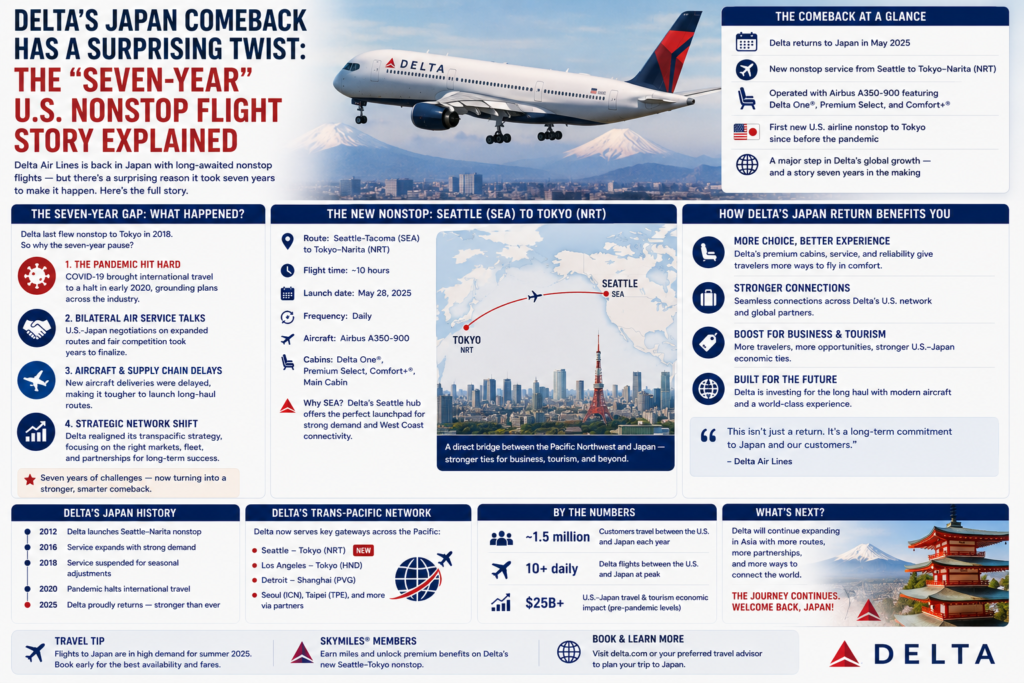
A Delta Air Lines announcement brought a long-absent transpacific market back into focus—but there is an important detail travelers should know. The seven-year gap involved Delta’s service to Taiwan via Tokyo Narita, not a new Delta nonstop flight between Narita and the United States. Here’s what actually happened, why Tokyo Narita mattered, and what it means for travelers planning U.S.-Asia trips.
For travelers who remember Delta Air Lines’ former Tokyo Narita hub, the airline’s return to parts of its old Asia-Pacific network has been a notable development.
But one headline circulating around this story can be misleading.
The original seven-year reference was connected to Delta’s return to Taiwan, rather than Delta launching a new nonstop service between Tokyo Narita International Airport and the United States.
That distinction matters.
Delta announced in December 2023 that it would launch a new nonstop service between Seattle-Tacoma International Airport and Taiwan Taoyuan International Airport, marking the airline’s first nonstop U.S.-Taiwan route. The service was scheduled to begin June 6, 2024, using Airbus A330-900neo aircraft. Delta had previously served Taipei, but that service ended in May 2017. Aviation Week+1
The reason Tokyo Narita appears prominently in the story is that Delta previously served Taipei through its Tokyo Narita operation.
In other words, Narita was an important part of Delta’s former Asia network—but the new Seattle-Taipei service was designed to eliminate the need for that Tokyo connection.
And there is another major piece of context: Delta subsequently moved its Tokyo operation away from Narita and into Tokyo Haneda, the airport much closer to central Tokyo.
Delta announced in 2019 that it planned to transfer its full U.S.-Tokyo operation from Narita to Haneda beginning in March 2020. Delta Professional+1
So for North American travelers, the real story is bigger than one flight.
It is the story of how Delta rebuilt its Pacific network after closing its Tokyo Narita hub, how Seattle became an increasingly important gateway to Asia, and how nonstop flights can change the way travelers plan long-haul trips.
What Actually Happened?
Delta announced on December 7, 2023, that it would launch nonstop service between Seattle-Tacoma International Airport (SEA) and Taiwan Taoyuan International Airport (TPE).
The service was scheduled to begin on June 6, 2024, and was planned as a daily, year-round operation.
The aircraft selected for the route was the Airbus A330-900neo.
According to Delta’s announcement, the aircraft configuration included:
- 28 Delta One seats
- 28 Delta Premium Select seats
- 56 Delta Comfort+ seats
- 168 Main Cabin seats
That gave the aircraft a total of 280 seats. Airways
For travelers, the importance of the announcement was straightforward.
Seattle already served as one of Delta’s major Pacific gateways.
Adding Taipei created another direct connection between the U.S. West Coast and East Asia.
It also strengthened Delta’s position in the Pacific at a time when the airline was rebuilding and reshaping its international network after the pandemic.
Why Was the “Seven Years” Figure Important?
Delta had previously served Taiwan.
But that service ended in May 2017.
According to aviation-industry reporting, Delta’s former Taipei service operated through Tokyo Narita, where the airline had developed a major Asia-Pacific hub. The Points Guy+1
That means the seven-year gap wasn’t simply about Delta disappearing from a generic Asia destination.
It represented a major change in how Delta connected North America with Taiwan.
Under the old model, Tokyo Narita was an important connecting point.
Under the new model, Seattle became the U.S. gateway.
That is a major difference.
Tokyo Narita Was Once Extremely Important to Delta
To understand why the story can be confusing, it helps to go back to Delta’s history in Japan.
Delta inherited a substantial Pacific network through its combination with Northwest Airlines.
Tokyo Narita became one of the airline’s most important international connecting points.
From Narita, Delta could connect passengers arriving from the United States to destinations throughout Asia.
That included places such as:
- Taipei
- Manila
- Singapore
- Seoul
- Bangkok
- Other destinations across the Asia-Pacific region
In the years following the Northwest merger, Narita served as an important bridge between North America and Asia.
But the aviation industry changed.
And Tokyo’s airport landscape changed with it.
Haneda Changed the Tokyo Equation
For many international travelers, Tokyo has two major airports:
Narita International Airport (NRT) and Haneda Airport (HND).
The airports serve the same broad metropolitan region, but they have very different geographic advantages.
Haneda is much closer to central Tokyo.
Narita is located in Chiba Prefecture, well outside central Tokyo.
SoraNews24 has previously explained the difference, noting that Narita can require considerably more time and expense to reach central Tokyo compared with Haneda. SoraNews24 —Japan News—
For travelers, airport location matters.
If you’re flying to Tokyo for business, tourism or a short visit, the time required to reach the city can significantly affect your trip.
That made Haneda increasingly attractive.
Delta Made a Major Strategic Decision
In 2019, Delta announced that it had received final approval from the U.S. Department of Transportation for a major expansion at Haneda.
The airline said it would become the largest U.S. carrier serving Haneda, with flights to several American cities.
Those included:
- Seattle
- Detroit
- Atlanta
- Honolulu
- Minneapolis/St. Paul
- Los Angeles
- Portland
Delta said it would transfer its full Tokyo operation from Narita to Haneda beginning in March 2020. DDelta Professional+1
This was a major strategic change.
Instead of using Narita as its primary Tokyo gateway, Delta would focus on Haneda.
That was intended to put its flights closer to Tokyo’s urban population and improve the convenience of its Tokyo service.
Then the Pandemic Changed Everything
The timing could hardly have been more dramatic.
Delta’s planned Tokyo network transition coincided with the emergence of COVID-19.
International aviation experienced an unprecedented disruption.
Borders closed.
Passenger demand collapsed.
Airlines suspended routes.
Schedules changed repeatedly.
The aviation industry that existed in early 2020 looked completely different from the industry that emerged several years later.
Delta’s Tokyo strategy ultimately became part of a much larger restructuring of the airline’s Asia-Pacific network.
Instead of rebuilding its former Narita hub, Delta increasingly focused on other strategic gateways.
One of the most important became Seoul-Incheon.
Seattle Became a Critical Piece of Delta’s Pacific Strategy
Seattle is naturally positioned for flights across the Pacific.
The city has a strong technology and business economy and is geographically well positioned for service to Asia.
Delta has invested heavily in Seattle as an international gateway.
That makes Seattle an obvious location for a direct Taipei route.
Instead of flying:
United States → Tokyo → Taipei
travelers could fly:
Seattle → Taipei
That eliminates a connection.
And eliminating a connection can make a huge difference on a long international journey.
Why Nonstop Flights Matter So Much
For travelers, nonstop service offers several practical advantages.
Less time spent in airports
A connecting itinerary requires passengers to leave one aircraft and transfer to another.
A nonstop flight eliminates that step.
Fewer opportunities for missed connections
If you have two flights, the first delay can affect the second.
With a nonstop flight, that particular connection risk disappears.
Simpler luggage logistics
Depending on the itinerary, baggage handling can be more complicated when multiple flights and airlines are involved.
A nonstop journey is generally simpler.
More convenient for business travelers
Business travelers often value time.
A nonstop flight can eliminate several hours of connection time.
Better for travelers who dislike airports
Some passengers simply prefer boarding once and staying aboard until reaching their destination.
For a long Pacific journey, that can be a major advantage.
The Airbus A330-900neo Was an Important Part of the Route
Delta selected the Airbus A330-900neo for the Seattle-Taipei service.
The aircraft is a modern wide-body designed for long-haul international operations.
Delta’s configuration includes multiple cabin products.
Delta One
This is Delta’s premium business-class cabin on long-haul routes.
On the A330-900neo, Delta One is arranged in a premium configuration intended for long-distance travel.
Premium Select
Premium Select sits between Delta One and the airline’s economy products.
It provides travelers with a larger seat and additional space compared with Main Cabin.
Comfort+
Delta Comfort+ offers additional legroom and other benefits compared with standard Main Cabin seating.
Main Cabin
The standard economy product remains the most accessible cabin for many travelers.
This multi-cabin configuration gives Delta several ways to sell the same long-haul route to different types of passengers.
Why Taiwan Is Important for U.S. Travelers
Taiwan is an important destination for both leisure and business travel.
Taipei is a major Asian city with a strong technology sector, international business connections, cultural attractions and a well-developed transportation network.
For American travelers, direct access can be particularly useful.
The Seattle-Taipei route connects the U.S. Pacific Northwest directly with one of East Asia’s major economic centers.
It also provides opportunities for onward travel within Asia.
Delta Wasn’t Simply Returning to Its Old Network
It would be easy to interpret the announcement as Delta simply bringing back the exact same network it had before.
That’s not what happened.
The airline’s post-pandemic strategy is substantially different.
The old system relied heavily on Tokyo Narita as a connecting hub.
The newer system relies more heavily on strategically positioned gateways such as Seattle and Seoul.
That reflects a broader shift in the airline industry.
Airlines increasingly favor nonstop routes that connect major origin-and-destination markets rather than relying exclusively on large connecting hubs.
What Happened to Delta’s Narita Hub?
Delta eventually abandoned Narita as a hub.
The airline’s 2019 plan had already called for its U.S.-Tokyo flights to move to Haneda.
Industry reporting later noted that Delta had completely left Narita by March 2020. The Points Guy
That is why describing a new Delta U.S.-Narita nonstop route as the “first” or “new” service would be inaccurate.
Delta’s current Tokyo strategy is centered on Haneda, not Narita.
Delta’s current Tokyo information highlights flights from Haneda to the U.S. and lists Honolulu among its featured destinations. Delta
So Is Delta Flying Between Narita and the U.S.?
Travelers should check the current schedule for their exact dates, but the key historical point is clear:
Delta moved its U.S.-Tokyo operation from Narita to Haneda.
The airline’s 2019 announcement explicitly stated that the full operation would be transferred. DDelta Professional
Therefore, travelers should not interpret the seven-year Taiwan story as an announcement of a new Delta Narita-to-U.S. route.
If you’re searching for Delta’s Tokyo service, Haneda is the airport to pay attention to.
Why This Matters When Booking a Trip
Airport codes can be easy to overlook when you’re purchasing an international ticket.
A traveler may search for “Tokyo” without realizing that Tokyo has multiple airports.
That can lead to an itinerary that isn’t what they expected.
For example:
NRT = Tokyo Narita
HND = Tokyo Haneda
The distinction matters.
If your hotel is in central Tokyo, the airport you arrive at can affect how long it takes to reach your accommodation.
It can also matter when you’re connecting to another flight.
A traveler who arrives at Narita but needs to depart from Haneda may have to make a lengthy airport transfer.
That’s why passengers should check airport codes carefully before finalizing an itinerary.
The New Seattle-Taipei Route Was About More Than Convenience
Delta’s new route also reflected the airline’s broader effort to strengthen its position in the Asia-Pacific market.
Delta described the Seattle-Taipei service as part of its expansion in the region.
The airline said the route would become its seventh nonstop international market in the Pacific from Seattle. AirlineGeeks.com
That is significant because Seattle gives Delta a platform for connecting travelers from across the United States.
A passenger from another U.S. city may be able to connect through Seattle before continuing nonstop to Taipei.
That makes the route relevant beyond the Pacific Northwest.
What About Travelers From the East Coast?
For travelers based in New York, Boston, Miami, Washington, D.C., Chicago or other eastern U.S. cities, Seattle may not be the most geographically direct gateway to Asia.
But the route can still be useful.
Airline networks allow passengers to connect through hubs.
A traveler could potentially fly:
New York → Seattle → Taipei
rather than:
New York → another U.S. hub → another Asian hub → Taipei
The attractiveness of the itinerary depends on schedule, price, connection time and availability.
This is why travelers should compare the complete itinerary rather than looking only at the first flight.
The Bigger Competition in the Pacific
Delta is not the only airline competing for U.S.-Asia travelers.
American, United and multiple Asian airlines operate extensive transpacific networks.
Travelers can choose among different gateways and connecting cities.
For a traveler headed to Taiwan, possibilities may include:
- Nonstop service
- Connections through Japan
- Connections through South Korea
- Connections through other Asian hubs
- Connections through U.S. gateways
The best itinerary depends on the passenger’s departure city and destination.
A West Coast traveler may value a nonstop flight more than someone on the East Coast.
A business traveler may prioritize schedule.
A family may prioritize price and baggage allowances.
A frequent flyer may prioritize loyalty benefits.
Delta’s Current Asia Network Continues to Evolve
The Seattle-Taipei story should also be viewed within Delta’s larger Asia-Pacific strategy.
Delta has continued expanding its international network in 2026.
For example, the airline announced plans for additional Hawaii flying, including new Minneapolis-St. Paul–Maui service and the return of Boston–Honolulu service beginning December 19, 2026. Delta News Hub
The airline has also continued adjusting its pricing and fuel-surcharge structure for tickets originating in Japan.
Delta’s current published information says that, for tickets issued on or after July 1, 2026, the one-way fuel surcharge from Japan to North America and Central/South America is JPY 65,000, while the Japan-Hawaii amount is JPY 40,400. Delta
Those figures can change as Delta reviews Japan-origin fuel surcharges.
This illustrates an important point for travelers:
International airline schedules and pricing are constantly changing.
A route announced several years ago may not operate with exactly the same frequency, aircraft or price today.
What American Travelers Should Check Before Booking Japan or Taiwan Flights
If you’re planning a trip across the Pacific, there are several things worth checking before purchasing.
1. Check the airport code
Don’t simply search “Tokyo.”
Confirm whether your itinerary uses:
NRT or HND.
2. Look for nonstop options
If avoiding connections is important, search specifically for nonstop flights.
3. Compare the complete itinerary
A lower fare may involve a much longer journey.
4. Check connection times
A very short connection can be risky.
A very long connection can make a cheap ticket less attractive.
5. Check the operating carrier
A ticket sold by one airline may involve another airline operating one or more segments.
6. Check baggage rules
International itineraries can have different baggage policies depending on fare and operating carrier.
7. Check your return flight
Don’t focus only on the outbound journey.
The return itinerary may have different schedules and connection times.
What If Your Flight Changes?
International travel plans can change for many reasons.
An airline can modify a schedule.
A flight can be delayed.
A connection can become impossible.
A traveler may need to move the trip to a different date.
A passenger may need to cancel.
In these situations, travelers should review the rules associated with their specific ticket.
If your itinerary was booked through a travel agency or another travel provider, that provider may also need to handle changes.
Need Help Booking or Changing a Flight?
For travelers who need assistance with common flight requirements, customer support is available at:
📞 1-877-730-2630
Travelers can call for help with:
- Booking a flight
- Canceling a flight ticket
- Rebooking a flight
- Rescheduling travel
- Flight ticket changes
- Upgrade requests
- Checking flight status
- Other travel requirements
If you’re checking the status of a specific flight, have the flight number, travel date and booking details available when you call.
The number above is the customer-service number provided for this article and is not represented as Delta Air Lines’ official telephone number.
For Delta’s official information, schedules, fares and policies, travelers should use Delta’s official website.
Delta Air Lines official website
Why the Narita Detail Still Matters
At first glance, the distinction between Narita and Haneda may seem like a technical detail.
It isn’t.
Tokyo’s airport situation tells the story of how international aviation has changed.
For decades, Narita was the main international gateway for Tokyo.
Then Haneda expanded its international operations.
Airlines began shifting flights closer to central Tokyo.
Delta ultimately moved its Tokyo operation to Haneda.
And as the airline rebuilt its Asia network, it increasingly focused on direct U.S.-Asia routes and other strategic hubs.
So the Narita reference provides historical context for understanding Delta’s modern network.
From Narita to Haneda: A Major Change in Strategy
Delta’s history in Tokyo can be summarized in three stages.
Stage 1: Narita hub
Delta used Narita as a major connecting point for flights between the U.S. and Asia.
Stage 2: Haneda expansion
As Haneda received more international slots, Delta shifted its Tokyo strategy toward the airport closer to central Tokyo.
Stage 3: Post-pandemic network restructuring
Rather than rebuilding the old Narita hub, Delta developed a broader network centered around gateways such as Seattle, Seoul and Haneda.
The Seattle-Taipei route fits into that third phase.
The Passenger Experience Is Changing Too
Modern international travelers have more choices than ever.
A passenger can compare dozens of possible itineraries from a phone.
They can select cabins.
They can monitor flight status.
They can receive schedule notifications.
They can make certain changes online.
But more choice also creates more complexity.
Two flights to the same destination may have very different:
- Connection times
- Airports
- Aircraft
- Cabin configurations
- Baggage policies
- Prices
- Loyalty benefits
- Cancellation conditions
That makes it increasingly important to look beyond the headline price.
Is a Nonstop Flight Always Better?
Not necessarily.
Nonstop service is usually convenient, but it may cost more.
A one-stop itinerary might be significantly cheaper.
Another itinerary might have a more convenient departure time.
A traveler may also prefer a particular airline because of loyalty status.
For some passengers, paying extra for nonstop service is worthwhile.
For others, saving money is more important.
There is no universal answer.
The right choice depends on the traveler.
What Made Delta’s Seattle-Taipei Service Significant?
The significance can be summarized in four points.
First: It restored Delta’s presence in Taiwan
The airline had been absent from Taiwan since 2017.
Second: It created a U.S.-Taiwan nonstop
Seattle became the U.S. gateway for Delta’s direct Taiwan service.
Third: It reduced dependence on Tokyo connections
Passengers no longer needed to rely on the old Narita-based Delta model to reach Taipei.
Fourth: It reinforced Seattle’s role as a Pacific gateway
The route fit into Delta’s broader international strategy from Seattle.
The Seven-Year Gap Was a Sign of How Much Aviation Had Changed
When Delta ended its Taiwan service in 2017, the airline’s Asia network looked very different.
At that time, Narita still played a significant role.
By the time Delta announced the Seattle-Taipei route in 2023, the airline had moved away from that model.
The new service therefore represented more than simply restarting an old destination.
It was a new way of serving the market.
That is why the “seven-year” figure is meaningful.
It marks the time since Delta last served Taiwan, but it also illustrates the transformation of Delta’s Pacific network.
What Travelers Should Take Away
If you’re a North American traveler planning a trip to Japan, Taiwan or another Asian destination, the main lesson is to check the current route and airport rather than relying on older information.
Delta’s network has changed significantly since the days when Narita functioned as a major Delta hub.
The airline’s own 2019 announcement made clear that it intended to move its Tokyo U.S. services to Haneda. DDelta Professional
The later Seattle-Taipei announcement represented a different development: a new nonstop U.S.-Taiwan connection after a seven-year absence. AirlineGeeks.com
That distinction helps travelers understand what they are actually booking.
Final Verdict: A Major Delta Asia Expansion—But Not a New Narita-U.S. Route
The headline “Delta Airlines adds first nonstop flight between Japan’s Narita Airport and U.S. in seven years” needs clarification to avoid changing the underlying facts.
The seven-year return involved Taiwan, not a new Narita-U.S. Delta route.
Delta announced in 2023 that it would launch nonstop Seattle-Taipei service, beginning June 6, 2024. The airline had last served Taiwan in May 2017, when its Taipei operation was connected with its Tokyo Narita network. Aviation Week+1
Meanwhile, Delta had already decided to transfer its U.S.-Tokyo services from Narita to Haneda, with the move planned for March 2020. DDelta Professional+1
That makes the real story more interesting than the simplified headline.
Delta didn’t simply bring back an old Narita route. It rebuilt part of its Pacific strategy around new nonstop connections.
For travelers, the result is more choice—but also a greater need to check airport codes, schedules, fare rules and connection details before booking.
And if your plans involve a flight booking, cancellation, rebooking, rescheduling, upgrade or flight-status check, you can call:
📞 1-877-730-2630
Keep your reservation information available so the relevant itinerary can be reviewed.
Original News Source & Credit
The requested topic appears to conflate two separate facts. The underlying seven-year story concerns Delta’s return to Taiwan, while Narita was the former Tokyo gateway through which Delta served Taipei.
For source credit, the most relevant aviation coverage is:
The Points Guy — “Delta unveils service to Taiwan for the 1st time in 7 years”
The report explains that Delta had not served Taiwan since May 2017 and that its former Taipei service operated through Tokyo Narita. The Points Guy
Read The Points Guy’s original report
Aviation Week — “Delta To Launch First Nonstop U.S.-Taiwan Service”
The report covers Delta’s planned Seattle-Taipei nonstop service and the airline’s previous Taiwan operation via Tokyo Narita. Aviation Week
Read Aviation Week’s original report
Delta Air Lines — Official announcement concerning its Tokyo Haneda expansion
Delta’s own announcement confirms the planned transfer of its U.S.-Tokyo operation from Narita to Haneda. DDelta Professional
Read Delta’s official Tokyo network announcement
SoraNews24 also covered Delta’s post-pandemic expansion of U.S.-Japan flying, including the resumption of Haneda-Los Angeles service and the launch of Haneda-Honolulu service. SoraNews24 —Japan News—
Read SoraNews24’s Delta Japan coverage
Editorial accuracy note
This article deliberately does not repeat the requested headline as a factual statement, because doing so would incorrectly suggest that Delta launched a new U.S.-Narita nonstop route after seven years. The underlying reporting supports a different story: Delta returned to Taiwan with a new Seattle-Taipei nonstop after a seven-year absence, while Narita was part of the airline’s former Taiwan connection and former Tokyo hub strategy.