Travelers returning to the United States from areas affected by the 2026 Ebola outbreak may face enhanced screening and health monitoring. Here are the CDC’s current recommendations, the symptoms to watch for, and what to do if you become sick after travel.
Need help with your flight? Call 1-877-730-2630 for assistance with booking, canceling, rebooking, rescheduling, upgrading, or checking flight status.
International travel can be exciting, but returning home after traveling through an area experiencing an infectious-disease outbreak can raise important questions.
What happens when you arrive at a U.S. airport?
Do you need to monitor your health?
How long should you watch for symptoms?
Can you continue with your normal activities?
And what should you do if you develop a fever or other symptoms after returning home?
The Centers for Disease Control and Prevention (CDC) currently has specific guidance for travelers arriving in the United States after being in countries affected by the 2026 Ebola outbreak.
The current outbreak involves Bundibugyo virus disease, a type of Ebola disease, in parts of Central and East Africa. CDC identifies the Democratic Republic of the Congo (DRC) and Uganda as countries affected by the current outbreak response and includes South Sudan in its traveler-management guidance because of its proximity and substantial cross-border travel with the DRC. CDC+1
For travelers, the most important message is straightforward:
If you recently traveled through an affected country, pay attention to CDC and public-health instructions, monitor your health for the recommended period, and seek guidance immediately if symptoms develop.
CDC currently says that the overall risk to the U.S. public and travelers remains low. CDC
Here is what travelers should know.
What Is Happening With Ebola Right Now?
CDC is responding to an outbreak of Ebola disease caused by Bundibugyo virus in affected areas of the Democratic Republic of the Congo and Uganda.
The current outbreak is not the same virus species associated with every previous Ebola outbreak.
CDC’s current public-health guidance identifies Bundibugyo virus disease as a viral hemorrhagic fever caused by infection with Bundibugyo virus. The agency says it is a serious and potentially deadly disease, while also noting that early supportive care improves the chance of survival. CDC
As of CDC’s June 11, 2026 update, no cases associated with this outbreak had been confirmed in the United States, and CDC said the overall risk to the American public and travelers remained low. CDC
That distinction is important.
Travelers should take public-health instructions seriously, but they should not interpret enhanced screening as evidence that ordinary travel within the United States has suddenly become dangerous.
Which Countries Are Included in the Current U.S. Traveler Guidance?
CDC’s current guidance identifies three countries for the U.S. traveler-management response:
- Democratic Republic of the Congo
- Uganda
- South Sudan
However, CDC distinguishes between affected countries and specific areas of concern.
For the current response, CDC identifies:
Entire DRC as an area of concern.
Kampala, Uganda as an area of concern.
For South Sudan, CDC says no specific area of concern has been identified, but travelers from South Sudan are included because the country borders the DRC and there is significant travel across the shared border. CDC
That means travelers should not assume that every person who simply passed through one of these countries has exactly the same follow-up requirements.
Where you traveled within the country and what you did there can matter.
How Long Should You Monitor Your Health?
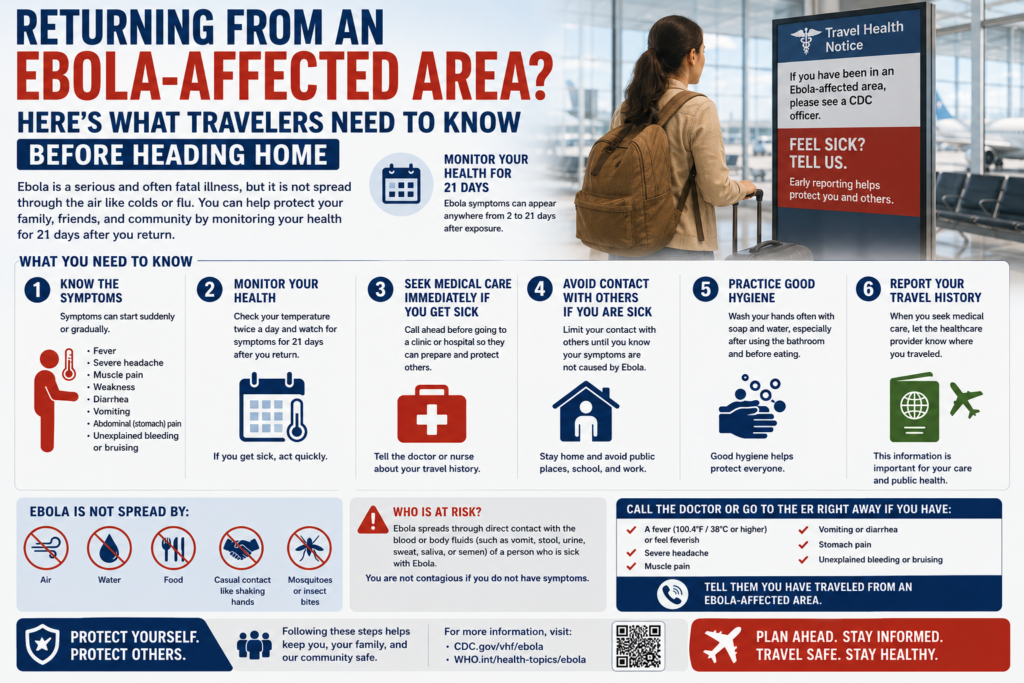
CDC’s current traveler guidance says people traveling to the United States from DRC, Uganda or South Sudan should watch their health for 21 days after leaving the country. CDC
The 21-day period is particularly important because symptoms can develop after a person has left an affected area.
If you were in an area CDC identifies as an area of concern, the agency recommends taking your temperature every day and again if you feel sick.
If you were in one of the affected countries but not in an area of concern, CDC recommends taking your temperature if you feel sick. CDC
The practical lesson for travelers is simple:
Don’t stop paying attention to your health the moment you land.
Keep monitoring during the recommended 21-day period.
What Symptoms Should Travelers Watch For?
CDC says travelers should watch for symptoms that can include:
- Fever of 100.4°F (38°C) or higher
- Feeling feverish
- Headache
- Body aches
- Rash
- Weakness or tiredness
- Sore throat
- Diarrhea
- Vomiting
- Stomach pain
- Unexplained bleeding or bruising
Unexplained bleeding or bruising is described by CDC as a late-stage symptom. CDC
These symptoms are not unique to Ebola.
A traveler returning from Central or East Africa could become sick with many other conditions.
In fact, CDC’s clinical guidance emphasizes that most ill travelers returning from areas with active Ebola outbreaks or areas where Ebola disease is endemic are usually sick with more common infections, such as malaria. CDC
That is one reason travelers shouldn’t try to diagnose themselves based on a symptom list.
The important information for a healthcare professional is the combination of:
Symptoms + recent travel + possible exposure.
What Should You Do If You Become Sick After Returning?
This is arguably the most important part of the guidance.
If you develop signs or symptoms that could be consistent with Ebola disease after returning from an affected area, CDC advises travelers to:
Separate themselves from other people.
Call their local health department for advice about medical care.
Tell the health department about their recent travel and symptoms.
Follow the instructions they receive.
CDC specifically advises people who develop symptoms not to travel while sick and to travel only after being cleared by a doctor or health official. CDC
This is important because showing up unexpectedly at a healthcare facility without advance notification can make it harder for medical staff to prepare appropriately.
Calling ahead allows public-health and healthcare personnel to determine the appropriate next step.
Why Should You Call Before Going to a Healthcare Facility?
If you’ve recently traveled from a country experiencing an Ebola outbreak and develop concerning symptoms, don’t simply walk into an emergency department without telling anyone about the travel history.
CDC recommends contacting public-health authorities first when possible.
The health department can help determine where and how you should receive medical evaluation.
If you cannot reach your health department immediately and need urgent medical attention, CDC says to contact a healthcare provider, explain your symptoms and tell them about your recent travel from a country with an Ebola outbreak. Calling ahead helps the healthcare facility prepare for your arrival and take appropriate precautions. CDC
The objective is not to frighten travelers.
It is to make sure that healthcare professionals have the information they need before a potentially infectious patient arrives.
Does Simply Traveling From an Affected Country Mean You Have Ebola?
No.
CDC makes an important distinction between travel history and exposure risk.
Simply having traveled to an affected country is not, by itself, proof that someone has been exposed to Ebola.
CDC’s interim guidance specifically says that travel itself is not an epidemiologic risk factor for Bundibugyo virus disease. Public-health officials assess additional factors, including where the traveler went and whether they experienced situations that could have involved exposure. CDC
Those factors can include contact with a sick person, certain healthcare activities, funeral or burial activities, and contact with animals or animal body fluids.
So a traveler who spent time in an affected country but had no relevant exposure is not automatically considered infected.
What Counts as a Potential Exposure?
CDC’s current public-health guidance identifies a number of situations that may have exposure potential.
These include:
Contact with someone who has an acute febrile illness
Close interaction with someone who is acutely sick may be relevant to the exposure assessment.
Visiting a healthcare facility
Travelers who visited healthcare facilities or traditional healers in an area of concern may receive additional assessment.
Attending a funeral or burial
Certain funeral and burial activities can involve exposure to infected body fluids.
Contact with bats or nonhuman primates
CDC identifies potential exposure involving bats, bat urine or droppings, nonhuman primates, or their blood, body fluids or raw meat.
Entering caves or mines known to be inhabited by bats can also be relevant. CDC
Occupational exposures can also matter.
Healthcare workers, laboratory personnel, burial workers and others who worked in environments where exposure was possible may require a different assessment.
What Happens When Certain Travelers Arrive in the United States?
CDC and other federal agencies introduced enhanced public-health screening and other measures during the current outbreak response.
Travelers arriving from affected countries may undergo public-health entry screening.
CDC says travelers may be:
- Escorted to a designated screening area
- Asked questions about their travel history and symptoms
- Checked for fever using non-contact thermometers
- Observed for signs of illness by CDC staff CDC
These measures are intended to identify travelers who may need additional public-health assessment.
For travelers who are healthy and have no high-risk exposure, the process does not necessarily mean they will be placed in isolation or prevented from continuing normal activities.
CDC’s interim guidance states that asymptomatic travelers without high-risk exposures generally have no movement restrictions under the federal recommendations. CDC
State, tribal, local and territorial health authorities can choose to implement measures that provide a greater level of public-health protection than federal guidance.
Which U.S. Airports Are Involved?
CDC’s May 28 traveler information listed four U.S. airports designated for affected travelers under the enhanced screening and routing measures:
- Washington Dulles International Airport (IAD)
- Hartsfield-Jackson Atlanta International Airport (ATL)
- George Bush Intercontinental Airport (IAH)
- John F. Kennedy International Airport (JFK) CDC
Airlines work with affected travelers to rebook flights when routing requirements apply.
Travelers should therefore pay close attention to airline communications if their itinerary involves one of the countries covered by the current response.
A flight may not operate exactly as originally booked.
Could Your Flight Be Rebooked?
Possibly.
CDC’s current traveler information says affected travelers may have their air travel rerouted so they arrive at designated U.S. airports for public-health screening. Airlines are responsible for working with affected travelers on rebooking. CDC
This is an important distinction for travelers.
A routing change in this situation may be the result of a federal public-health measure rather than an ordinary airline schedule change.
If your itinerary changes, save every notification you receive.
Keep your:
- Original itinerary
- New itinerary
- Airline emails
- Text messages
- Boarding passes
- Reservation number
- Rebooking information
That documentation can be useful if you need to clarify your itinerary later.
What Happens During Public-Health Screening?
CDC says travelers may be asked about their recent travel and health.
Screening can include a questionnaire and temperature measurement.
Travelers may also be observed for signs of illness. CDC
If additional assessment is necessary, public-health officials can determine the appropriate next steps.
The process is designed to identify travelers who may require additional monitoring or evaluation.
It is not a diagnosis.
What Happens After You Arrive Home?
For travelers covered by the current guidance, public-health authorities may follow up during the 21 days after departure from an affected country.
CDC’s interim guidance says monitoring can take place by:
- Telephone
- Video conference
- Text message
- App
- Web form
- In-person contact
The frequency depends on the traveler’s exposure assessment and circumstances. CDC
Travelers who were in an area of concern and had no high-risk exposure are advised to self-monitor, including daily temperature measurement, and notify their health department if symptoms develop during the 21-day period. CDC
Can You Travel Again During the 21-Day Period?
This is a situation where travelers should not simply make their own assumptions.
CDC’s guidance says travelers who plan to travel outside their jurisdiction should notify the relevant health department in advance.
Public-health authorities may coordinate with the destination jurisdiction depending on the circumstances. CDC
So if you’re planning another domestic trip shortly after returning from an affected area, contact the health department handling your monitoring before making the trip.
If you’re planning international travel, additional coordination may be necessary.
Are Travelers Automatically Quarantined?
Not necessarily.
CDC’s interim guidance for asymptomatic travelers with no identified high-risk exposures does not recommend movement restrictions as part of the general federal approach. CDC
The response is instead based on risk assessment.
That means two travelers who visited the same country might receive different follow-up recommendations if their activities and potential exposures were different.
For example, someone who worked in an Ebola treatment unit may have a substantially different exposure assessment from someone who stayed in a hotel and visited tourist attractions.
What If You Worked in Healthcare During Your Trip?
Healthcare workers and other occupational travelers should take their exposure history seriously.
CDC identifies healthcare work, environmental cleaning, waste handling, laboratory work and burial activities among situations that can involve potential exposure. CDC
Healthcare workers returning to the United States may receive specific monitoring arrangements through public-health or occupational-health programs.
If you worked with patients suspected or confirmed to have Ebola disease, tell public-health authorities exactly what you did, what protective equipment you used and whether any exposure occurred.
Don’t assume that “I wore PPE” automatically eliminates the need for an assessment.
Public-health officials will evaluate the circumstances.
What If You Had Contact With an Infected Person?
Tell the health department.
High-risk exposure requires a different level of assessment from ordinary travel.
CDC’s public-health guidance specifically directs health departments to use separate guidance for people with high-risk exposures or suspected or confirmed Bundibugyo virus disease. CDC
If you believe you may have had direct contact with an infected person’s body fluids or another high-risk exposure, don’t wait for symptoms before informing public-health officials.
The sooner they know about a potential exposure, the sooner they can determine appropriate monitoring and care.
What If You Feel Fine?
That’s good—but continue following the applicable guidance.
A person can feel completely well after arriving home.
CDC nevertheless recommends that travelers from affected countries watch their health for the specified 21-day period. CDC
If you were in an area of concern, daily temperature monitoring is recommended.
Being symptom-free does not mean you should ignore the public-health instructions you were given.
Don’t Diagnose Yourself With Ebola
A fever after international travel can have many causes.
CDC specifically notes that malaria and other more common infections are often responsible for illness among travelers returning from areas where Ebola is present. CDC
That’s why medical professionals need the complete picture.
If you become ill, tell them:
Where you traveled.
When you left the affected area.
Where you stayed.
What activities you participated in.
Whether you had contact with sick people.
Whether you visited healthcare facilities.
Whether you had animal exposures.
Whether you attended funerals or burials.
This information can help public-health and healthcare professionals determine what illnesses and exposures should be considered.
What Is the Current Risk to Americans?
According to CDC’s June 11, 2026 update, the overall risk to the American public and travelers remains low. CDC also reported that no cases associated with the current outbreak had been confirmed in the United States at that time. CDC
That is reassuring.
However, the situation remains dynamic.
CDC describes the outbreak as evolving and continues to update its travel and public-health guidance. CDC+1
Travelers should therefore check current CDC information before and after international travel rather than relying on an old article, social-media post or message from another traveler.
What Travelers Should Do Before Flying Home
If you’ve been traveling in an affected region, preparation can make the return journey easier.
Keep your travel records
Know the dates and locations of your recent travel.
Know where you stayed
Keep hotel and itinerary information accessible.
Remember your activities
Think about whether you visited healthcare facilities, attended funerals, worked in healthcare or had animal contact.
Monitor your health
Follow CDC’s recommended 21-day monitoring period.
Keep your temperature information available
If daily monitoring is recommended for your circumstances, record it consistently.
Know whom to contact
Follow the instructions provided by public-health officials.
Don’t travel while sick
If symptoms develop, contact public-health authorities and follow their instructions.
What If Your Return Flight Is Changed?
Public-health measures can result in flight rerouting or rebooking.
If your airline contacts you about a change:
- Read the notification carefully.
- Confirm the new itinerary.
- Save the original itinerary.
- Save the new confirmation.
- Check your connection times.
- Confirm baggage arrangements.
- Contact the airline or booking provider if the new itinerary creates a problem.
If you need help with a reservation, customers can call:
1-877-730-2630
Assistance is available for booking, canceling, rebooking, rescheduling, upgrading, and checking flight status.
Keep your reservation information available when calling.
What If You Need to Cancel or Reschedule?
Health concerns should take priority over travel plans.
If public-health officials instruct you not to travel, follow those instructions.
For ordinary reservation assistance, customers can call 1-877-730-2630 for help with booking, cancellation, rebooking, rescheduling or other flight-related requests.
Airline rules, fare conditions, availability and fees vary.
If your itinerary has been changed because of a government public-health measure, explain that when discussing your reservation so the representative can review the circumstances.
The Most Important Rule: Don’t Travel While Sick
If symptoms develop during the 21-day monitoring period, CDC says travelers should isolate themselves from others, contact their local health department and follow instructions about medical evaluation. CDC
Do not simply board another flight and hope that the symptoms disappear.
Do not assume a fever is “just jet lag.”
Do not visit a healthcare facility without explaining your recent travel if you are unable to reach public-health officials first.
And do not wait until you’re standing at the airport to disclose your symptoms.
Calling ahead gives public-health and healthcare professionals the opportunity to determine the safest next step.
A Quick Checklist for Returning Travelers
If you recently traveled from an area covered by CDC’s current Ebola guidance, keep this checklist handy:
✔ Watch your health for 21 days after leaving the affected country.
✔ If you were in an area of concern, monitor your temperature daily.
✔ Know the symptoms to watch for.
✔ If symptoms develop, separate yourself from others.
✔ Contact your local health department.
✔ Tell healthcare professionals about your recent travel.
✔ Don’t travel while sick.
✔ Follow public-health instructions about monitoring and additional travel.
✔ Keep your travel and reservation documents.
✔ Check CDC’s latest guidance because the outbreak response can change.
The Bottom Line for Travelers
The current Ebola outbreak requires attention, but travelers should also keep the risk in perspective.
CDC says the overall risk to the U.S. public and travelers remains low, and no U.S. cases associated with the current outbreak had been confirmed as of June 11, 2026. CDC
At the same time, travelers returning from DRC, Uganda or South Sudan may be subject to enhanced public-health screening and follow-up measures.
The most important step is to know where you traveled and whether you had any potential exposure.
If you traveled through an area of concern, follow the recommended health-monitoring instructions.
If you develop symptoms, don’t travel.
Separate yourself from others and contact public-health authorities for guidance.
And remember that many illnesses can cause fever, fatigue, stomach problems or other symptoms after international travel. Ebola is not the only possibility, which is why professional assessment matters.
The best response isn’t panic.
It’s preparation.
Know the current guidance.
Monitor your health.
Keep your travel records.
And tell healthcare and public-health professionals about your recent travel if you become sick.
Need Help With Your Flight?
If your travel plans have been affected and you need assistance with your reservation, call:
1-877-730-2630
Customers can call for assistance with:
- Booking
- Canceling
- Rebooking
- Rescheduling
- Flight upgrades
- Checking flight status
Have your confirmation number, itinerary and travel dates available when calling.
Flight availability, airline policies, fare conditions and fees can vary.
For flight assistance, call 1-877-730-2630.
Source Credit and Medical Disclaimer
This article is an independently written travel-information guide based on the Centers for Disease Control and Prevention (CDC) guidance titled “Information for Travelers Returning from Ebola-Affected Areas” and CDC’s related current guidance on what travelers should do after travel. The CDC pages used for this article were updated in May and June 2026. CDC+1
Additional facts were checked against CDC’s current interim guidance for U.S. health departments managing travelers from countries affected by the 2026 outbreak. CDC
This article is not affiliated with, sponsored by, or endorsed by the CDC.
Important: This is general travel information, not medical advice. Ebola-related guidance can change as the outbreak develops. Travelers should consult current CDC guidance and their state or local health department for instructions applicable to their individual circumstances. If you develop concerning symptoms after travel, contact public-health or medical professionals and disclose your recent travel history.