
Published: August 12, 2026
A layover can be one of the most confusing parts of air travel.
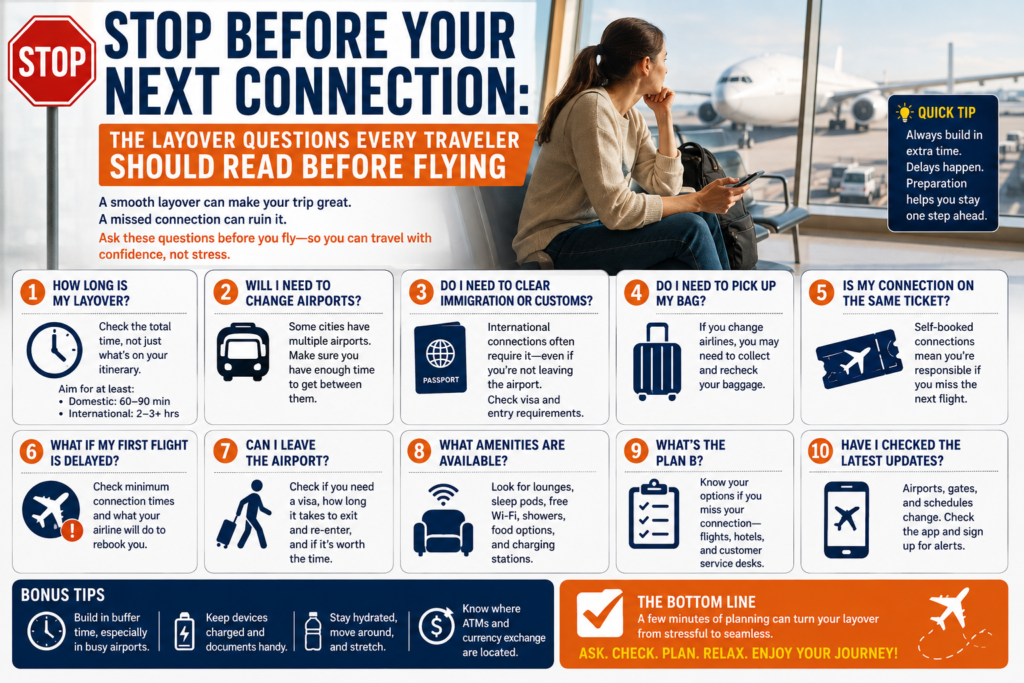
Is a two-hour connection enough? Do you have to go through security again? What happens to checked luggage? Can you leave the airport during a long layover? What if your first flight is delayed and you miss the second one?
These questions become even more complicated when an itinerary involves an international connection, separate tickets or a change of airport.
The good news is that most layover problems can be avoided by understanding how connections work before you begin your trip.
There is no universal layover rule that applies to every airport or itinerary. Connection requirements can depend on the airport, airline, ticket type, whether you’re traveling domestically or internationally, whether your bags are checked through, and whether you are connecting on one reservation or separate tickets.
This guide answers the most important layover questions and explains what travelers should check before booking.
Important notice: Airport procedures, immigration requirements, baggage rules and airline policies can change. Always verify the requirements for your specific itinerary with the airline and relevant airport or government authorities before traveling.
What Is a Layover?
A layover is the period between two flights when you temporarily stop at an airport before continuing to your destination.
For example:
New York → Chicago → Los Angeles
If your flight from New York arrives in Chicago at 2:00 p.m. and your connecting flight to Los Angeles departs at 4:00 p.m., you have a two-hour layover.
The layover is different from the actual flight time.
Your total journey includes:
First flight + layover + second flight
Layovers can be short or long.
A short connection might give you only 45 minutes to reach the next gate.
A long layover might last several hours—or even overnight.
Is a Layover the Same as a Stopover?
Not necessarily.
The terms are sometimes used differently by airlines and travelers, but generally a layover is a relatively short stop between flights, while a stopover usually refers to a longer planned stay at an intermediate destination.
The exact definitions can vary by airline and ticketing rules.
If your itinerary gives you a long period between flights, check how the airline classifies it and whether your fare rules impose any restrictions.
How Long Should a Layover Be?
There is no single perfect layover length.
The right amount of time depends on the airport and itinerary.
A domestic connection at a familiar airport may be relatively straightforward.
An international connection can involve additional procedures.
Factors that can affect your required connection time include:
- Airport size.
- Terminal layout.
- Whether you need to change terminals.
- Security requirements.
- Immigration or customs.
- Baggage procedures.
- Airline policies.
- Whether the flights are on one reservation.
- Whether the first flight is likely to experience delays.
- Whether you have special mobility requirements.
A connection that looks comfortable on a booking website may feel very different when you actually have to walk across a large airport.
What Is a Minimum Connection Time?
Airlines and airports use Minimum Connection Time (MCT) standards to determine how much time is generally required to make a particular connection.
The MCT can differ depending on:
- Domestic-to-domestic connections.
- Domestic-to-international connections.
- International-to-domestic connections.
- International-to-international connections.
- Terminal changes.
- Airline combinations.
If an airline sells a connecting itinerary as one ticket, the booking system generally takes applicable connection requirements into account.
But that doesn’t mean the connection is guaranteed to be stress-free.
A connection can still fail because of a delayed first flight, a long security line, weather or other operational problems.
Is a One-Hour Layover Enough?
Sometimes.
But whether it is enough depends heavily on the airport and itinerary.
A one-hour domestic connection at a compact airport may be manageable.
A one-hour connection requiring a terminal transfer, security screening or immigration could be much more challenging.
Travelers should therefore avoid judging a connection only by the number of minutes shown on the itinerary.
Ask:
What exactly do I have to do during those minutes?
If the answer is simply “walk to another nearby gate,” the connection may be relatively straightforward.
If you need to collect luggage, clear immigration, pass security and take an airport train, the same amount of time becomes much more restrictive.
What Happens During a Domestic Layover?
A domestic connection is often simpler because you generally remain within the domestic side of the airport.
For example:
Atlanta → Dallas → Denver
If both flights are domestic and your baggage is checked through to Denver, you may simply need to leave the first aircraft, find the connecting gate and board the second flight.
However, airport-specific procedures still vary.
You may need to change terminals or pass through security depending on the airport and your route.
What Happens During an International Layover?
International connections can involve additional steps.
Depending on where you are traveling, you may need to:
- Clear immigration.
- Collect checked baggage.
- Pass customs.
- Recheck baggage.
- Go through security again.
- Change terminals.
- Obtain or verify travel documents.
This is why international travelers should not assume that a connection is equivalent to a domestic connection of the same length.
Do You Have to Go Through Security Again During a Layover?
Sometimes.
The answer depends on the airport and the route.
Some airports have secure connecting areas that allow passengers to move directly between gates.
Other connections require passengers to leave the secure area and pass through security again.
International connections can be particularly complicated because the rules differ between countries and airports.
Before your trip, check the airport’s connection instructions rather than assuming you will simply walk from one gate to another.
Do You Have to Go Through Immigration During a Layover?
Again, sometimes.
The answer depends on where your first flight arrives, where your next flight departs and the country’s transit rules.
For example, an international traveler connecting through another country may have to pass through immigration even if the final destination is somewhere else.
In other cases, an airport may provide an international transit process that allows eligible passengers to remain airside.
Don’t assume that the word “layover” means you automatically avoid immigration.
Check the specific transit requirements for your nationality and itinerary.
What Happens to Your Checked Bags?
This is one of the most important layover questions.
If your flights are booked together on a single itinerary, your checked baggage may be tagged through to your final destination.
But international customs procedures can require passengers to collect and recheck baggage at certain points.
The rules can also be different when flights are booked separately.
Before leaving the check-in counter, look at your baggage receipt.
It should show the airport code where your bag is tagged.
If you’re unsure, ask the airline agent:
“Is my bag checked through to my final destination?”
That one question can prevent a major problem.
What If You Booked Separate Tickets?
Separate tickets require extra caution.
Suppose you buy:
Ticket 1: New York → London
and separately purchase:
Ticket 2: London → Rome
Even though the flights appear to create one journey, the airlines may treat them as separate trips.
If your first flight is delayed and you miss the second flight, the second airline may not be obligated to protect you in the same way it would protect a passenger traveling on one connected itinerary.
You may also need to collect your baggage and check in again.
For separate-ticket itineraries, leave considerably more time than you might for a protected connection.
What Is a Protected Connection?
When flights are purchased as a single itinerary from an airline or ticketing arrangement that provides connection protection, the airline generally has procedures for handling certain missed connections caused by disruptions.
That does not mean every situation is automatically covered.
But it can be very different from buying two unrelated tickets.
This is one reason travelers should compare the convenience and risk of separate tickets before choosing the cheapest combination.
What Happens If Your First Flight Is Delayed?
If your first flight is delayed, the effect on your second flight depends on how much connection time remains.
If both flights are on one itinerary, the airline may automatically rebook you or provide other options if the delay causes you to miss your connection.
If the flights are on separate tickets, you may have significantly fewer protections.
The best thing to do is monitor the itinerary and contact the airline as soon as it becomes clear that the connection is at risk.
What If You Miss Your Connecting Flight?
Don’t panic.
Go to the airline’s customer-service desk or use the airline’s app or website to determine your options.
If the missed connection was caused by a disruption involving an earlier flight on the same itinerary, the airline may have procedures for rebooking affected passengers.
If you deliberately arrived late or missed boarding for another reason, the rules can be different.
And if the second flight was booked separately, you may need to deal directly with that airline.
Can You Leave the Airport During a Layover?
Sometimes, yes—but not always.
Whether you can leave depends on several factors:
- The length of the layover.
- Your passport and visa requirements.
- The country where you’re connecting.
- Whether you must clear immigration.
- Whether you have enough time to return.
- Whether you have checked luggage.
- Airport security procedures.
For international layovers, leaving the airport can require you to formally enter the country.
That may mean needing a visa or meeting other entry requirements.
Never assume that a transit passenger can automatically leave the airport.
How Long Should a Layover Be if You Want to Leave the Airport?
A very short layover is usually a poor opportunity for sightseeing.
Even if the airport is close to a city center, you need to account for:
- Leaving the aircraft.
- Immigration.
- Transportation into the city.
- Time spent at the destination.
- Transportation back.
- Security.
- Boarding requirements.
Traffic can add another layer of uncertainty.
A sightseeing plan that looks perfect on paper can become stressful if a train is delayed or traffic is heavy.
For a short connection, staying at the airport is usually the safer choice.
Can You Sleep at an Airport During a Long Layover?
Some travelers do.
Whether it is comfortable depends on the airport.
Some airports have:
- Sleeping lounges.
- Hotels.
- Quiet areas.
- Reclining seats.
- 24-hour facilities.
Others may be noisy, crowded or close at night.
If you plan to sleep during a long layover, research the airport ahead of time.
Also consider your belongings and personal safety.
Should You Book an Overnight Layover?
An overnight connection can sometimes reduce airfare, but it changes the travel experience.
You may need to:
- Stay at an airport hotel.
- Collect checked baggage.
- Leave and re-enter the terminal.
- Obtain a transit or entry visa.
- Pay for transportation.
- Adjust your sleep schedule.
Compare the money saved with the additional cost and inconvenience.
A cheaper ticket isn’t necessarily cheaper once you add transportation, accommodation and meals.
Can You Change the Airport During a Layover?
This is possible in some cities—but it can be risky.
Some metropolitan areas have multiple airports.
For example, a ticket might require you to arrive at one airport and depart from another.
That’s not a traditional airside connection.
You may need to:
- Collect your luggage.
- Clear immigration.
- Travel across the city.
- Check in again.
- Clear security again.
Allow substantial additional time.
Never book a tight connection between different airports simply because the flight times look convenient.
Do Airlines Wait for Connecting Passengers?
Usually, passengers should not assume that an aircraft will wait.
Commercial airlines operate according to complex schedules involving aircraft, crews, gates and connecting passengers.
A delayed passenger does not automatically mean the aircraft will remain at the gate.
If your flight is delayed, contact the airline and follow its instructions.
What Should You Do During a Short Layover?
If your connection is tight, prioritize the next flight.
When the first aircraft lands:
- Check the connecting gate.
- Confirm the terminal.
- Follow airport connection signs.
- Avoid unnecessary stops.
- Keep your boarding information accessible.
- Ask airport or airline staff for assistance if you’re unsure where to go.
If you have limited mobility or require assistance, arrange it with the airline in advance whenever possible.
What Should You Do During a Long Layover?
A longer connection gives you more flexibility.
You might:
- Eat.
- Rest.
- Work.
- Explore the airport.
- Visit an airport lounge.
- Shop.
- Sleep.
- Leave the airport if immigration and visa requirements permit it.
But remember to keep track of the next flight.
A long layover can make passengers complacent.
Set an alarm and monitor gate information so you don’t lose track of time.
Can You Use an Airport Lounge During a Layover?
Often, yes.
Eligibility depends on the lounge and how you access it.
Access can be available through:
- Airline status.
- Premium-cabin tickets.
- Lounge memberships.
- Credit-card benefits.
- Paid entry at some facilities.
But lounge access doesn’t guarantee that the lounge is close to your gate.
Before relaxing, check how long it will take to reach your departure gate.
What If the Gate Changes?
Gate changes are common enough that travelers should monitor their flight information throughout a connection.
Don’t assume the gate printed on your original boarding pass will remain unchanged.
Airports can change gates because of aircraft swaps, operational requirements, delays or other reasons.
If you have a tight connection, a gate change can significantly alter your travel time.
Should You Choose a Longer Layover?
For many travelers, yes.
A longer connection can provide a valuable buffer against delays.
It can also reduce stress.
Instead of running from one terminal to another, you may have enough time to:
- Use the restroom.
- Eat.
- Find your gate.
- Deal with a baggage issue.
- Handle security.
- Recover from a delayed first flight.
The trade-off is obvious: you’ll spend more time traveling.
But for an important trip, some travelers may consider the additional buffer worthwhile.
Is a Long Layover Always Better?
Not necessarily.
An extremely long layover can create its own problems.
You might have to spend many hours in an uncomfortable airport.
If the layover is overnight, you may have additional accommodation costs.
If you have separate tickets, a long layover can help—but you still need to understand baggage and check-in requirements.
The goal isn’t necessarily to maximize the layover.
It’s to find a connection that gives you a reasonable balance between convenience and reliability.
What About Families Traveling With Children?
Families should generally allow more time than solo travelers.
Moving through an airport with children can take longer.
You may need additional time for:
- Restrooms.
- Food.
- Strollers.
- Security.
- Walking between gates.
- Unexpected delays.
A connection that looks comfortable for one adult may feel extremely tight for a family.
What About Elderly Travelers?
Older passengers may also benefit from additional connection time.
Long distances between gates can be physically demanding.
If you require wheelchair assistance or other accessibility services, arrange them with the airline before the trip.
Don’t rely on being able to cross a huge terminal quickly.
What If You Have a Disability or Mobility Need?
Passengers who need accessibility assistance should contact the airline before travel.
Tell the airline what assistance you require and confirm the arrangements.
At large airports, distances between gates can be considerable.
A connection that looks adequate on paper may require additional time if wheelchair assistance or other support is necessary.
What Documents Should You Keep During a Layover?
Keep your important travel documents accessible.
These may include:
- Passport.
- Boarding pass.
- Confirmation number.
- Visa or travel authorization where applicable.
- Baggage receipt.
- Hotel information.
- Airline contact details.
- Travel-insurance information.
Don’t put your passport or boarding information in checked luggage.
You may need them during the connection.
What If Your Baggage Doesn’t Arrive?
If your checked bag doesn’t appear at baggage claim, report the problem to the airline immediately.
Don’t simply leave the airport and hope the bag appears later.
The airline can provide instructions for reporting delayed or missing baggage and explain what happens next.
Keep your baggage claim tag.
It can be important for tracking the bag.
What Should You Pack in Your Carry-On?
For a connection, keep essential items in your carry-on.
Consider carrying:
- Passport and identification.
- Medication.
- Important documents.
- Phone and charger.
- Valuables.
- A change of essential clothing.
- Items you may need during a delay.
That way, if your checked baggage is delayed, you still have critical belongings with you.
Can a Layover Become a Trip Delay?
Absolutely.
A layover can be extended because of:
- Weather.
- Mechanical problems.
- Air-traffic restrictions.
- Crew issues.
- Airport congestion.
- Security incidents.
- Aircraft changes.
If the delay becomes substantial, check your airline’s policies and your travel-insurance coverage if you purchased a policy.
What If You Need to Rebook Because of a Layover Problem?
If your airline caused a disruption, contact the airline as soon as possible.
If you’re traveling on one itinerary, ask what rebooking options are available.
If you have separate tickets, contact each airline.
Don’t assume that one airline is responsible for another airline’s ticket.
How Can Travelers Avoid Layover Problems?
A few simple habits can make connections much easier.
Book One Itinerary When Possible
One reservation can be easier to manage than multiple unrelated tickets.
Avoid Extremely Tight Connections
Saving a little money isn’t always worth the stress.
Research the Airport
Know whether you’ll need to change terminals.
Check Baggage Rules
Understand where your checked bag will be collected.
Review Transit Requirements
Especially for international travel.
Monitor Your Flight
Watch for gate and schedule changes.
Keep Essentials With You
Never put critical travel documents or medication in checked luggage.
What Is the Biggest Layover Mistake?
The biggest mistake is assuming that every layover works the same way.
A two-hour domestic connection may be simple.
A two-hour international connection may be complicated.
A two-hour connection on one ticket may be very different from a two-hour connection on two separate tickets.
A two-hour connection at a small airport may feel completely different from a two-hour connection at a giant international hub.
The clock is only one part of the equation.
Layover Questions: Quick Answers
Is a one-hour layover enough?
Sometimes, but it depends on the airport and connection type.
Do I have to go through security again?
Possibly. Airport and itinerary-specific rules apply.
Do I have to collect my bags?
Not always. International customs procedures and separate tickets can change the answer.
Can I leave the airport?
Possibly, provided you can legally enter the country and have enough time to return.
What if my first flight is delayed?
Contact the airline if your connection is threatened.
What if I miss my connection?
Go to the airline’s service desk or use the airline’s app to determine your rebooking options.
Are separate tickets risky?
They can be. A delay on one ticket may not automatically protect the other reservation.
Is a longer layover safer?
Generally, additional connection time provides more buffer, although an excessively long layover has its own disadvantages.
Should I book the cheapest connection?
Not necessarily. Consider reliability, airport complexity, connection time and whether the flights are on one reservation.
Final Notice for Travelers
A layover isn’t simply “waiting for your next flight.”
It can involve navigation, security, immigration, customs, baggage collection, terminal transfers and strict airline deadlines.
The more complicated the itinerary, the more important it becomes to understand what happens between flights.
Before booking, ask:
Where do I land?
Where does my next flight leave?
Do I need to change terminals?
Do I need to clear immigration?
Do I need to collect my bags?
Do I need to go through security again?
Are both flights on the same ticket?
What happens if the first flight is delayed?
Those questions can help you choose a connection that works in the real world—not just one that looks attractive on a booking screen.
Need Help With Your Flight?
Customers who need help with booking, cancelling, rebooking, rescheduling or upgrading a flight ticket can call:
1-877-730-2630
Customers who want to check their flight status can also call:
1-877-730-2630
Have your booking confirmation, itinerary and flight details available when calling.
Notice: This number is provided for flight-assistance services. It is not presented as an official telephone number for any airline, airport, immigration authority, government agency or emergency service. Travelers should verify official policies and requirements directly with the relevant airline and government authorities.
Important Travel Notice
This article provides general travel information and is not a guarantee that a particular connection will be permitted or achievable. Connection procedures can vary by airport, airline, country, nationality, ticket type and travel date. Always confirm your specific itinerary, baggage arrangements, transit/visa requirements and minimum connection requirements before traveling.