
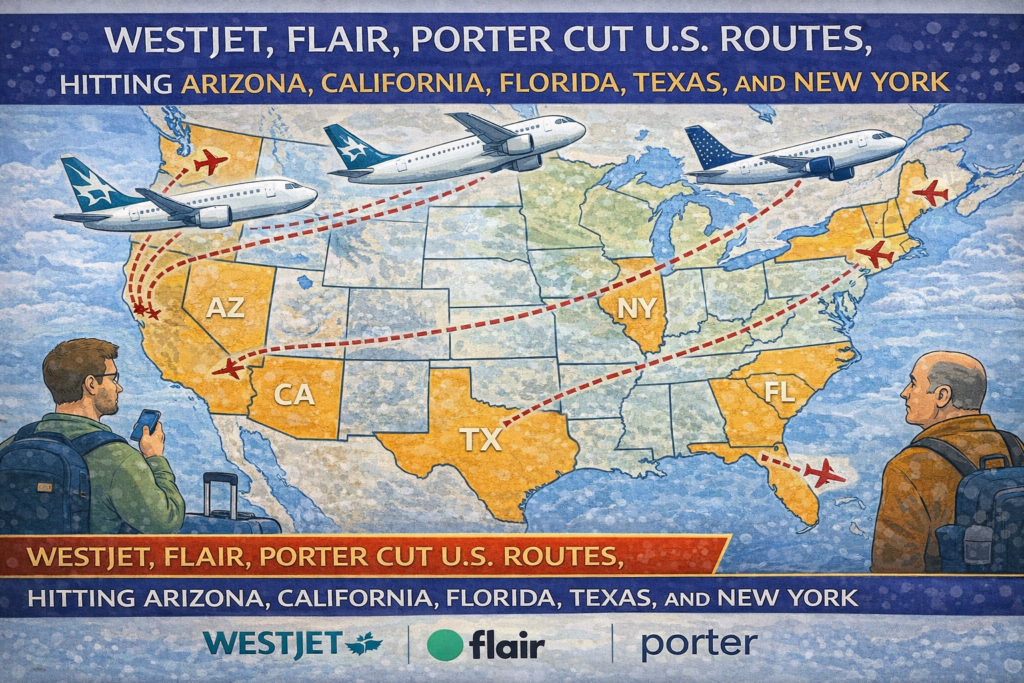
Arizona Joins U.S. States Facing Canadian Flight Reductions
Arizona has joined the growing list of U.S. states—including California, Florida, Texas, and New York—experiencing significant cuts in flights from Canada. Canadian travelers are reducing their trips to the U.S., and airlines like WestJet, Flair Airlines, and Porter Airlines are responding by reducing seat availability on popular routes. The decrease in demand has left travelers struggling to find direct connections to their favorite U.S. destinations.
Declining Transborder Travel Hits Key U.S. Destinations
For years, Canadians have favored U.S. states like Arizona for warm winters and scenic landscapes. However, the latest data shows a sharp decline in cross-border travel:
- Florida: Canadian tourists dropped from 3.41 million in 2024 to 1.2 million by early 2025.
- California: Reduced flights to Los Angeles, San Francisco, and other cities.
- Nevada: Fewer Canadians traveling to Las Vegas and Reno.
- Texas: Significant reductions in flights to Dallas, Houston, and Austin.
Airports such as Toronto Pearson and Montreal-Trudeau have seen transborder traffic declines of 15.5% and 17.9% respectively, prompting airlines to reduce seat capacity and increase prices.
How Airlines Are Cutting U.S. Routes
Recent airline adjustments across Canada–U.S. flights include:
| Airline | Type of Change | U.S. Routes / Markets Affected | Scale of Reduction |
|---|---|---|---|
| WestJet | Major transborder network cuts | Boston, San Francisco, San Diego, Los Angeles, Las Vegas, Chicago, Atlanta, Orlando, Nashville, Raleigh‑Durham, Seattle | 15 routes removed; U.S. summer capacity down ~19.6%, ASMs down ~32% |
| Air Canada | Reduced seat capacity | New York, Florida, California, Chicago, Las Vegas | Seats down 9% YoY; schedule adjustments across transborder flights |
| Flair Airlines | Deep cutbacks | Multiple U.S. leisure routes | Capacity down ~58%, largest percentage drop among Canadian carriers |
| Porter Airlines | Mixed pattern | Select U.S. routes | Repositioning traffic; 23% of ASMs directed to U.S. |
| Other Canadian carriers | Aggregate reduction | Broad Canada–U.S. market | ~450,000 seats cut for Q1 2026 vs Q1 2025 (~10%) |
Florida: Canadian Travelers Turn Away
Florida, historically a top destination for snowbirds and theme park enthusiasts, has seen the steepest decline in flights. Toronto and Montreal airports have experienced major reductions, leaving travelers with fewer options for direct flights to Orlando, Tampa, and Miami. Higher prices and reduced availability have made Florida less accessible for Canadian visitors this season.
California: Reduced Access to West Coast Hotspots
Canadian flights to California have also declined, affecting cities such as Los Angeles and San Francisco. Vancouver International Airport alone saw a 5.4% drop in transborder traffic in August 2025, growing to 10.6% by November. Airlines are redeploying aircraft to more profitable routes in the Caribbean and Mexico, leading to longer layovers and higher fares for Canadians visiting California.
Nevada: Fewer Canadians in Las Vegas
Las Vegas, a hub for Canadian gamblers and conference-goers, has seen a sharp reduction in flights. Direct routes from Vancouver to Nevada have been eliminated, forcing travelers to connect through other U.S. hubs, increasing travel costs and inconvenience. The city’s tourism industry is feeling the impact of lower Canadian visitation.
Texas: Canadian Travelers Scale Back
Texas, once popular for its rodeos, shopping, and sports, has experienced significant declines in Canadian traffic. Toronto and Calgary report double-digit drops in transborder passengers, prompting airlines to reduce service to Dallas, Houston, and Austin. Political tensions and fluctuating exchange rates are cited as contributing factors to the declining demand.
The Broader Tourism Impact
The reduction in flights from Canada is reshaping the U.S. tourism economy:
- Popular destinations are seeing fewer visitors and declining revenue.
- Airlines are focusing on markets with stronger demand, including the Caribbean, Latin America, and transatlantic routes.
- Canadians face limited travel options, higher fares, and longer travel times to U.S. cities.
This trend highlights the sensitivity of U.S. tourism to cross-border travel patterns and currency fluctuations, and suggests a longer-term realignment of airline networks between Canada and the United States.