
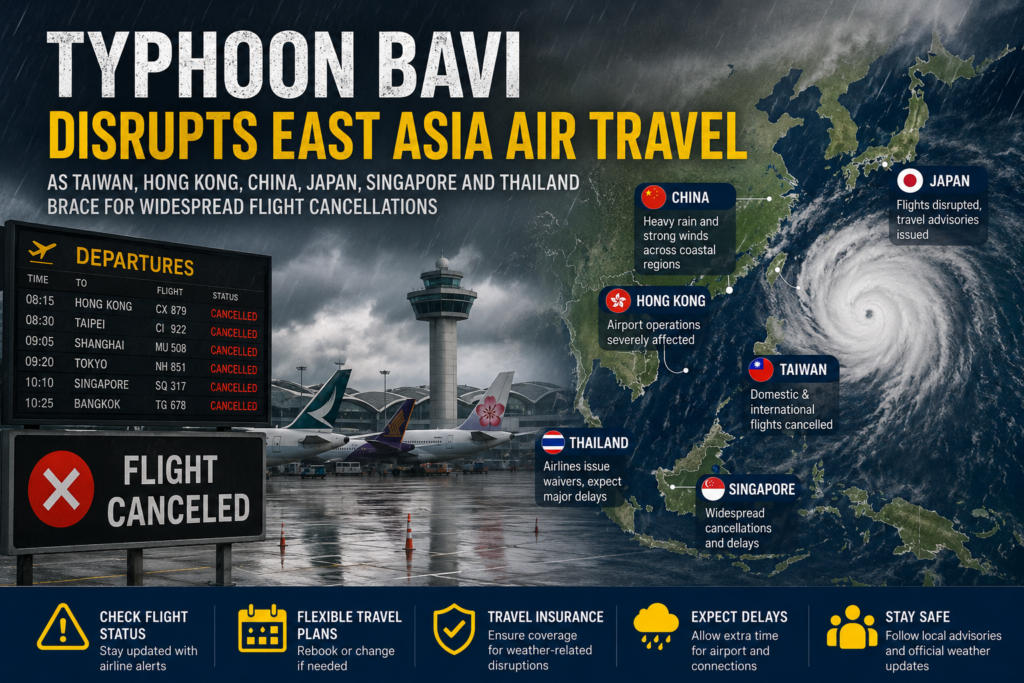
Typhoon Bavi Disrupts East Asia Air Travel
Taiwan, Hong Kong, China, Japan, Singapore and Thailand Brace for Widespread Flight Cancellations
Super Typhoon Bavi has triggered widespread travel disruption across East Asia, forcing airlines to cancel or reschedule flights, prompting governments to issue emergency warnings, and disrupting airport operations across Taiwan, Hong Kong, Japan, mainland China and other regional travel hubs.
The powerful storm, which intensified over the western Pacific before approaching Taiwan and China’s eastern coastline, has emerged as one of the most significant weather events affecting regional aviation this year. Airlines across Asia have activated contingency plans as strong winds, heavy rainfall and dangerous sea conditions continue to affect flight schedules and airport operations.
Taiwan Faces Major Aviation Disruptions
Taiwan has been among the hardest-hit aviation markets as Typhoon Bavi approached the island.
Authorities issued land and sea warnings while forecasting extremely heavy rainfall in mountainous areas and along the northern part of the island. Local governments closed schools and suspended work in several jurisdictions as emergency preparations intensified.
Taiwan’s major airports, including Taiwan Taoyuan International Airport, experienced extensive flight cancellations and schedule adjustments. Airlines suspended numerous domestic and international services as safety became the primary concern.
Emergency authorities also evacuated residents from vulnerable mountainous regions where the risk of flooding and landslides increased significantly. Military personnel and emergency response teams were placed on standby to assist with rescue and recovery operations if necessary.
Hong Kong Airlines Cancel Flights Ahead of the Storm
Although Hong Kong was not expected to receive a direct landfall, airlines operating through Hong Kong International Airport cancelled dozens of flights because of the storm’s impact on regional air routes.
Flights connecting Hong Kong with Taiwan, Japan and parts of mainland China were among those affected. According to airport information, more than 40 flights were cancelled while several others experienced delays as carriers adjusted schedules before weather conditions deteriorated.
Major airlines including Cathay Pacific, HK Express, Hong Kong Airlines and Greater Bay Airlines announced flexible booking arrangements, allowing affected passengers to change travel dates or rebook flights without standard change fees on eligible tickets.
Airport authorities advised travelers to monitor flight information before leaving for the airport as operational conditions continued to evolve.
China Activates Emergency Preparations
Mainland China activated extensive emergency measures as forecasts indicated that Typhoon Bavi would move toward the country’s eastern coastline.
Authorities in Fujian and Zhejiang provinces suspended ferry services, instructed fishing vessels to return to port and evacuated thousands of residents from vulnerable coastal communities.
Emergency management agencies mobilized rescue personnel while local governments prepared shelters and flood-control measures. Meteorological agencies warned that the combination of strong winds and heavy rainfall could create dangerous conditions across several provinces.
The preparations come only days after other severe weather events caused flooding and storm-related damage in parts of southern China, increasing concerns about cumulative impacts on infrastructure and transportation.
Japan’s Southwestern Islands on High Alert
Japan also experienced significant aviation disruptions as Typhoon Bavi approached Okinawa Prefecture and the Sakishima Islands.
Japan Airlines (JAL) and All Nippon Airways (ANA) cancelled hundreds of flights serving the affected region, with tens of thousands of passengers expected to experience travel disruptions.
Authorities warned residents about the potential for destructive winds, flooding and landslides. Local governments urged people to complete emergency preparations before weather conditions worsened.
Power outages were reported in parts of the affected islands as utility companies responded to storm-related damage.
Airlines Across Southeast Asia Adjust Operations
The impact of Typhoon Bavi has extended beyond the areas expected to experience direct effects.
Several airlines operating regional networks through Singapore, Thailand and Malaysia announced operational adjustments because aircraft rotations, airport slot availability and regional weather conditions were being affected.
AirAsia confirmed that flights operating between July 10 and July 12 on several East Asian routes could experience disruptions and advised passengers to monitor booking notifications for updates.
Malaysia Airlines also cancelled selected Kuala Lumpur-Taipei services because of expected weather impacts.
These adjustments reflect the interconnected nature of regional aviation, where disruptions at one major airport can affect aircraft schedules across multiple countries.
Why Typhoons Cause Regional Aviation Disruptions
Typhoons affect aviation well beyond their immediate path.
Commercial aircraft are designed to operate safely in challenging weather, but airports and airlines may suspend operations when wind speeds exceed operational safety limits or when severe turbulence, lightning or reduced visibility create unacceptable risks.
Airlines also reposition aircraft before major storms to protect fleets and ensure quicker recovery once conditions improve.
As a result, cancellations often begin before the storm reaches an airport, helping reduce the number of stranded aircraft and passengers.
Passenger Safety Remains the Priority
Civil aviation authorities and airlines consistently emphasize that safety remains the overriding factor in operational decisions during severe weather events.
Pilots, dispatch teams and air traffic controllers continuously assess meteorological information before departures. If conditions are expected to deteriorate during takeoff, landing or en route operations, flights may be delayed or cancelled.
Although cancellations create inconvenience for travelers, aviation experts note that early schedule adjustments reduce operational risks and allow airlines to recover more efficiently after storms pass.
Advice for Travelers
Passengers traveling across East Asia during Typhoon Bavi are being encouraged to remain flexible and stay informed.
Most airlines serving affected destinations have introduced travel waivers allowing passengers to change flights without paying standard rebooking fees, subject to airline conditions.
Travelers are advised to:
- Check flight status before leaving for the airport.
- Register for airline notifications.
- Review flexible booking options if travel plans are affected.
- Allow additional travel time because airport operations may change quickly.
- Follow instructions issued by airport authorities and local emergency agencies.
Many airports continue normal operations even while selected flights are cancelled, making real-time flight information especially important.
Broader Impact on Regional Tourism
East Asia is one of the world’s busiest aviation markets, with extensive connections linking Taiwan, Hong Kong, China, Japan, South Korea and Southeast Asia.
Weather disruptions affecting one major hub frequently cascade across the region as aircraft and flight crews operate multiple daily routes between countries.
Business travelers, tourists and cargo operators are all likely to experience schedule adjustments until weather conditions improve and airlines restore normal operations.
Industry analysts note that airlines have become increasingly effective at managing severe weather through advanced forecasting, flexible scheduling and digital passenger communication, helping reduce recovery times following major storms.
Emergency Agencies Continue Monitoring the Storm
Meteorological agencies across East Asia continue to monitor Typhoon Bavi’s movement as it progresses toward China’s eastern coast.
Forecasts indicate the storm will continue producing damaging winds, heavy rainfall and dangerous coastal conditions across parts of Taiwan, Japan and eastern China before gradually weakening inland.
Authorities have urged residents in affected areas to remain alert, follow evacuation orders where issued and avoid unnecessary travel during periods of severe weather.
Outlook
While the full impact of Typhoon Bavi will depend on its final track and intensity, the storm has already demonstrated how quickly severe weather can disrupt one of the world’s busiest aviation regions.
With flights cancelled, airports operating under contingency plans and emergency agencies on high alert, travelers across East Asia are being encouraged to monitor official updates closely and expect schedule changes over the coming days.
As weather conditions stabilize, airlines are expected to gradually restore normal services, although some delays may continue while aircraft and crews return to their scheduled rotations.