Delta, United and Other Airlines Introduce Lower-Cost Business Class Options: What Travelers Need to Know
Business class has traditionally represented an all-inclusive premium travel experience: spacious seats, priority airport services, lounge access, flexibility and enhanced onboard amenities.
That model is changing.
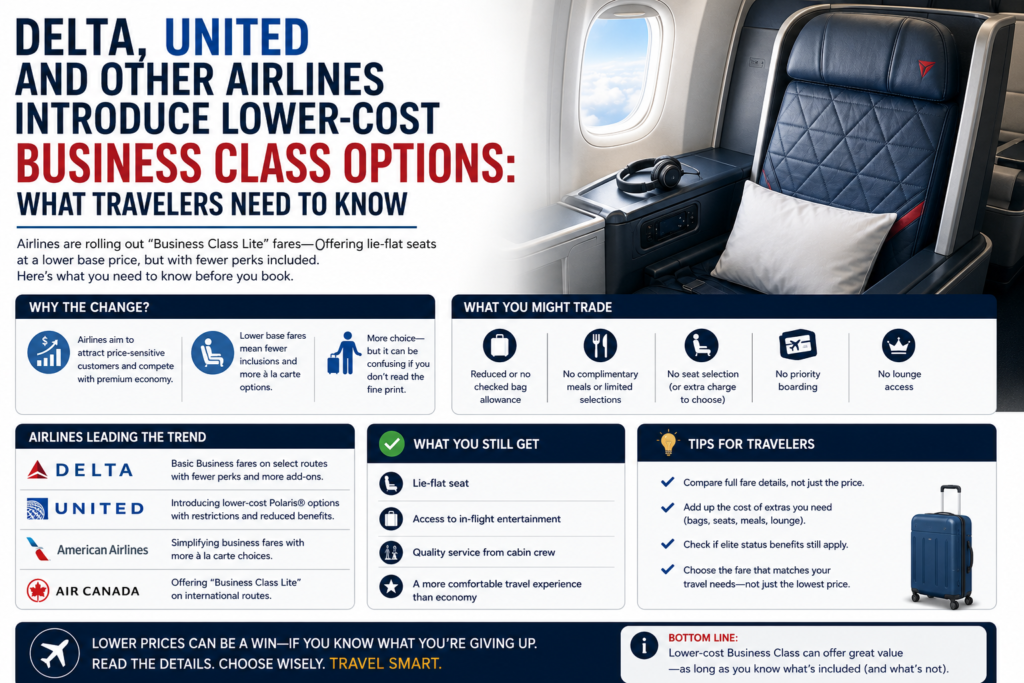
Several major airlines are introducing lower-priced versions of premium cabin fares that provide access to business-class seating while removing some benefits that were previously included in a standard premium ticket.
The trend reflects a broader shift in airline pricing strategies, where carriers are separating products into more categories and allowing passengers to choose which features they want to pay for.
For travelers, these new fares may create opportunities to access premium seats at lower prices. However, they also require closer attention to what is included — and what is not.
The Rise of “Basic” Premium Fares
Airlines have used segmented pricing models for years in economy cabins, particularly through basic economy fares.
These lower-priced tickets typically offer the same seat and onboard service as standard economy but include restrictions related to seat selection, changes, baggage and loyalty benefits.
Now, similar concepts are expanding into premium cabins.
Delta Air Lines has introduced a “Basic Business” fare within its Delta One international business-class product, while also creating lower-tier versions of some other premium cabin fares. The airline says these options allow customers to choose the level of service that best matches their needs.
The move follows similar approaches by other international and U.S. carriers that have introduced more restricted premium tickets.
What Delta’s Basic Business Fare Includes
Delta says passengers purchasing Basic Business still receive the core onboard Delta One experience.
That includes premium cabin features such as:
- A business-class seat.
- Enhanced onboard dining.
- Premium service.
- Access to the same cabin environment as other Delta One passengers.
However, some benefits associated with traditional business-class tickets are reduced or removed.
Depending on the fare rules, restrictions may include:
- Limited or no advance seat selection.
- Reduced flexibility for changes.
- Different mileage earning.
- Reduced baggage benefits.
- No Delta One lounge access through the fare alone.
Passengers with separate qualifying memberships or eligible credit cards may still have lounge access depending on their circumstances.
United’s Approach to Lower-Cost Premium Travel
United Airlines has also expanded its use of fare segmentation in premium cabins.
The airline has introduced more restricted versions of higher-tier products, including fares aimed at travelers who want the premium seat but may not need every traditional benefit.
United’s international business-class product, Polaris, includes lie-flat seating and premium services, but fare differences can affect flexibility, benefits and eligibility rules.
Like Delta, United’s approach reflects an effort to capture demand from travelers who want premium comfort but may be unwilling or unable to pay the highest business-class prices.
Why Airlines Are Creating These Fare Categories
Airlines use different fare levels because passengers value different parts of the travel experience.
A leisure traveler flying internationally may primarily want:
- A comfortable seat for a long overnight flight.
- More space.
- Better food and service.
A corporate traveler may place greater importance on:
- Flexible changes.
- Priority services.
- Lounge access.
- Schedule options.
By separating these features, airlines can offer different price points while maintaining premium cabin demand.
The strategy is also designed to improve revenue management by allowing airlines to sell the same cabin to different customer groups with different willingness to pay.
Critics Say Premium Travel Is Becoming More Complicated
While airlines describe these changes as increased choice, some travel industry observers argue that they represent another step toward unbundling services.
The criticism is that passengers may see a lower advertised premium fare but must pay more to restore benefits that were once considered standard parts of business-class travel.
This debate is similar to earlier discussions surrounding basic economy, where airlines introduced lower entry prices but attached additional restrictions.
How These Changes Affect Travelers
The value of a lower-cost business-class fare depends on how a passenger uses the ticket.
Travelers focused on the seat
For passengers taking a long-haul flight and mainly wanting a lie-flat seat, a restricted business-class fare may offer good value.
If lounge access, flexible changes and premium airport services are not important, paying less may make sense.
Travelers flying for work
Business travelers may prefer traditional business-class fares because schedules can change.
A cheaper ticket may become less valuable if changing a flight requires additional fees or creates fewer options.
Families and couples
Travelers who want to sit together should pay close attention to seat assignment rules.
A lower fare may create challenges if advance seat selection is limited.
Frequent flyers
Loyalty program members should review how different fare classes affect mileage earning and elite-status benefits.
What Passengers Should Check Before Booking
Before choosing a lower-cost business-class ticket, travelers should review several details.
Seat selection
Can you choose your seat before departure?
This is particularly important for passengers traveling together.
Change and cancellation rules
Does the fare allow adjustments if plans change?
Lounge access
Is lounge access included, or does it require a separate membership or qualifying status?
Baggage allowance
Does the fare include the same baggage benefits as other business-class tickets?
Loyalty benefits
Will the ticket earn the same miles or status credits?
Total price difference
The cheapest premium fare is not always the best value if adding necessary extras removes the savings.
A Broader Shift in Airline Pricing
The introduction of lower-cost business-class options is part of a wider transformation in airline pricing.
Carriers increasingly offer multiple versions of the same cabin, allowing customers to select different combinations of:
- Price.
- Flexibility.
- Benefits.
- Services.
This approach has become common throughout the travel industry, including hotels, car rentals and vacation packages.
Companies are increasingly separating basic access from optional upgrades, allowing customers to customize their purchases.
The Future of Business Class
Business-class travel is likely to continue evolving as airlines balance customer expectations with revenue goals.
Premium cabins remain among the most profitable parts of airline operations, and demand for premium seats has remained strong.
At the same time, airlines are looking for ways to attract travelers who want premium comfort but are sensitive to price.
Lower-cost business-class fares may become more common as carriers experiment with different combinations of benefits and restrictions.
Final Thoughts
Delta, United and other airlines are changing how passengers buy business-class travel by introducing lower-priced premium fares with fewer included benefits.
For some travelers, these options may provide a more affordable way to experience premium seating. For others, the reduced flexibility and missing perks may make traditional business-class fares a better choice.
The key difference is that business class is no longer necessarily a single product. Travelers now need to compare not only the seat but also the complete package of services included with the ticket.
As airlines continue refining their pricing models, understanding fare differences will become increasingly important for passengers seeking the best value from premium travel.