
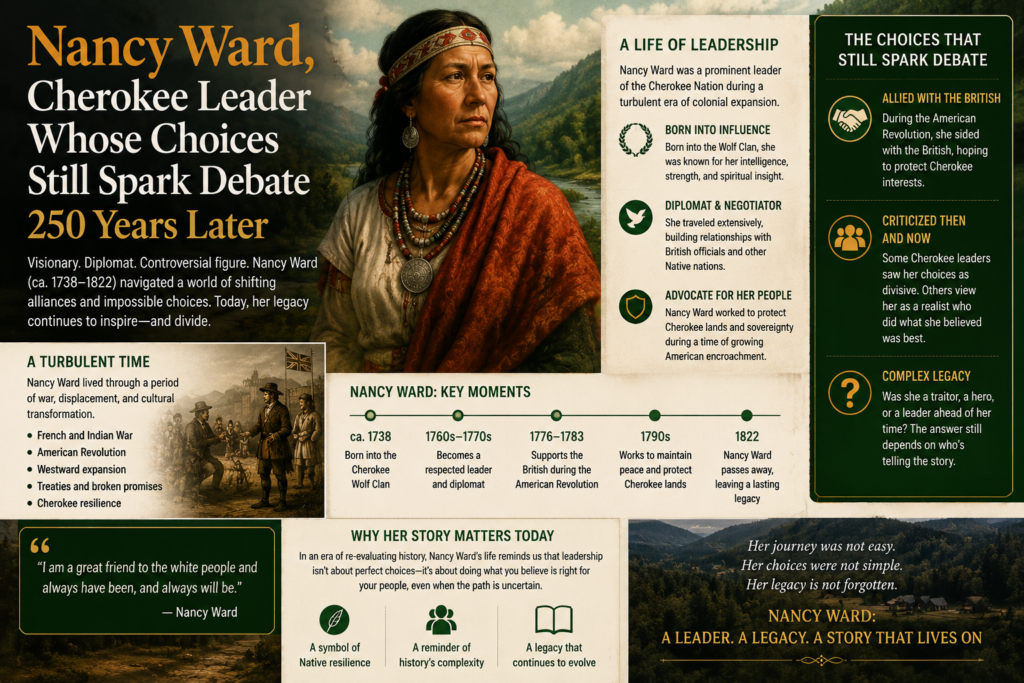
Nancy Ward, Cherokee Leader Whose Choices Still Spark Debate 250 Years Later
More than two centuries after her lifetime, Nancy Ward remains one of the most discussed figures in Cherokee history.
Known in Cherokee as Nanyehi, Ward was a respected leader, diplomat and holder of the title Ghigau, or “Beloved Woman,” a position associated with significant influence in Cherokee society. Her life unfolded during one of the most turbulent periods in Native American and colonial history, when Cherokee communities faced increasing pressure from European settlers, expanding colonial governments and conflicts over land.
Today, Ward’s legacy continues to generate discussion because her decisions reflected the difficult choices Indigenous leaders faced while trying to protect their communities during a period of rapid political change.
Who Was Nancy Ward?
Nancy Ward was born around 1738 in the Cherokee town of Chota, an important Cherokee settlement in what is now eastern Tennessee.
Her Cherokee name, Nanyehi, is associated with the Cherokee Wolf Clan, and she became prominent at a young age after demonstrating leadership during conflict. Historical accounts describe her involvement in the 1755 Battle of Taliwa, where she fought alongside Cherokee warriors after the death of her husband, Kingfisher. Following her actions, she received the title Ghigau, often translated as “Beloved Woman.”
The title carried important responsibilities. The Beloved Woman traditionally held a respected position within Cherokee political life, including involvement with councils and decisions concerning prisoners taken during conflicts.
A Leader During a Time of Crisis
Ward lived through a period when Cherokee communities were navigating competing pressures.
During the 18th century, the Cherokee interacted with British colonial authorities, later American settlers and neighboring Indigenous nations. Trade relationships, military alliances and land agreements became increasingly important as European settlement expanded.
Ward became known as an advocate for maintaining communication and peaceful relations with settlers. She served as a translator and intermediary in some interactions between Cherokee leaders and European Americans, although historians continue to debate how her choices should be understood within the larger context of colonial expansion.
The Debate Over Her Role in Cherokee History
Ward’s legacy remains complex because she supported negotiation with settlers at a time when many Cherokee people were experiencing growing pressure and loss of land.
Some historical interpretations emphasize her efforts to prevent violence and protect Cherokee communities through diplomacy.
Others argue that cooperation with colonial powers had complicated consequences because settlers continued to acquire Cherokee territory despite diplomatic efforts.
The debate reflects a broader question faced by many Indigenous leaders of the era: whether survival required negotiation with expanding colonial governments or resistance against them.
Rather than representing a simple division between cooperation and opposition, Ward’s story illustrates the difficult choices available to Native leaders during a period of profound upheaval.
Nancy Ward and the American Revolution
The American Revolution created further challenges for Cherokee communities.
Different Cherokee groups made different choices about alliances, with some supporting the British and others seeking accommodation with American settlers.
Historical accounts describe Ward as favoring peaceful relations with colonial communities and attempting to reduce conflict. Some accounts state that she warned settlers about planned attacks and intervened to protect captives, including Lydia Bean, a settler who had been captured during conflict.
Historians continue to examine these events through different perspectives, considering both Ward’s actions and the broader pressures facing Cherokee society.
A Voice in Cherokee Diplomacy
Ward’s influence extended beyond individual acts during conflicts.
As a Beloved Woman, she participated in political discussions and treaty negotiations. Her position gave her a rare public role during a period when many women in European societies had limited formal political influence.
Her involvement also reflected traditions within Cherokee society, where women could hold important social and political responsibilities.
Ward’s presence in diplomatic discussions challenged the assumptions of some colonial representatives who were unfamiliar with Cherokee systems of governance.
The Land Question and Cherokee Displacement
The central issue shaping Cherokee history during Ward’s lifetime was land.
As settlers moved into Cherokee territories, disputes increased. Treaties often resulted in Cherokee land losses, creating tensions within the Cherokee Nation.
In her later years, Ward reportedly opposed additional land transfers and expressed concern about the future of Cherokee families.
She died in 1822, before the forced removal of thousands of Cherokee people during the Trail of Tears in the late 1830s. The removal followed the passage of the Indian Removal Act and subsequent government actions that displaced Cherokee communities from their southeastern homelands.
Remembering Nancy Ward Today
Nancy Ward’s story remains part of Cherokee historical discussions and is recognized at several historic locations.
Her gravesite near Benton, Tennessee, is listed on the National Register of Historic Places and is associated with the Trail of Tears National Historic Trail. The site preserves information about her role as a Cherokee leader and diplomat.
For many, Ward represents Indigenous leadership, diplomacy and resilience. For others, her story raises questions about the limits of negotiation during an era of colonization and land loss.
Both perspectives reflect the complexity of her historical moment.
Why Her Story Still Matters 250 Years Later
The continued interest in Nancy Ward’s life reflects broader conversations about Indigenous history and the challenges of interpreting figures who lived through periods of major transformation.
Her story highlights several themes that remain relevant today:
Leadership under pressure
Ward made decisions during a period when Cherokee communities faced military threats, political uncertainty and territorial loss.
The role of women in history
Her career challenges older assumptions that political leadership was exclusively a male role.
The complexity of historical figures
Like many leaders from periods of conflict, Ward cannot easily be placed into a single category. Her actions involved diplomacy, survival strategies and difficult compromises.
The importance of Indigenous perspectives
Understanding figures like Ward requires examining Cherokee traditions, political structures and historical experiences alongside colonial records.
Final Thoughts
Two hundred and fifty years after the conflicts that shaped her life, Nancy Ward remains a powerful and debated figure in American and Cherokee history.
She was a warrior, diplomat and political leader whose choices reflected the extraordinary challenges facing the Cherokee people in the 18th and early 19th centuries.
Her legacy is not defined by a single decision or viewpoint. Instead, it represents the complexity of leadership during a time when Indigenous nations were attempting to protect their people, traditions and lands amid dramatic change.