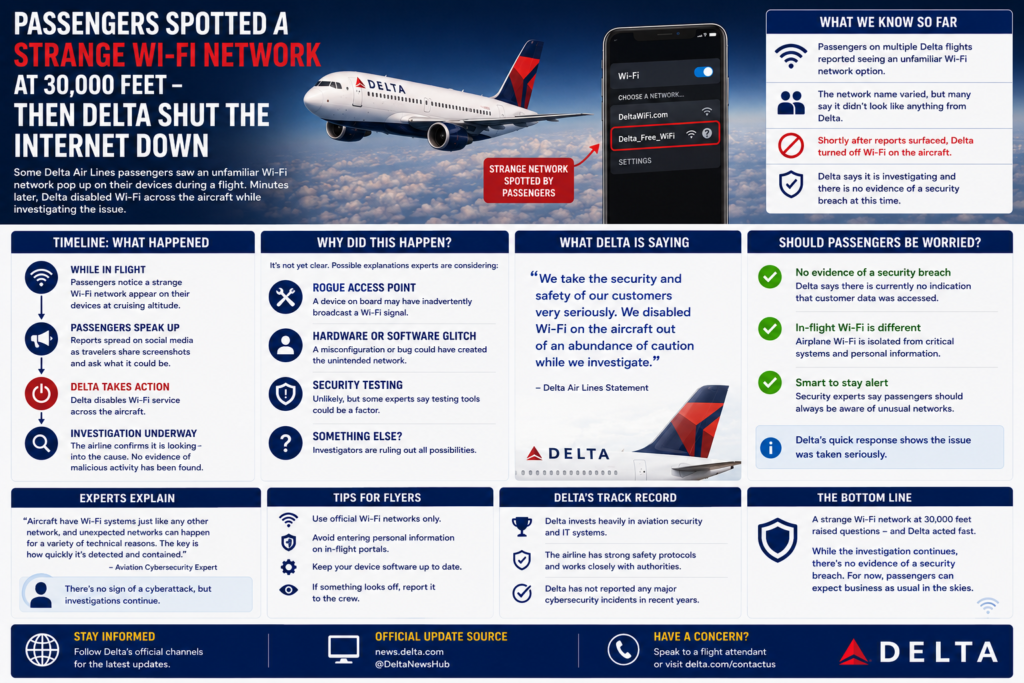
A routine Delta flight from Las Vegas to Atlanta took an unexpected turn when passengers encountered an unauthorized Wi-Fi network in the cabin. Crew members shut down the aircraft’s onboard Wi-Fi for roughly 30 minutes while the incident was reported to authorities. Delta says its systems were not hacked and that the aircraft’s safety was never threatened.
Imagine settling into your seat, opening your laptop or phone and looking for the familiar airline Wi-Fi network.
Then you notice something isn’t quite right.
That’s what happened aboard Delta Air Lines Flight 591, which was traveling from Las Vegas to Atlanta on August 10, 2026.
Passengers and crew became aware of an unauthorized Wi-Fi network appearing onboard the aircraft. Delta subsequently shut down its passenger Wi-Fi service for approximately 30 minutes while the situation was investigated.
The incident attracted particular attention because the flight departed Las Vegas shortly after one of the world’s largest cybersecurity gatherings, DEF CON, had taken place in the city.
But despite the dramatic circumstances, Delta says there was no compromise of the airline’s critical systems, and the safety of the flight was never in question.
The incident is nevertheless a useful reminder that passengers should be careful about connecting to unfamiliar wireless networks—especially when traveling.
What Happened on Delta Flight 591?
Delta Flight 591 was traveling from Las Vegas to Atlanta on Monday, August 10.
During the flight, an unauthorized wireless network appeared onboard.
According to information reported by PEOPLE, the network was reportedly named “Delta Wifi Fast.”
The unusual network attracted attention because it appeared to imitate the airline’s legitimate onboard Wi-Fi service.
The flight crew was alerted.
Delta then deactivated the aircraft’s Wi-Fi functionality for approximately 30 minutes.
The pilots also reported the situation to air traffic control.
According to an aviation data message reported by PEOPLE, the crew believed that someone aboard the aircraft had created a fraudulent Wi-Fi network and was attempting to scam passengers. People.com
The aircraft continued its journey.
There was no indication that the aircraft itself was in danger.
Was Delta Actually Hacked?
This is where the story needs careful explanation.
Delta says no.
The airline stated that there was no hack of its systems, including the in-flight Wi-Fi system.
Instead, Delta said an unauthorized network appeared onboard and was not provided or operated by the airline.
That means the incident appears to have involved someone creating or broadcasting a separate wireless network that could potentially be mistaken for the legitimate airline network.
This is substantially different from gaining unauthorized access to Delta’s internal systems.
It is also different from taking control of an aircraft.
Did the Incident Affect the Airplane’s Safety?
According to Delta, no.
The airline said:
“The safety of the flight was never in question and no aircraft operating systems were affected.”
That is one of the most important facts in the story.
The passenger Wi-Fi system is not the same thing as the aircraft’s flight-control systems.
Aviation networks are designed with security boundaries between passenger-facing systems and critical aircraft functions.
The Federal Aviation Administration also told PEOPLE that it was aware of the situation and that a breach involving an onboard Wi-Fi system would not affect an airplane’s critical flight-safety systems. People.com
So while the incident raised cybersecurity concerns, there is currently no evidence that someone took control of the airplane.
Why Did the Crew Turn Off Wi-Fi?
The decision makes sense from a security perspective.
Once an unauthorized network was discovered, the safest immediate response was to remove access to the aircraft’s passenger Wi-Fi while the situation was assessed.
Turning off the service effectively eliminated the environment in which passengers could potentially connect to the suspicious network.
It also gave the airline and authorities time to determine what was happening.
For passengers, that meant something relatively simple:
The internet stopped working.
For the crew, however, the situation required investigation.
What Is an “Evil Twin” Wi-Fi Attack?
Cybersecurity experts use the term “evil twin” to describe a fraudulent wireless access point designed to imitate a legitimate network.
The concept is relatively simple.
Imagine you’re at an airport and see:
Airport_Free_WiFi
You connect.
But instead of connecting to the airport’s legitimate network, you may have connected to an attacker-controlled access point using the same or a very similar name.
The attacker can potentially use the connection to redirect users, collect information or present fake login pages.
The same basic concept could theoretically be used aboard an airplane.
If passengers are accustomed to seeing a particular airline Wi-Fi network, they may not carefully verify whether the network they’re joining is legitimate.
Why an Airplane Is an Interesting Environment for This Type of Attack
Airline passengers are a particularly attractive target for social engineering because they are already expecting to connect to Wi-Fi.
People routinely open their phones after boarding and search for:
- The airline’s Wi-Fi
- Free messaging
- Internet access
- Entertainment
- Flight information
That makes a fake network potentially difficult for an inexperienced user to recognize.
Passengers may also be tired, distracted or eager to get online.
Someone traveling for business might immediately begin checking email.
Someone on vacation might open social media.
Someone else might simply want to message family.
That creates opportunities for a malicious actor to trick people into connecting to the wrong network.
What Could Happen If Someone Connects to a Fake Network?
The consequences depend on what the fraudulent network is designed to do.
A malicious wireless access point could potentially direct users to a fake login page.
For example, a passenger might see a page asking for:
- An email address
- A password
- A Google login
- Credit-card information
- Other personal information
If a passenger enters sensitive information into a fraudulent page, that information could potentially be captured by the attacker.
That’s why passengers should be cautious when connecting to unfamiliar networks.
The Strange Timing: Las Vegas and DEF CON
Another reason the incident attracted attention was the flight’s departure location.
Las Vegas had just hosted DEF CON, one of the world’s best-known hacker and cybersecurity conferences.
DEF CON 2026 took place in Las Vegas from August 6 through August 9.
Delta noted the timing in its statement, pointing out that large cybersecurity conferences had been held in Las Vegas over the weekend. People.com
That naturally led to speculation about whether the person responsible for the unauthorized network was connected to the cybersecurity community.
However, there is currently no confirmed evidence establishing who created the network or why.
That distinction matters.
The timing may be interesting.
It is not proof of a connection.
Was Someone Trying to Steal Passenger Information?
The available information suggests that authorities and Delta believed the network may have been intended to deceive passengers.
The pilot reportedly told air traffic control that someone had created a scam Wi-Fi network and that they believed the person was trying to scam other passengers. People.com
Cybersecurity experts quoted in coverage of the incident have pointed to the possibility of an evil-twin-style attack.
But the investigation remains ongoing.
At this stage, it would be inappropriate to state as fact that passenger information was stolen.
There has been no reported confirmation of a passenger-data breach.
Was the Person Arrested?
The information currently available does not establish that an individual responsible for the network has been publicly identified or charged.
The FBI has confirmed awareness of the reports and is in contact with local and corporate partners, according to PEOPLE. People.com
That means the investigation may involve federal authorities.
But travelers should be careful with social-media claims about an arrest, suspect identity or alleged motive unless those details are confirmed by authorities.
Why Did the FBI Become Involved?
Cybersecurity incidents involving commercial aircraft can raise federal concerns.
Even when an event does not affect flight safety, creating a fraudulent wireless network aboard an aircraft can potentially involve criminal conduct.
The FBI’s involvement does not necessarily mean that the aircraft was “hacked.”
It means authorities are examining an incident involving technology, passengers and an aircraft.
That is a reasonable distinction.
The FAA Is Also Aware of the Incident
The Federal Aviation Administration is aware of the incident and is looking into the report.
The FAA’s role is especially important because aviation cybersecurity involves more than protecting passengers’ personal information.
Regulators also have to ensure that systems connected to aircraft operations remain isolated and protected.
In this case, the FAA indicated that even a breach of an onboard Wi-Fi system would not affect the aircraft’s critical flight-safety systems. People.com
That should reassure travelers who may have interpreted the incident as an attempt to take over the airplane.
Why Airplane Wi-Fi Is Different From the Aircraft’s Flight Systems
It is easy to imagine an airplane as one giant connected computer.
It isn’t.
Commercial aircraft contain numerous systems with different functions and different levels of protection.
Passenger-facing systems may provide:
- Internet connectivity
- Entertainment
- Messaging
- Streaming
- Flight maps
- Onboard shopping
Aircraft operational systems, meanwhile, are responsible for functions essential to flight.
Those systems are subject to aviation certification and cybersecurity requirements.
The existence of passenger Wi-Fi therefore does not mean that someone who compromises a passenger device can simply access the aircraft’s flight controls.
The FAA specifically emphasized this distinction in response to the Delta incident. People.com
Why Did Passengers Notice Something Was Wrong?
The precise sequence of how passengers first noticed the suspicious network is still being investigated.
But the situation illustrates how unusual wireless activity can become visible to ordinary travelers.
When people open their device’s Wi-Fi settings, they may see a list of available networks.
If a network appears that looks almost identical to the airline’s legitimate service, some passengers may connect without thinking twice.
Frequent travelers sometimes recognize subtle differences between legitimate networks and suspicious ones.
But not everyone knows what to look for.
How Can Travelers Protect Themselves?
The incident provides several practical lessons.
1. Verify the Wi-Fi network name
Don’t automatically connect to the strongest signal.
Check the airline’s official instructions for the correct network name.
2. Don’t enter sensitive information into unfamiliar pages
If a Wi-Fi portal suddenly asks for information that seems unnecessary, stop.
3. Avoid entering financial information through suspicious captive portals
If you’re unsure whether a page is legitimate, don’t provide your credit-card details.
4. Be suspicious of unusual login requests
An airline Wi-Fi portal shouldn’t normally need your email password or other unrelated credentials.
5. Use cellular service when appropriate
If you’re still on the ground or have cellular connectivity available, you may prefer using your mobile connection rather than an unfamiliar Wi-Fi network.
6. Keep software updated
Security updates can protect devices against known vulnerabilities.
7. Use a VPN when appropriate
A reputable VPN can add another layer of protection, although it does not make a fraudulent network completely safe.
What If You Already Connected to a Suspicious Network?
If you believe you accidentally connected to a fraudulent Wi-Fi network, don’t panic.
First, disconnect.
Then consider:
- Turning off Wi-Fi
- Forgetting the network
- Checking whether you entered passwords
- Changing compromised passwords
- Enabling multi-factor authentication
- Monitoring financial accounts if sensitive information was entered
- Running your device’s security tools
If you entered a password into a suspicious website, changing that password from a trusted connection is particularly important.
And if you used the same password elsewhere, change it there too.
What Passengers Shouldn’t Do
Travelers should also avoid trying to investigate or confront another passenger themselves.
If you notice something suspicious on an aircraft:
Tell a flight attendant.
The crew has procedures for dealing with unusual behavior, suspicious devices and potential security concerns.
Trying to confront someone could make the situation more dangerous.
Did the Plane Have to Turn Around?
No.
The flight continued to Atlanta.
The Wi-Fi was temporarily disabled, but the aircraft did not need to make an emergency landing because of the incident.
That is another important distinction.
The aircraft’s flight was not endangered according to Delta’s statement.
The disruption was primarily related to passenger connectivity and cybersecurity concerns.
How Long Was the Wi-Fi Off?
Delta said the aircraft’s Wi-Fi functionality was disabled for approximately 30 minutes.
After the situation was addressed, the flight continued normally.
For passengers, losing internet service for half an hour may have been frustrating.
For the crew, temporarily sacrificing connectivity was a small price to pay for ensuring that passengers weren’t being exposed to a potentially fraudulent network.
Why This Story Is Bigger Than One Flight
The incident highlights an emerging issue in modern aviation.
Airlines increasingly offer connected cabins.
Passengers expect to be able to:
- Browse the internet
- Send messages
- Stream content
- Work remotely
- Use social media
- Access cloud services
That means airlines have to manage two competing priorities.
They need to provide reliable connectivity.
But they also need to prevent connectivity from creating new security risks.
The more connected aircraft become, the more important cybersecurity becomes.
Free Wi-Fi Makes Security Even More Important
Airlines are increasingly moving toward free or lower-cost Wi-Fi.
That is good news for passengers.
But free connectivity can also make travelers less cautious.
When people have to purchase internet access, they may pay more attention to what network they are using.
When the service is simply available, passengers may automatically connect.
That creates an environment where a fake network could potentially blend into the normal passenger experience.
What Delta’s Response Says About Airline Security
Delta’s response was relatively straightforward.
The airline:
- Identified an unauthorized network.
- Disabled onboard Wi-Fi temporarily.
- Notified relevant authorities.
- Confirmed that critical aircraft systems were unaffected.
- Began investigating.
That is essentially what passengers would want an airline to do.
The airline didn’t continue providing Wi-Fi while investigators tried to determine whether passengers were being targeted.
It temporarily removed the service.
What Makes the Incident Particularly Unusual?
Several things came together.
An aircraft full of connected passengers
Most modern travelers carry smartphones, tablets or laptops.
A fake-looking airline network
The unauthorized network reportedly used a name designed to resemble Delta’s legitimate service.
A cybersecurity conference in the same city
DEF CON had just taken place in Las Vegas.
A captive environment
Everyone was aboard the same aircraft.
Limited alternatives
Once passengers were airborne, they couldn’t simply leave the area or use another public Wi-Fi network.
Those factors made the situation unusual.
The “Hacker Plane” Headline Needs a Reality Check
Some social-media posts may make the incident sound like someone hacked a plane.
That’s not what the confirmed information says.
The available evidence indicates:
An unauthorized Wi-Fi network appeared aboard the aircraft.
It does not establish:
Someone hacked Delta’s flight-control systems.
It does not establish:
Someone took control of the aircraft.
It does not establish:
The aircraft was in danger of crashing.
And it does not establish:
Passenger data was stolen.
Those distinctions are essential for accurate reporting.
Why the Investigation Matters
Even though the flight was safe, investigators still need to determine what happened.
Questions include:
- Who created the network?
- What equipment was used?
- How did it appear to passengers?
- Was it connected to the aircraft’s legitimate Wi-Fi?
- Was it designed to collect credentials?
- Did anyone connect?
- Was any information collected?
- Did the creator have malicious intent?
- Was the network created before takeoff or after departure?
- Was the incident related to the DEF CON conference?
Those questions could determine whether additional security measures are necessary.
Could This Happen on Other Airlines?
Potentially, the underlying concept is not unique to Delta.
Any environment where users routinely connect to wireless networks can theoretically be targeted by a fraudulent access point.
That includes:
- Airports
- Hotels
- Coffee shops
- Conference centers
- Trains
- Public transportation
- Aircraft
The lesson is therefore broader than one airline.
Travelers should develop the habit of verifying the network they’re joining.
Why Travelers Should Be Careful With “Free Wi-Fi”
The word free can be powerful.
People often connect to a free network because there is no financial cost.
But the potential cost could be much greater if the connection is fraudulent.
A free network should not automatically be trusted.
Instead, travelers should ask:
Is this definitely the official network?
If the answer isn’t clear, don’t connect.
What Should You Do Before Your Next Flight?
A few simple preparations can improve your security.
Update your phone
Install current operating-system updates.
Update your browser
Make sure your browser is current.
Enable two-factor authentication
This provides an additional layer of protection if a password is compromised.
Use unique passwords
Avoid using the same password for multiple important accounts.
Download entertainment before departure
If the Wi-Fi fails, you won’t be completely dependent on connectivity.
Save important travel information offline
Keep copies of:
- Boarding passes
- Hotel reservations
- Rental-car information
- Important telephone numbers
- Travel documents
That way, a Wi-Fi outage won’t leave you stranded without access to critical information.
And What About the Flight Itself?
The biggest reassurance from this incident is that the aircraft remained safe.
Delta explicitly said that no aircraft operating systems were affected.
The FAA also indicated that a passenger Wi-Fi breach would not affect critical flight-safety systems. People.com
So travelers should not interpret the event as evidence that airline Wi-Fi is connected directly to the systems controlling the aircraft.
The bigger risk was cybersecurity for passengers—not control of the aircraft.
What Travelers Should Remember
The most useful lesson from Delta Flight 591 is surprisingly simple:
Don’t assume that every Wi-Fi network with an airline’s name is legitimate.
If something looks unusual, ask a crew member.
And if the airline temporarily turns off Wi-Fi, there may be a good reason.
In this case, Delta’s decision to disable the service was reportedly temporary.
The airplane continued to Atlanta.
No flight-safety systems were affected.
And authorities are now examining the incident.
Need Help With Your Flight?
Unexpected changes in airline service can make travel plans stressful.
If you need assistance with your flight requirements, you can call:
📞 1-877-730-2630
Assistance is available for:
- Booking a flight
- Canceling a ticket
- Rebooking
- Rescheduling
- Flight ticket changes
- Upgrade requests
- Checking flight status
- Other travel requirements
For a flight-status inquiry, keep your flight number, travel date and reservation information available when you call.
Important: The telephone number above is the customer-service number supplied for this article. It is not Delta Air Lines’ official customer-service number and should not be represented as such.
For official Delta information, schedules and policies, use the airline’s official website:
Delta Air Lines official website
Final Takeaway: The Wi-Fi Disappeared, But the Plane Was Never in Danger
What began as an ordinary Delta flight from Las Vegas to Atlanta became an unusual cybersecurity incident after an unauthorized Wi-Fi network appeared onboard.
The crew noticed the problem.
The aircraft’s passenger Wi-Fi was temporarily shut down.
The pilots reported the situation.
Delta investigated.
The FAA became aware of the incident.
And the FBI was also reported to be in contact with relevant parties. People.com
But the most important fact is reassuring:
Delta says the airline’s systems were not hacked, the aircraft’s critical operating systems were not affected, and flight safety was never in question.
The incident nevertheless provides a valuable warning for anyone who travels.
A familiar Wi-Fi name isn’t necessarily proof that a network is legitimate.
A fake network can be designed to look convincing.
And when you’re 30,000 feet in the air, you have little reason to take unnecessary cybersecurity risks.
So before you tap “Connect,” take a second look.
If something doesn’t seem right, ask the crew.
And if the airline turns the Wi-Fi off, remember that being temporarily offline is considerably better than allowing a suspicious network to remain available to hundreds of passengers.
Original News Source & Credit
The current incident was reported by PEOPLE, which reported that an unauthorized Wi-Fi network appeared during Delta Flight 591 from Las Vegas to Atlanta on August 10, 2026. Delta told PEOPLE that the network was not provided or operated by Delta, that the aircraft’s Wi-Fi was disabled for approximately 30 minutes, and that the flight’s safety and critical aircraft systems were not affected. The report also notes that the FBI and FAA were aware of the incident. People.com
Read the original PEOPLE report
TechCrunch also reported on the incident after Delta confirmed that someone had set up a fake Wi-Fi network during the flight.
Read the TechCrunch report
Editorial accuracy note
This article distinguishes between an unauthorized passenger Wi-Fi network and a hack of an aircraft’s operational systems. The available reporting supports the former, not the latter. It also does not establish that passenger information was stolen or publicly identify the person responsible. Those matters remain subject