
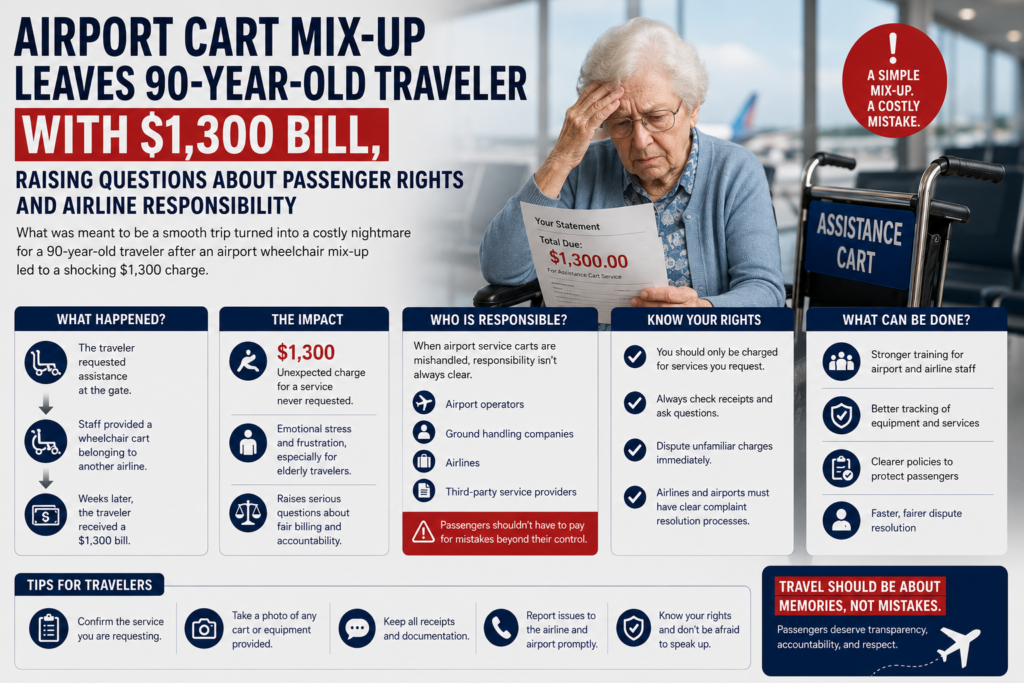
Airport Cart Mix-Up Leaves 90-Year-Old Traveler With $1,300 Bill, Raising Questions About Passenger Rights and Airline Responsibility
A routine request for assistance at an airport turned into an expensive travel ordeal for a 90-year-old passenger after an airport cart reportedly dropped him at the wrong boarding gate, causing him to miss his flight and incur approximately $1,300 in hotel, meal and related expenses while waiting for the next available departure.
The case, first highlighted in The New York Times‘ travel advice column, has drawn attention to an issue many travelers rarely consider: who is responsible when airport assistance services contribute to a missed flight. While the incident involved an elderly passenger and an airport transport cart, travel experts say it also illustrates broader questions about airline liability, airport operations and the limits of consumer protections when multiple parties are involved.
What Happened?
According to the reported account, the traveler accepted assistance from an airport cart after an airline employee arranged transportation to his departure gate.
Instead of being taken to the correct boarding location, the cart reportedly left him at the wrong gate. By the time the mistake was discovered and he reached the correct gate, boarding had already closed and the aircraft had departed.
Because no alternative flight was immediately available, the traveler remained at the destination airport for approximately two days before continuing his journey. During that period, he said he paid about $1,300 for hotel accommodation, meals and other necessary expenses.
The traveler later sought reimbursement, arguing that he missed the flight because of assistance arranged through the airline rather than because he arrived late on his own.
The Central Question: Who Is Responsible?
The case highlights a complex area of air travel where responsibility is not always straightforward.
Commercial airlines are generally responsible for transporting passengers according to the terms of their contract of carriage. Airports, meanwhile, often manage terminal facilities and may contract third-party companies to provide wheelchair assistance or electric cart transportation.
As a result, determining financial responsibility can become difficult when a missed flight involves airport services rather than an operational issue such as a mechanical delay or crew shortage.
Legal and consumer advocates note that liability may depend on who operated the transportation service, whether it was arranged by the airline, and the specific circumstances surrounding the incident.
Airport Cart Services Often Operate Separately
Many travelers assume that airport carts are operated directly by airlines, but that is not always the case.
At numerous airports, electric carts and mobility assistance are managed either by the airport authority or by specialized contractors working under service agreements. Airlines frequently coordinate assistance for passengers who request help, but the personnel providing that assistance may not be airline employees.
That distinction can become important if a passenger later seeks reimbursement, since responsibility may rest with different organizations depending on who provided the service.
How Airlines Typically Classify Missed Flights
Airline reservation systems generally classify passengers who are not present at the gate before boarding closes as “no-shows.”
Once a passenger is recorded as a no-show, the airline’s standard policies usually apply unless the airline determines that exceptional circumstances warrant an alternative outcome.
Consumer advocates note that airline computer systems generally record whether a passenger boarded, not why they failed to do so. Consequently, situations involving airport navigation errors or third-party assistance can fall into a gray area that may require manual review.
Consumer Protection Rules May Not Cover Every Situation
The U.S. Department of Transportation (DOT) requires airlines to provide refunds in certain circumstances, such as when a carrier cancels a flight and the passenger chooses not to travel.
However, federal rules do not automatically require airlines to reimburse hotel costs or meals when a missed flight results from circumstances outside the airline’s direct operational control.
Whether reimbursement is available often depends on the airline’s customer service policies, contractual obligations and the specific facts of each case.
Assistance for Older Travelers
U.S. aviation regulations require airlines to provide assistance to passengers with disabilities under the Air Carrier Access Act.
Many older travelers also request mobility assistance, including wheelchair services or electric cart transportation, even if they do not identify as having a disability.
While airlines must provide reasonable assistance when requested, the regulations do not automatically resolve disputes over financial responsibility if an error occurs during transportation within the airport.
Each complaint is generally evaluated according to the available evidence and the circumstances surrounding the incident.
Documentation Can Make a Difference
Consumer advocates say travelers experiencing problems at an airport should document events as thoroughly as possible.
Helpful records may include:
- Boarding passes.
- Flight itineraries.
- Receipts for hotels and meals.
- Photographs showing gate information.
- Names or identification numbers of airport or airline personnel involved.
- Written communications with the airline.
These records can strengthen reimbursement requests or consumer complaints if disputes arise later.
Why Timing Matters at the Gate
Even when passengers have completed check-in and passed through airport security, airlines generally require travelers to arrive at the departure gate before boarding closes.
Gate closure times vary by airline but frequently occur between 10 and 20 minutes before scheduled departure for domestic flights, with earlier deadlines common for international services.
Once the aircraft door closes, reopening the flight for a late-arriving passenger is generally not permitted because of operational and safety procedures.
That reality means even a short navigation error inside a large airport can result in a missed flight.
Airport Navigation Can Be Challenging
Modern hub airports are significantly larger than in previous decades.
Some terminals span several concourses connected by trains, buses, moving walkways or electric carts. Gate assignments may also change shortly before departure because of operational requirements.
For passengers with reduced mobility or those unfamiliar with large airports, reaching the correct gate can be particularly challenging, making reliable assistance services an important part of the travel experience.
What Travelers Can Do to Reduce Risk
Although incidents such as this remain uncommon, travel experts recommend several precautions:
- Verify the gate number on airport information displays, even when using assistance services.
- Monitor airline mobile apps for gate changes.
- Allow additional time when connecting through large airports.
- Request assistance well before boarding begins.
- If transported by an airport cart, confirm the gate number before leaving the vehicle.
These steps cannot eliminate every risk but may help prevent misunderstandings if gate assignments change or navigation errors occur.
Seeking Reimbursement
When travelers believe they have incurred expenses because of mistakes by airport or airline personnel, experts generally recommend beginning with the airline’s customer relations department.
If the issue is not resolved, passengers may also contact the airport authority if airport-operated services were involved or file a complaint with the U.S. Department of Transportation when appropriate.
Some travel insurance policies may also reimburse certain unexpected accommodation and meal expenses, depending on the reason for the delay and the policy’s terms.
Broader Consumer Questions
The reported incident has prompted broader discussion about accountability in modern air travel.
As airports increasingly rely on multiple contractors to provide passenger services, determining responsibility when problems occur can become more complicated. Travelers often interact with airline employees, airport staff, security personnel and third-party contractors during a single journey, even though each organization operates under different responsibilities.
Consumer advocates say clearer communication and better coordination among service providers could help reduce confusion and improve outcomes when unexpected situations arise.
Outlook
The case of the 90-year-old traveler serves as a reminder that even assistance intended to make travel easier can sometimes lead to unexpected complications. While the passenger’s reported $1,300 in additional expenses has drawn attention, the broader issue extends beyond a single reimbursement request.
For travelers, the incident underscores the importance of confirming gate information, keeping documentation when problems occur and understanding that responsibility for airport services may not always rest with a single organization. As airports continue to handle growing numbers of passengers—many of whom rely on mobility assistance—the case is likely to remain part of the ongoing conversation about passenger rights, customer service and accountability in air travel.