
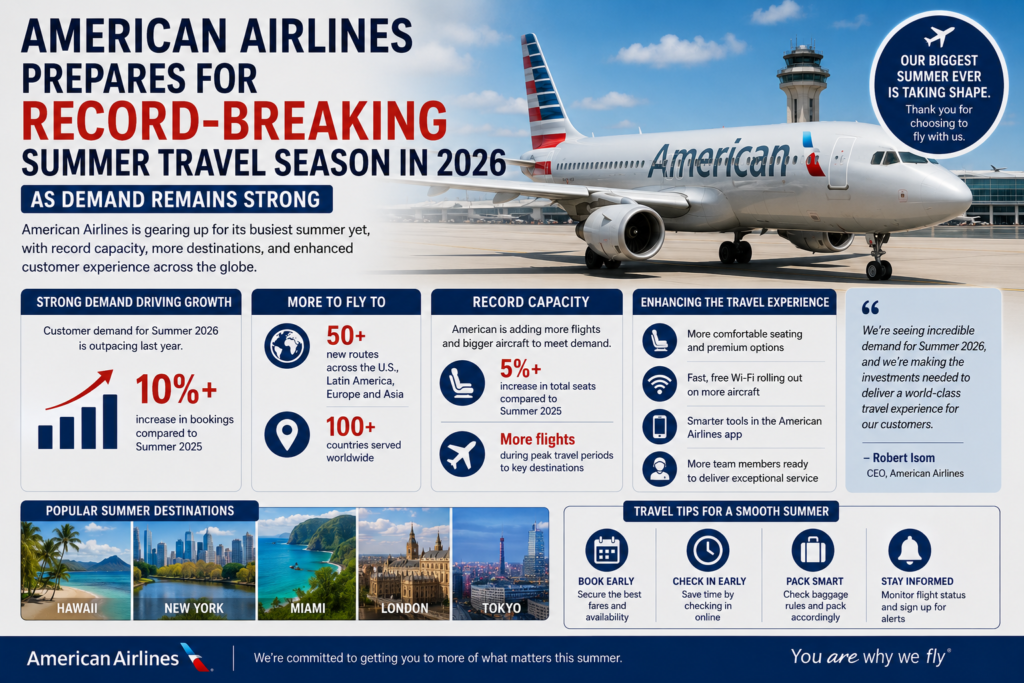
American Airlines Prepares for Record-Breaking Summer Travel Season in 2026 as Demand Remains Strong
Fort Worth, Texas: American Airlines says it is preparing for the busiest summer travel season in its history, expecting to carry more passengers than ever before as strong leisure and international travel demand continues into 2026.
The airline announced that it expects to welcome more than 75 million customers across approximately 750,000 flights during its summer travel period, which runs from May 21 through September 8. If those projections are met, the carrier would surpass its previous summer passenger record set in 2019, before the COVID-19 pandemic disrupted global aviation.
While the figures come from American Airlines’ own operational forecast, they reflect broader trends across the U.S. airline industry, where carriers continue to report robust passenger demand despite higher operating costs, aircraft delivery delays and periodic air traffic control constraints.
American Airlines Expands Capacity for Peak Travel
According to the airline, the record-breaking forecast is supported by its largest-ever summer schedule.
American plans to operate thousands of daily flights across its domestic and international network while increasing capacity on several high-demand routes. The airline said it has also made operational changes at some of its largest hubs to improve reliability during one of the busiest travel periods of the year.
The summer schedule includes expanded international flying, particularly across the Atlantic, where demand for travel between North America and Europe has remained strong since international travel recovered following the pandemic.
Dallas-Fort Worth Hub Receives Operational Changes
A significant portion of American’s summer preparations focuses on Dallas Fort Worth International Airport (DFW), the airline’s largest hub.
American said it has introduced a 13-bank flight schedule, reorganizing the timing of arrivals and departures throughout the day. According to the company, the revised schedule has already reduced delays, lowered the number of missed passenger connections and decreased gate changes during its initial implementation.
The airline also reported improvements in baggage handling performance and customer satisfaction at DFW following the operational changes. These performance figures were provided by American Airlines and have not been independently verified.
Because DFW serves as the airline’s primary connecting hub, improvements there can influence flight operations across much of American’s domestic and international network.
Philadelphia Strengthens Its Transatlantic Role
American Airlines also announced schedule adjustments at Philadelphia International Airport, one of its primary gateways for transatlantic flights.
The airline said it has redesigned portions of its afternoon departure schedule to provide additional connection opportunities while reducing congestion during peak operating periods.
Philadelphia remains one of American’s busiest international hubs, serving destinations throughout Europe during the summer travel season. According to the airline, the revised scheduling is intended to improve on-time performance while giving passengers greater flexibility when connecting to overseas flights.
Chicago O’Hare Expected to See Strong Growth
Among American’s major hubs, Chicago O’Hare International Airport is projected to experience one of the largest increases in passenger traffic this summer.
The airline expects to serve more than 5.2 million customers at O’Hare during the summer season, representing an 11% increase compared with 2025 and a 48% increase compared with 2023, according to company projections.
The expansion is significant because O’Hare remains one of the most competitive airports in the United States, with several major airlines operating extensive networks.
Industry analysts note that maintaining high flight activity at slot-constrained airports such as O’Hare can also help airlines preserve valuable gate access and operating rights.
Memorial Day Marks the Start of Peak Travel
American expects the busy summer season to begin with Memorial Day weekend, traditionally one of the year’s busiest travel periods.
According to the airline, more than 4.2 million passengers are expected to travel on over 40,000 flights between May 21 and May 26.
The carrier projects that May 22 will be the busiest travel day during the holiday weekend.
Airports throughout the United States typically experience heavier passenger volumes during Memorial Day, Independence Day and Labor Day holiday periods.
Investments in Operational Reliability
Beyond expanding its schedule, American says it has invested in operational improvements designed to reduce disruptions during the busy travel season.
The airline has emphasized investments in technology, aircraft maintenance, baggage handling systems and operational planning intended to improve reliability across its network.
Like other major U.S. carriers, American continues using predictive analytics and real-time operational monitoring to identify potential disruptions before they affect large numbers of passengers.
These initiatives come as airlines face increasing pressure to improve on-time performance while managing weather disruptions, air traffic control delays and higher passenger volumes.
Industry Continues Recovering Beyond Pre-Pandemic Levels
American’s summer outlook reflects broader recovery trends across commercial aviation.
Since international travel restrictions were lifted, airlines have reported sustained demand for leisure travel, particularly to Europe, the Caribbean and major U.S. vacation destinations.
Industry organizations have reported that passenger demand has generally exceeded pre-pandemic levels on many international routes, while domestic travel has remained resilient despite inflation and higher airfare in some markets.
The expected record summer for American Airlines is therefore consistent with broader industry trends rather than an isolated development.
Challenges Remain Despite Strong Demand
Although airlines expect another busy summer, operational challenges remain.
Aircraft manufacturers continue experiencing delivery delays that have limited fleet expansion for many carriers.
Air traffic control staffing shortages in parts of the United States have also contributed to periodic delays, particularly during periods of severe weather.
Summer thunderstorms across the eastern United States and hurricane activity later in the season also remain significant operational risks.
Consequently, airlines continue encouraging passengers to monitor flight status regularly and remain flexible if weather-related disruptions occur.
Travelers May Benefit From Expanded Choices
For passengers, American’s expanded summer schedule could provide additional travel options on several domestic and international routes.
Increased flight frequencies can improve itinerary flexibility while offering more connection opportunities through major hubs such as Dallas-Fort Worth, Charlotte, Philadelphia, Miami, Phoenix and Chicago.
At the same time, higher passenger demand means many flights are expected to operate with high seat occupancy, particularly during weekends and major holidays.
Travel experts continue recommending booking flights well in advance for peak travel periods to secure preferred departure times and fare options.
Operational Planning Takes Center Stage
Rather than relying solely on adding more flights, airlines increasingly focus on improving operational efficiency.
Network planning, aircraft utilization, crew scheduling and airport coordination all play important roles in reducing delays during high-demand periods.
American’s revised hub scheduling strategy reflects a broader industry trend toward optimizing existing infrastructure instead of simply expanding flight numbers.
Industry analysts note that operational reliability has become an increasingly important competitive factor as travelers place greater value on on-time performance and fewer cancellations.
Passenger Advice for the Summer
With airports expected to remain busy throughout the summer, travelers are encouraged to prepare in advance.
Passengers should verify flight schedules before leaving for the airport, complete online check-in when available, and allow sufficient time for baggage drop and security screening.
American also recommends using its mobile application to receive real-time notifications about gate changes, boarding times and operational updates.
Travelers flying internationally should ensure that passports, visas and any destination-specific entry requirements are completed before departure.
Outlook
American Airlines’ projection of 75 million passengers and 750,000 flights illustrates the continued strength of demand across the U.S. aviation sector. While those figures represent the airline’s own forecast, they align with broader expectations for another exceptionally busy summer travel season.
Whether the airline ultimately establishes a new passenger record will depend on operational performance, weather conditions and travel demand through early September. However, American’s expanded schedule, revised hub operations and continued investment in reliability indicate that the carrier is preparing for one of the largest travel seasons in its nearly century-long history. As millions of travelers take to the skies over the coming months, the airline’s ability to maintain reliable operations during peak demand will be closely watched across the industry.