
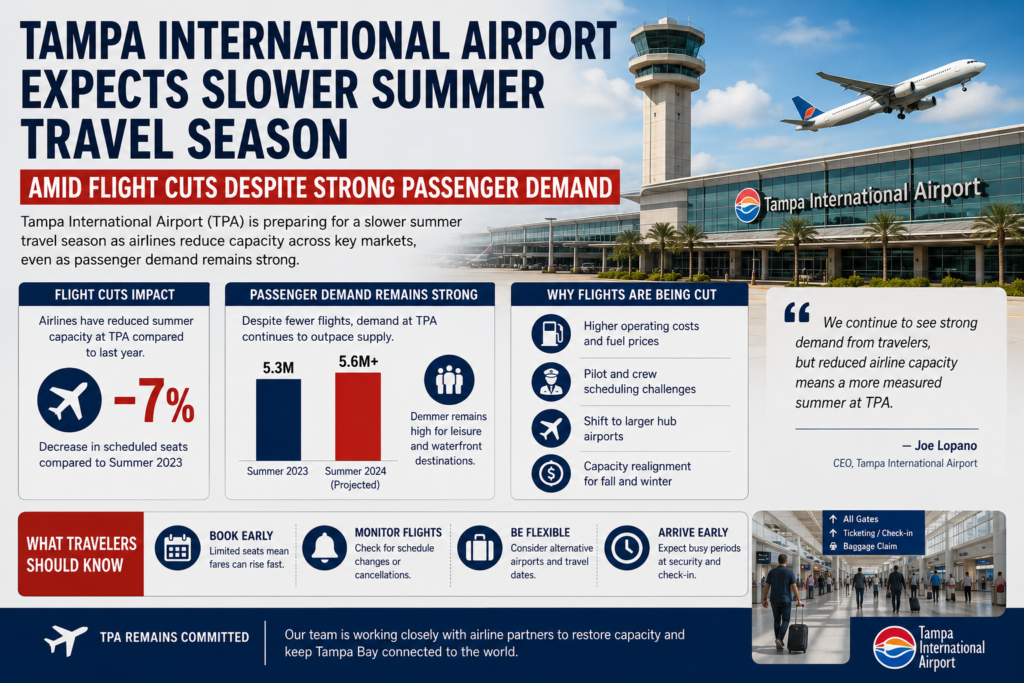
Tampa International Airport Expects Slower Summer Travel Season Amid Flight Cuts Despite Strong Passenger Demand
Tampa, Florida: Tampa International Airport (TPA) is preparing for a different kind of summer travel season in 2026. While airports across the United States continue to welcome millions of vacationers during one of the busiest travel periods of the year, Tampa International officials say passenger traffic is expected to be lower than in recent summers—not because travelers have lost interest in flying, but because airlines are operating fewer flights.
Airport officials project that this summer could become the slowest peak travel season the airport has experienced since 2022, reflecting broader changes in airline scheduling, fleet utilization and operating costs. Despite the reduction in departures, industry experts say demand for air travel remains healthy, with many flights expected to operate near capacity.
Fewer Daily Flights Scheduled This Summer
According to Tampa International Airport, airlines are scheduled to operate approximately 237 departing flights per day during the summer travel season, compared with around 255 daily departures during the same period last year. That represents a reduction of 18 daily departures, or nearly 8%.
Airport officials emphasized that the decrease does not reflect weakening passenger demand. Instead, it is largely the result of airlines adjusting their schedules and reducing flight frequencies on selected routes.
The airport defines its summer travel season as the period between Memorial Day weekend and mid-August, when schools resume classes and leisure travel typically begins to slow.
Spirit Airlines Accounts for Most of the Reduction
Airport representatives said Spirit Airlines accounts for the majority of the reduced departures.
According to Tampa International Airport, 14 of the 18 daily flight reductions are linked to Spirit’s schedule changes, while the remaining cuts result from other airlines operating certain routes fewer days each week instead of daily service.
Rather than eliminating destinations altogether, several airlines have adjusted frequencies to better match operational needs and demand patterns.
Passenger Numbers Expected to Decline Slightly
Tampa International expects to handle around 65,000 passengers each day during the summer season.
Although that remains a substantial volume of travelers, it is below the more than 70,000 daily passengers the airport regularly handled during the summers of 2024 and 2025.
Overall, the airport expects approximately 6.1 million passengers to travel through its terminals between June and August, illustrating that Tampa remains one of Florida’s busiest aviation gateways even with fewer scheduled departures.
Flights Expected to Leave Full
While travelers may notice fewer departure options on some routes, aviation experts say aircraft are likely to be fuller than in previous years.
Commercial pilot Jim Shilling told Spectrum Bay News that airlines are increasingly relying on larger aircraft instead of operating multiple smaller flights. This strategy enables carriers to transport a similar number of passengers while reducing operating costs, particularly fuel expenses.
According to Shilling, airlines can often improve efficiency by operating one larger aircraft instead of several smaller departures on the same route.
As a result, travelers may encounter fewer available seats even though passenger demand remains strong.
Rising Fuel Costs Continue to Influence Airline Decisions
Fuel prices remain one of the aviation industry’s largest operating expenses.
Industry observers say higher fuel costs have encouraged airlines to review network profitability, reducing frequencies on routes that generate lower returns while concentrating capacity where demand is strongest.
United Airlines Chief Executive Officer Scott Kirby has indicated that elevated fuel costs continue to influence scheduling decisions across the airline industry, with network adjustments expected to continue through parts of 2026.
Several major U.S. airlines—including American Airlines, Delta Air Lines, Southwest Airlines and United Airlines—have adjusted schedules by reducing weekly frequencies on selected routes while maintaining service to key destinations.
Travel Demand Remains Resilient
Despite fewer scheduled departures, airport officials and aviation analysts say travelers continue to show strong interest in flying.
Industry data indicates that many domestic flights are departing with high load factors, meaning a large percentage of available seats are occupied.
This trend suggests that airlines are carefully matching available capacity with passenger demand rather than responding to a widespread decline in travel.
For passengers, the practical impact may be reduced flexibility when choosing departure times, particularly on routes where airlines have eliminated certain daily frequencies.
Peak Travel Days Still Expected
Although Tampa International is not expecting to set passenger records this summer, airport officials anticipate several particularly busy travel days.
The airport has identified May 31, June 1, July 5 and August 2 among the busiest days of the season and recommends that passengers allow extra time for parking, check-in and security screening.
Officials continue to advise arriving at least two hours before domestic flights and three hours before international departures, particularly during weekends and holiday periods.
Airport Encourages Travelers to Plan Ahead
To improve the travel experience during the busy summer period, Tampa International Airport has issued several recommendations for passengers.
Travelers are encouraged to:
- Check flight status before leaving for the airport.
- Reserve airport parking in advance where possible.
- Use airline mobile applications for real-time updates.
- Arrive early to accommodate security screening and baggage check.
- Monitor weather forecasts, as Florida’s afternoon thunderstorms can occasionally affect flight schedules.
The airport also recommends using its Express Curbsides and Cell Phone Waiting Lot to reduce congestion around terminal roadways.
Weather Could Add to Operational Challenges
Florida’s summer weather remains another factor influencing airport operations.
Afternoon thunderstorms frequently develop across central Florida during the warmer months, sometimes causing temporary delays for arriving and departing aircraft.
Because aircraft often operate multiple flights throughout the day, weather-related delays at one airport can affect schedules across an airline’s broader network.
Passengers are encouraged to monitor airline notifications for any schedule changes, particularly during periods of severe weather.
Airlines Continue Optimizing Their Networks
Across the United States, airlines have increasingly focused on improving profitability by optimizing schedules rather than maximizing the number of departures.
Instead of offering multiple flights with lower passenger loads, many carriers now prefer operating fewer flights using larger aircraft capable of carrying more travelers.
This strategy helps reduce fuel consumption, crew costs and aircraft utilization expenses while maintaining service to important destinations.
Industry analysts note that these adjustments have become more common as airlines continue balancing strong travel demand with higher operating costs.
Tampa Airport Remains a Major Florida Gateway
Despite this summer’s slower growth, Tampa International Airport continues to rank among Florida’s leading commercial airports.
The airport serves dozens of domestic and international destinations and remains an important gateway for business travelers, tourists and residents across the Tampa Bay region.
Airport officials continue investing in long-term expansion projects, including the construction of the new Airside D terminal, designed to accommodate future passenger growth over the coming years.
What Travelers Should Expect
For most passengers, the summer travel experience at Tampa International is expected to remain smooth, although they may notice fewer departure choices on certain routes.
Travelers should expect:
- Slightly fewer daily flight options.
- High passenger loads on many flights.
- Busy airport terminals during holiday weekends.
- Possible weather-related delays typical of Florida summers.
- Continued recommendations to arrive early and monitor airline updates.
Airport officials stress that the reduction in flights should not be interpreted as declining interest in travel. Instead, it reflects airlines’ efforts to operate more efficiently while continuing to meet strong passenger demand.
Outlook
Tampa International Airport’s 2026 summer season illustrates a broader trend emerging across the U.S. aviation industry: airlines are carrying strong numbers of passengers while operating fewer flights.
Although the airport expects approximately 18 fewer departures each day compared with last summer, officials believe aircraft will remain full and travel demand will continue to support a busy season.
For travelers, careful planning, early arrivals and regular monitoring of airline notifications remain the best ways to navigate the summer travel period successfully. While passengers may have fewer flight choices than in previous years, Tampa International expects to continue providing reliable service as millions of travelers pass through its terminals over the coming months.