
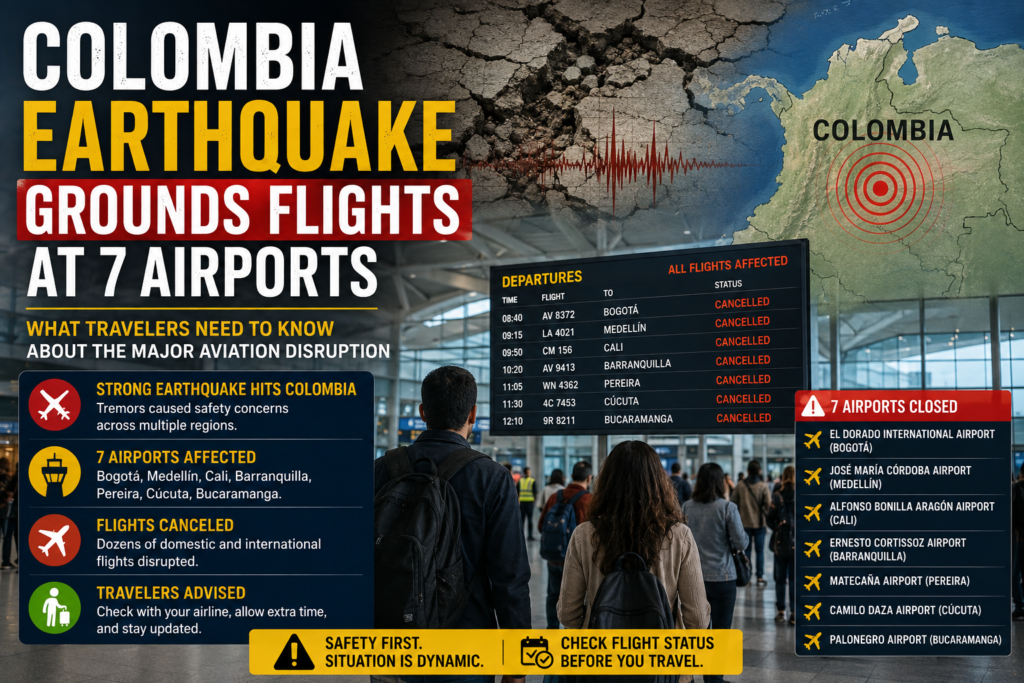
Colombia Earthquake Grounds Flights at 7 Airports: What Travelers Need to Know About the Major Aviation Disruption
Colombia Travel & Flight Update | August 11, 2026
A powerful magnitude 7.4 earthquake struck western Colombia on Monday, August 10, triggering a major humanitarian emergency and temporarily suspending flight operations at seven airports as authorities inspected terminals and aviation infrastructure for damage.
The earthquake was Colombia’s strongest recorded earthquake of the 21st century, according to the Colombian Geological Service. The U.S. Geological Survey measured the earthquake at magnitude 7.4 and placed its depth at about 107 kilometers, or 66 miles. Reuters+1
The disaster caused widespread damage across western Colombia. At least 111 people were reported killed, hundreds were injured, and approximately 1,600 buildings were damaged, including at least 61 that completely collapsed, according to the Associated Press. Rescue operations continued as authorities searched for people trapped beneath rubble. AP News
For the aviation industry, the earthquake created an immediate challenge.
Colombia’s civil aviation authority, Aerocivil, temporarily suspended operations at airports in Cali, Pereira, Manizales, Quibdo, Armenia, Cartago and Buenaventura while authorities and engineers assessed the facilities. Deep Arrival reported that the airport suspensions affected travelers across several important areas of western Colombia, including the Coffee Region and Pacific coast. Deep Arrival+1
For passengers who already have tickets, the situation means that checking a general airport status is not enough. Travelers need to confirm the status of their specific flight before leaving for the airport.
For customers who need assistance with booking, canceling, rebooking, rescheduling or upgrading a flight ticket, help is available at:
1-877-730-2630
Customers can also call the same toll-free number to check flight status and receive assistance with their itinerary.
A magnitude 7.4 earthquake strikes western Colombia
The earthquake struck western Colombia on Monday, August 10.
Its epicenter was near San José del Palmar in the Chocó region, approximately 400 kilometers, or about 250 miles, west of Bogotá, according to the U.S. Geological Survey and the Associated Press. AP News
The shaking was felt well beyond the immediate epicenter.
Major cities including Cali, Pereira, Quibdo and Manizales experienced significant effects, while the earthquake was also felt in neighboring Ecuador and Panama. Bogotá experienced the tremor as well, although the capital avoided the level of destruction seen in some western cities. AP News
The earthquake caused buildings to collapse, damaged hospitals and other infrastructure, and left residents searching through rubble for survivors.
In Cali, Colombia’s third-largest city, emergency crews and residents worked together to search damaged buildings.
In Pereira, a four-story building collapsed, while damage was also reported at the city’s airport.
In Manizales, part of the city’s historic neo-Gothic cathedral collapsed during the earthquake. Reuters+1
The scale of the earthquake made transportation safety a major concern.
Airports in affected areas could not simply continue normal operations while engineers were determining whether terminals, equipment and other facilities had been damaged.
That led to temporary flight suspensions.
Seven airports were affected by flight suspensions
Aerocivil identified seven airports where operations were temporarily suspended:
- Cali
- Pereira
- Manizales
- Quibdo
- Armenia
- Cartago
- Buenaventura
Deep Arrival reported the same seven-airport suspension list based on Aerocivil’s updates. Deep Arrival
Reuters also reported that operations at several regional airports, including Pereira, Manizales, Quibdo, Armenia, Cartago and Buenaventura, were suspended while engineers conducted structural inspections. Reuters
The Associated Press likewise reported that authorities suspended flights at airports including Manizales, Quibdo, Armenia, Cartago, Buenaventura and Pereira while they assessed damage. AP News
Cali’s Alfonso Bonilla Aragón International Airport was also included in Aerocivil’s updated information, according to Deep Arrival. Deep Arrival
The airport disruption therefore affected a broad section of western Colombia’s aviation network.
However, travelers should not interpret the situation as meaning that every airport in Colombia was closed.
Bogotá was not included in Aerocivil’s seven-airport suspension list. That means an airport outside the affected group can continue operating even while individual flights involving a suspended airport are disrupted. Deep Arrival
Why airports can remain closed after an earthquake
An airport does not become safe to operate simply because the shaking has stopped.
After a major earthquake, engineers and airport authorities need to inspect multiple parts of the facility.
That can include:
- terminal structures;
- ceilings and suspended fixtures;
- control facilities;
- navigation equipment;
- utilities;
- electrical systems;
- passenger areas;
- baggage systems;
- boarding gates;
- access roads;
- fuel infrastructure; and
- emergency-response systems.
Deep Arrival noted that airport inspections can take time because a runway may remain usable even when other parts of an airport require further evaluation. Deep Arrival
For example, passengers may be able to see an aircraft on the ground and assume that flights are about to resume.
But an airline cannot necessarily board passengers until the airport confirms that the relevant facilities are safe.
Aftershocks can add another complication.
A structure that survived the initial earthquake may still require inspection if additional tremors occur.
The Colombian Geological Service reported that 21 aftershocks had been recorded by late Monday and warned that additional tremors were likely. Reuters
That is why travelers should rely on official airport or airline confirmation rather than assuming an airport will reopen at a particular time.
Pereira airport sustained visible damage
One of the clearest examples of the earthquake’s effect on aviation infrastructure came from Pereira.
The Associated Press reported that pieces of the airport ceiling fell while travelers sheltered during the earthquake.
Photos and videos showed passengers moving through areas affected by dust and debris. AP News
That kind of structural damage explains why aviation authorities needed to suspend operations while engineers assessed the facility.
For travelers, an airport terminal is more than a runway.
Passengers need safe access to check-in counters, security checkpoints, waiting areas and boarding gates.
Airlines also require operational systems for baggage handling, aircraft servicing and communications.
Any significant damage can therefore affect the ability to operate flights safely.
The earthquake caused a much larger humanitarian emergency
Although the flight disruption is significant for travelers, it represents only one part of the disaster.
The earthquake caused widespread destruction across western Colombia.
The Associated Press reported that approximately 1,600 buildings were damaged, with at least 61 completely collapsing. At least 111 people were reported dead and 87 injured in figures cited by the Colombian government at the time of the report. AP News
Reuters reported the national death toll at 111 and described rescue teams searching through collapsed buildings in cities including Cali and Pereira. Reuters
Rescue crews faced difficult conditions.
In some locations, emergency workers and volunteers manually removed rubble in the search for survivors.
The disaster also affected hospitals and other emergency facilities.
The earthquake therefore created simultaneous challenges for rescue operations, medical care, transportation and communications.
Cali faces major damage
Cali was among the cities heavily affected by the earthquake.
The Associated Press reported that residents and emergency workers searched damaged structures for survivors.
Local authorities reported extensive building damage, and some residents remained trapped in collapsed or partially collapsed structures. AP News
Reuters reported that 35 deaths and 700 injuries had been reported in Valle del Cauca, the province where Cali is located, in figures given by the president during the response. Reuters
The earthquake also disrupted normal activities in the city.
Officials postponed the Petronio Álvarez festival, a major annual celebration of Pacific music that had been scheduled to begin Wednesday. Reuters
Authorities also introduced curfews in Cali as officials responded to concerns about security and potential looting.
Pereira and the Coffee Region were also heavily affected
Pereira, located in Colombia’s Coffee Region, experienced significant structural damage.
The city was among the locations where emergency teams searched collapsed buildings for survivors.
The airport was also affected, with visible damage reported inside the terminal. AP News
The region has a history of significant earthquakes.
In 1999, a magnitude 6.2 earthquake struck near Armenia and killed more than 1,000 people, according to Reuters and the Associated Press. Reuters+1
That history makes the current earthquake particularly significant for communities in Colombia’s Coffee Region.
Manizales also suffered structural damage
Manizales was another city affected by the earthquake.
A tower of the city’s landmark neo-Gothic cathedral collapsed, sending debris into the surrounding area.
Authorities urged residents to remain outside while they assessed buildings and considered the possibility of aftershocks. Reuters+1
Flights at Manizales Airport were temporarily suspended as authorities inspected the facility.
For travelers, this meant that even if they had booked a flight for the same day, normal airport operations could not be assumed.
What about Bogotá?
Bogotá was shaken by the earthquake, but it was not among the seven airports listed by Aerocivil as temporarily suspended.
That distinction is important for travelers who have connections through Colombia’s capital.
A flight through Bogotá may still be affected if the passenger’s onward or incoming segment involves one of the affected western airports.
For example, a traveler could have a confirmed flight to Bogotá but an onward flight to Pereira.
If the Pereira airport remains suspended, the passenger’s overall itinerary could still be disrupted.
Deep Arrival specifically advised passengers connecting through Bogotá to verify every segment of their itinerary rather than assuming that a functioning Bogotá airport means the entire journey will operate normally. Deep Arrival
North American travelers should pay close attention
The earthquake is especially relevant to travelers from the United States and Canada who are visiting Colombia or connecting through the country.
Colombia is a major destination for North American travelers, with regular services connecting Colombian cities to North American gateways.
A passenger traveling to Colombia may not necessarily be flying directly into one of the affected airports.
However, domestic connections can create another point of disruption.
A traveler might arrive in Bogotá and then connect to Cali, Pereira, Armenia or another affected destination.
If that second flight is suspended, the traveler may need to change the itinerary even if the international flight operates normally.
That is why checking the status of the entire itinerary is essential.
A flight cancellation does not necessarily mean the whole trip is canceled
Passengers whose flights are disrupted should first determine what options are available through their airline.
Depending on the airline and the specific ticket, options may include:
- changing the travel date;
- rerouting through another airport;
- requesting a refund;
- changing a connection;
- rebooking on another available service; or
- postponing the trip.
The exact rules vary by carrier.
Passengers should therefore review the conditions attached to their reservation.
For customers needing assistance with booking, canceling, rebooking, rescheduling or upgrading a flight ticket, call:
1-877-730-2630
The same toll-free number can be used to check flight status.
Travelers should have their reservation details, ticket information and travel dates available when requesting assistance.
Avianca offers special options to eligible passengers
One important airline response involves Avianca.
Deep Arrival reported that Avianca issued a same-day notice for customers affected by the earthquake.
Eligible tickets for travel on August 10 could be changed to a new date within 15 days without a penalty or fare difference, according to the airline’s reported terms. Eligible passengers could also have rerouting or refund options depending on the circumstances. Deep Arrival
Travelers should verify whether their individual ticket qualifies before making changes.
A waiver applying to a specific travel date or group of passengers does not automatically apply to every ticket.
Airline policies can also change as the emergency develops.
Should travelers use another airport?
Some passengers may consider traveling to another airport if their original departure airport remains closed.
That can sometimes be an option, but travelers should not automatically assume another airport is safe or practical.
A road journey from one airport to another may involve damaged roads, traffic restrictions, fuel shortages or other transportation problems following a major earthquake.
Deep Arrival specifically cautioned that travelers considering an alternative airport should confirm both that the airport is operating and that the ground route is safe before accepting a change. DDeep Arrival
The best alternative is therefore not necessarily the closest airport on a map.
It is the airport that is confirmed operational and safely accessible.
Travelers with trips later this week should not panic—but should monitor developments
If your Colombia trip is scheduled for later this week, the current suspension does not automatically mean that you need to cancel your entire vacation.
Airport operations can change as inspections are completed.
At the same time, travelers should not assume that all services will immediately return to normal.
Aftershocks and continuing structural assessments could influence reopening decisions.
The safest approach is to keep the reservation while monitoring official updates from the airline and airport.
If your airline contacts you about a schedule change, review the available options before making additional arrangements.
Don’t assume an airport reopening means every flight is back
Even after an airport is declared operational, individual flights can remain affected.
Airlines may have aircraft and crews positioned elsewhere because of the disruption.
A flight canceled earlier in the day can create consequences for later services.
An aircraft scheduled to operate one route may not be in the correct location.
Crew members may also be unable to reach their assigned flights.
That can cause a ripple effect throughout an airline’s schedule.
For this reason, travelers should always check the specific flight number and travel date.
A general statement that an airport has reopened is not a substitute for flight confirmation.
Aftershocks remain a concern
Another reason the situation could change is the possibility of additional earthquakes.
Colombia’s Geological Service recorded 21 aftershocks by Monday evening and warned that more could occur. Reuters
Aftershocks do not necessarily mean that airports will remain closed indefinitely.
But they can affect ongoing inspections.
If engineers identify new damage following another significant tremor, an airport could require additional checks.
Travelers should therefore avoid relying on unofficial reopening predictions.
Colombia’s location makes earthquakes a recurring risk
Colombia sits in a seismically active region associated with the Pacific Ring of Fire.
The country experiences many earthquakes, although most are relatively small.
The Colombian Geological Service described the August 10 earthquake as the strongest recorded in the country during the 21st century. Reuters+1
Scientists cited several factors that may have contributed to the severity of the damage.
The earthquake was powerful, occurred inland and involved strike-slip movement.
Although its depth was considerable, experts said the magnitude and geological setting still produced strong shaking in populated areas. Reuters
International assistance is arriving
The earthquake has prompted offers of assistance from governments across the Americas.
The United States announced $15.5 million in emergency assistance for shelter, food and other earthquake-response needs, according to the Associated Press. AP News
El Salvador, Mexico and Chile also offered assistance.
Rescue teams, medical personnel and supplies were among the forms of support offered by regional governments. AP News
The international response highlights the scale of the disaster and the difficulties facing Colombian authorities as they work to locate survivors and assess damage.
What travelers should do before going to the airport
If you are scheduled to fly from or through western Colombia, take a few practical steps before leaving for the airport.
1. Check your exact flight
Do not rely on a general statement that flights are operating.
Check your flight number, departure airport and travel date.
2. Check every connection
If you have a connection through Bogotá or another Colombian airport, confirm both segments.
3. Contact your airline if the status is unclear
Airline representatives can provide the most relevant information for your reservation.
4. Do not travel to a suspended airport without confirmation
If operations remain suspended, arriving at the terminal will not restore the flight.
5. Allow additional time
Even when airports reopen, inspections, security procedures and passenger processing could take longer than usual.
6. Be cautious about alternative ground transportation
Road conditions may be affected by the earthquake.
7. Keep your phone and email available
Airlines may send schedule changes or rebooking information electronically.
8. Keep your reservation information handy
This makes it easier to request changes or obtain flight-status information.
What this means for passengers flying from the United States and Canada
For North American travelers, the most important point is that the disruption is regional rather than a shutdown of Colombia’s entire aviation network.
Seven western airports were temporarily affected.
Bogotá was not included in the seven-airport suspension list cited by Aerocivil.
That means travelers should look at their individual itinerary instead of assuming that every flight to Colombia is canceled. Deep Arrival
A passenger flying directly to Bogotá may have a different situation from someone connecting onward to Pereira.
Likewise, a traveler flying to another Colombian airport may be unaffected even while services in western Colombia remain disrupted.
The situation can change quickly
Natural disasters can produce rapidly changing transportation conditions.
An airport may remain closed for inspection and then resume limited operations.
A reopening may be followed by additional delays.
An airline may offer a waiver for passengers on one travel date and introduce a different policy later.
That is why travelers should continue checking official updates.
The latest information from Deep Arrival reported that operations at the affected airports remained temporarily suspended in Aerocivil’s same-day update. Deep Arrival
The status should therefore be treated as a developing situation rather than a fixed long-term closure.
Flight disruptions are secondary to the humanitarian response
While travelers understandably need information about cancellations and airport closures, the earthquake has caused a much broader emergency.
Rescue workers are still searching for survivors.
Hospitals and emergency facilities have been affected.
Thousands of structures have been damaged.
Communications have been disrupted in some areas.
Authorities are also dealing with aftershocks and difficult access to some remote parts of Chocó. Reuters+1
Travelers should keep this context in mind when considering changes to their itinerary.
The airport closures are primarily safety measures taken while authorities assess infrastructure following a devastating earthquake.
Bottom line: Seven airports suspended after Colombia’s strongest quake this century
A magnitude 7.4 earthquake struck western Colombia on August 10, causing widespread destruction and temporarily disrupting aviation operations.
The earthquake was the strongest recorded in Colombia during the 21st century, according to the Colombian Geological Service. Reuters+1
Aerocivil temporarily suspended operations at seven airports:
Cali, Pereira, Manizales, Quibdo, Armenia, Cartago and Buenaventura. Deep Arrival+1
The suspensions allowed authorities and engineers to inspect airport facilities for earthquake damage.
The disruption does not mean that all Colombian airports or all Colombian airspace are closed. Bogotá was not included in the seven-airport suspension list. However, travelers connecting through Bogotá can still be affected if another part of their itinerary involves an airport that remains closed. Deep Arrival
The humanitarian consequences are much larger.
At least 111 people were reported killed, hundreds were injured, and approximately 1,600 buildings were damaged, according to the Associated Press. Rescue workers continued searching for people trapped beneath collapsed structures. AP News
With aftershocks continuing and airport inspections underway, travelers should not rely on assumptions about when flights will resume.
Instead, passengers should verify their specific flight status before heading to the airport.
For customers who need help with booking, canceling, rebooking, rescheduling or upgrading a flight ticket, call:
1-877-730-2630
Customers can also call this toll-free number to check flight status.
Travelers should have their booking or ticket information available when calling.
Source Credit
Primary source: Deep Arrival, “Colombia Earthquake Suspends Flights at Seven Airports,” published August 10, 2026. The report identifies the seven affected airports, summarizes Aerocivil’s operational update and provides traveler guidance regarding flight checks and airline options. Deep Arrival
The aviation details were cross-checked against reporting from Reuters and The Associated Press, which independently reported the earthquake, airport suspensions and ongoing structural inspections. Reuters reported that the magnitude 7.4 earthquake was the strongest recorded in Colombia this century and that airport operations were suspended while engineers assessed damage. Reuters The Associated Press reported at least 111 deaths, approximately 1,600 damaged buildings and the effects of the earthquake in cities including Cali, Pereira, Quibdo and Manizales. AP News
Editorial note: This article reflects information available during the developing emergency on August 10–11, 2026. Airport operations, flight schedules, airline waivers and travel conditions may change as inspections continue and aftershocks occur. Travelers should verify their individual flight before traveling.
Customer-service notice: The telephone number 1-877-730-2630 is included based on the customer-service information supplied for this article. It is not represented as an official telephone number for Deep Arrival, Aerocivil, the Colombian government, an airport, an airline, Reuters or The Associated Press.
Source: Deep Arrival — “Colombia Earthquake Suspends Flights at Seven Airports”. The supporting facts were also cross-checked with Reuters and AP. Deep Arrival+2