
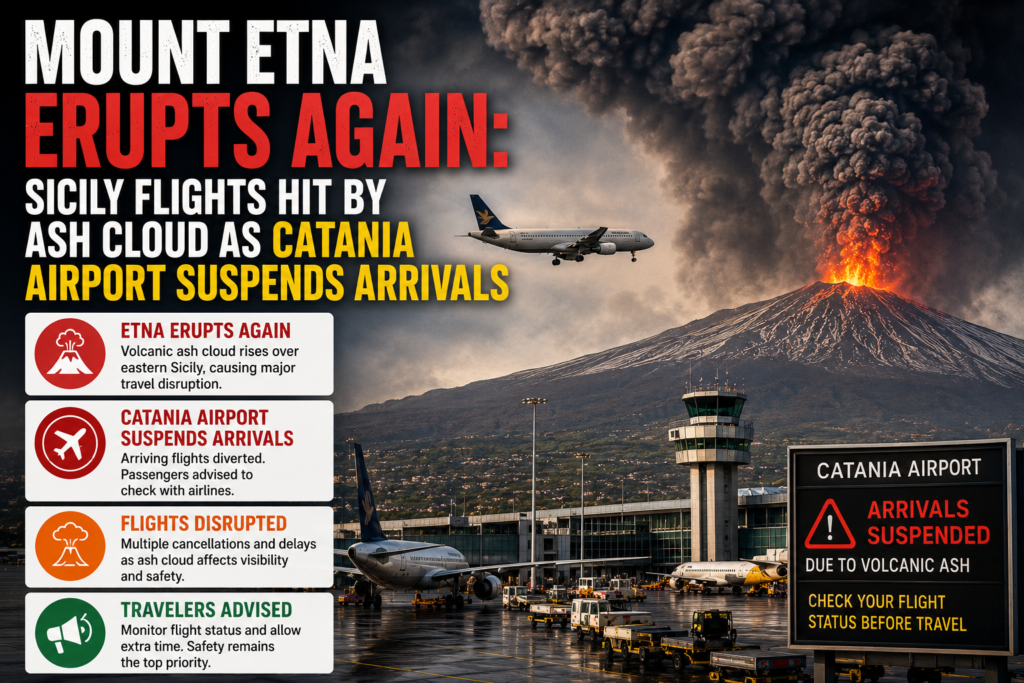
Mount Etna Erupts Again: Sicily Flights Hit by Ash Cloud as Catania Airport Suspends Arrivals
Sicily Travel & Flight Disruption Update | August 11, 2026
A fresh eruption of Mount Etna, Europe’s largest active volcano, has disrupted air travel in Sicily, forcing authorities to suspend incoming flights at Catania Airport after volcanic ash moved into the surrounding airspace.
The eruption has created another round of travel uncertainty for passengers visiting Sicily during the busy summer season. Catania’s airport is one of the island’s most important aviation hubs, serving millions of passengers each year and providing access to eastern Sicily, including popular destinations such as Catania, Taormina and Mount Etna itself.
According to Wanted in Rome, volcanic ash from Etna’s latest eruptive activity led to repeated restrictions at Catania Airport, with arrivals suspended until 17:00 local time on Monday, August 10. The airport operator, SAC, advised passengers to check the status of their individual flights before traveling to the airport. Wanted in Rome
Reuters separately reported that all incoming flights to Catania were suspended until 15:00 GMT on Monday, reflecting the changing operational situation as airport officials monitored the ash cloud and volcanic conditions. Reuters
The differing times reported in updates illustrate an important point for travelers: the situation can change quickly, and airport restrictions may be revised as ash moves, weather conditions change and aviation authorities reassess the risk.
For North American travelers with flights to or through Sicily, the disruption could mean delayed arrivals, diversions, missed connections or changes to travel plans.
Customers who need assistance with booking, canceling, rebooking, rescheduling or upgrading a flight ticket can call:
1-877-730-2630
Customers can also call the same toll-free number to check flight status before traveling to the airport.
Mount Etna sends ash into the air
Mount Etna has entered another active eruptive phase, producing volcanic ash and lava from vents near its summit.
Italy’s National Institute of Geophysics and Volcanology (INGV) reported ongoing activity from vents at elevations of approximately 2,750 meters and 2,360 meters, along with multiple lava flows and extensive lava fields. Reuters
The eruption itself is not unusual for Mount Etna.
Etna is one of the world’s most active volcanoes and frequently experiences periods of explosive and effusive activity.
What creates a problem for aviation is not necessarily the presence of lava on the volcano’s slopes.
The major concern for aircraft is volcanic ash in the atmosphere.
Ash particles can be carried by winds over significant distances. When an ash cloud reaches an airport’s surrounding airspace, aviation authorities may restrict flights because volcanic ash can create serious risks for aircraft engines and other components.
That is what has happened around Catania during the latest eruption.
Why volcanic ash is dangerous for aircraft
Volcanic ash is fundamentally different from ordinary dust.
It contains tiny particles of volcanic rock and glass that can be carried into an aircraft engine.
At high temperatures inside a jet engine, some of these particles can melt and then adhere to engine components.
That can affect engine performance.
Ash can also reduce visibility and potentially damage aircraft surfaces and sensors.
For that reason, airlines and aviation authorities treat volcanic ash clouds as a serious operational hazard.
The aviation alert for Etna remained at red, the highest level, according to Reuters’ report on Monday’s disruption. Reuters
That does not mean the entire region is unsafe for people on the ground.
It means that aviation authorities are closely monitoring the volcanic ash threat to aircraft.
As the ash moves and conditions change, restrictions can be introduced, extended or lifted.
Catania Airport is particularly vulnerable to Etna disruptions
Catania Airport, officially Catania–Fontanarossa Airport, is located in eastern Sicily relatively close to Mount Etna.
That proximity makes it an extremely important airport for the region but also leaves it vulnerable when volcanic ash is carried toward the airport.
Catania is one of Italy’s busiest airports and a major gateway for tourists visiting eastern Sicily.
For travelers arriving from North America, the airport can be part of a longer itinerary involving a connection elsewhere in Europe.
A passenger might travel:
New York → Rome → Catania
or
Toronto → London → Catania
or
Los Angeles → Frankfurt → Catania
If the Catania-bound segment is delayed or canceled, the disruption can affect the entire itinerary.
Even travelers whose first flight is operating normally can therefore be affected by an Etna-related closure at their final destination.
Incoming flights were suspended
The immediate aviation impact of the latest eruption was the suspension of incoming flights at Catania.
Wanted in Rome reported that arrivals were suspended until 17:00 on August 10 after volcanic ash entered the airport’s airspace. Wanted in Rome
Reuters reported a temporary suspension of all incoming flights until 15:00 GMT, based on information from airport operator SAC. Reuters
The precise reopening time can change because aviation authorities make decisions based on real-time conditions.
If ash remains in the area, restrictions may be extended.
If conditions improve, operations can resume.
That means travelers should not assume that a previously announced reopening time guarantees that their flight will depart or arrive at that time.
Flights can be diverted when Catania is restricted
When Catania cannot safely accept arriving aircraft, airlines may have to consider alternative arrangements.
Depending on the circumstances, an aircraft may be diverted to another airport in Sicily or elsewhere in Italy.
Passengers may then have to continue their journey by ground transportation or wait for an alternative flight.
This can be particularly difficult for international travelers who have connecting flights.
For example, a passenger arriving in Sicily on a flight that is diverted to another airport could face a long road journey before reaching Catania or another destination.
The availability of buses, taxis, rental cars and trains may also become more limited when large numbers of passengers are affected simultaneously.
Travelers should therefore avoid making expensive independent arrangements until they know what their airline is offering.
Palermo can provide an alternative – but not always an easy one
Sicily has more than one major airport.
Palermo Airport, on the island’s northern side, is farther from Mount Etna and can sometimes remain operational when Catania is affected by volcanic ash.
However, choosing Palermo as an alternative is not necessarily straightforward.
Catania and Palermo are on opposite sides of Sicily, and a journey between them can take several hours depending on traffic and transportation conditions.
A traveler whose original destination is Catania may therefore have to decide whether a flight into Palermo is genuinely useful.
Passengers should also confirm that the airline will accept a change to an alternative airport before purchasing a separate ticket.
Buying a new flight independently can leave a traveler responsible for the cost if the original airline does not reimburse the expense.
The disruption comes during Sicily’s busy summer season
The timing is significant.
August is one of the busiest travel periods in Italy, and Sicily is a major summer destination.
Visitors travel to the island for its beaches, historic towns, archaeological sites, food and cultural attractions.
Eastern Sicily is particularly popular.
Catania serves as a gateway to destinations including Taormina, Syracuse, Noto and Mount Etna itself.
As a result, a disruption at Catania Airport can affect a large number of vacationers.
The impact is not limited to passengers whose final destination is Catania.
Travelers headed to smaller towns and resorts across eastern Sicily may also depend on the airport.
Travelers should check their flight before leaving for the airport
SAC, the operator of Catania Airport, has urged passengers to verify their flight status before heading to the airport. Reuters
That is especially important during a volcanic eruption.
Travelers should check:
- their flight number;
- departure or arrival time;
- the operating airline;
- any cancellation notice;
- any diversion notice;
- their connection status; and
- instructions from the airline.
A flight can be listed as scheduled while operational conditions are still changing.
Passengers should therefore check again shortly before leaving for the airport.
If they are already at the airport, they should continue monitoring announcements and airline notifications.
Don’t assume that every flight to Sicily is canceled
The latest disruption is focused on Catania Airport and its surrounding airspace.
It does not mean that every flight to Sicily has been canceled.
Palermo and other airports can have different operational conditions.
Even at Catania, restrictions may affect arriving flights differently from departing flights.
That distinction is important.
A traveler reading that “Catania Airport is disrupted” should not automatically conclude that every flight involving the airport has been canceled.
The individual flight is what matters.
Passengers should confirm the status of their specific booking.
What does this mean for travelers from the United States and Canada?
North American visitors planning summer vacations in Sicily should pay particular attention if Catania is part of their itinerary.
Travelers from the United States and Canada frequently reach Sicily through major European connecting hubs.
That creates multiple points where a disruption can affect the journey.
Consider a traveler flying from Chicago to Rome and then connecting to Catania.
The Chicago-Rome flight may operate normally.
The Rome-Catania flight could then be delayed or suspended because of the volcanic ash.
The traveler may have to wait in Rome, change flights or be rerouted to another airport.
Alternatively, a traveler already in Sicily may have a departing flight from Catania that is affected by the airport’s operational restrictions.
In each case, the best response depends on the individual airline and ticket.
Why the volcano can disrupt flights without threatening the city directly
Volcanic eruptions can create aviation problems even when lava is not approaching populated areas.
The reason is the atmosphere.
An ash plume can move in a direction that is completely different from the direction of a lava flow.
The lava may remain close to the summit while ash travels toward an airport.
This is why authorities monitor not only the eruption itself but also:
- wind direction;
- wind speed;
- ash concentration;
- plume height;
- visibility;
- aviation forecasts; and
- volcanic activity.
The latest eruption produced significant ash, prompting aviation restrictions around Catania.
INGV continues to monitor Etna
Italy’s National Institute of Geophysics and Volcanology is responsible for monitoring volcanic activity in the country.
According to Reuters, INGV reported eruptive activity from multiple vents, with lava flows and extensive lava fields. The aviation alert remained at red during the latest disruption. Reuters
Scientists continue to monitor the volcano for changes.
This monitoring is important because Etna’s activity can change quickly.
An eruption can intensify, weaken or shift in character.
The aviation situation can consequently change along with it.
Etna has disrupted Catania flights before
The latest incident is not an isolated event.
Catania Airport has repeatedly experienced flight disruption because of Mount Etna’s volcanic activity.
The airport’s location close to the volcano means that ash clouds have historically forced authorities to restrict or suspend operations.
That does not make every eruption equally disruptive.
Some eruptions produce relatively little ash.
Others generate larger plumes that travel toward the airport.
Weather and wind conditions also determine whether ash moves toward populated areas and aviation routes.
For travelers, this means that the duration of an Etna-related airport disruption can be difficult to predict.
A reopening time is not a guarantee
One of the biggest mistakes travelers can make during a volcanic disruption is treating a reopening announcement as a guaranteed flight schedule.
Suppose airport officials announce that arrivals may resume at 5 p.m.
That does not necessarily mean that every aircraft scheduled to arrive at 5 p.m. will land.
Airlines may need time to reposition aircraft.
Crew schedules may have changed.
Earlier cancellations can create a backlog.
An aircraft that was supposed to arrive at Catania may already have been diverted elsewhere.
Therefore, even after airport restrictions are lifted, travelers can experience continuing delays.
Travelers with connections should be especially careful
Passengers with connecting flights face additional risks.
Imagine a traveler arriving at Catania from Rome and then taking a separate flight onward to another European destination.
If the Catania arrival is delayed by several hours, the connecting flight could be missed.
The same applies to passengers traveling in the opposite direction.
A delayed departure from Catania can cause a passenger to miss an international connection from Rome, Milan, London, Frankfurt or another hub.
Travelers with separate tickets should be especially cautious because the airlines may not have an obligation to protect a connection booked independently.
What should you do if your Catania flight is canceled?
If your flight is canceled because of the volcanic disruption, first check what options the airline provides.
Depending on the airline, passengers may be offered:
- a replacement flight;
- a date change;
- rerouting;
- a refund;
- travel credit; or
- transportation through another airport.
The exact options depend on the carrier, fare type and circumstances surrounding the cancellation.
Passengers should avoid assuming that the same rules apply across all airlines.
If you need assistance with booking, canceling, rebooking, rescheduling or upgrading your flight ticket, call:
1-877-730-2630
The same toll-free number can be used to check flight status.
Have your reservation number, passenger information and travel date available when requesting assistance.
What if your flight is delayed but not canceled?
A delay requires a different approach.
If the airline still lists the flight as operating, passengers should generally continue monitoring the status unless the carrier gives different instructions.
A delayed flight can eventually depart.
However, volcanic conditions can cause further schedule changes.
Travelers should therefore remain flexible.
If you are already at the airport, listen for announcements and check your airline’s notifications.
If you have not yet left for the airport, confirm the latest status before beginning your journey.
Don’t rush to buy a replacement ticket
When passengers see a cancellation notice, their first instinct may be to search for another flight and purchase it immediately.
That can sometimes be a costly mistake.
If the airline is offering rebooking, passengers may be able to change their itinerary without purchasing a completely new ticket.
A new ticket bought independently may not be refundable.
The airline may also later provide transportation on another service.
Before spending additional money, travelers should review their options with the carrier.
What if you need to travel urgently?
Some passengers cannot simply wait for the situation to resolve.
Business travelers, cruise passengers, people with hotel reservations and travelers with fixed vacation schedules may need an alternative route.
In that case, passengers can explore options such as:
- traveling to another Sicilian airport;
- changing the travel date;
- rerouting through another European city;
- changing the final destination; or
- delaying the trip until Catania operations stabilize.
However, each option has different costs and practical considerations.
An alternative airport may require several hours of ground transportation.
A different flight may have a long connection.
A date change may affect hotel and car-rental reservations.
Travelers should consider the entire itinerary rather than focusing only on the flight.
Cruise passengers should pay attention
Sicily is also a popular cruise destination.
Passengers flying into Catania before a cruise departure face an additional risk because a flight disruption can cause them to miss the ship.
Cruise passengers should therefore allow substantial time between their flight arrival and cruise departure.
If the cruise line has arranged transportation, passengers should contact the cruise operator before making independent changes.
Missing a cruise departure can be considerably more complicated than missing an ordinary flight connection.
Hotel and rental-car reservations may also be affected
Flight disruptions can have consequences beyond the airport.
A traveler who arrives a day late may need to modify a hotel booking.
A rental car reservation may need to be changed.
Tour bookings can also be affected.
Travelers should keep records of all changes and communicate with service providers as soon as they know that their itinerary will be affected.
Travel insurance may provide coverage for certain expenses, but policies vary.
Passengers should check their policy terms rather than assuming that volcanic activity automatically qualifies for reimbursement.
Should travelers cancel a Sicily vacation?
Not necessarily.
The latest disruption is a response to volcanic ash affecting aviation operations.
It does not automatically mean that Sicily as a whole is closed to visitors.
Many parts of the island can continue operating normally even when Catania experiences flight restrictions.
Travelers should distinguish between:
volcanic activity at Mount Etna,
aviation restrictions at Catania Airport,
and
general travel conditions across Sicily.
These are related but not identical.
The best approach is to monitor official updates and make decisions based on the specific destination and travel date.
Is Mount Etna dangerous for tourists?
Mount Etna is an active volcano, and visitors should always follow instructions from Italian authorities and local officials.
Tourists should not enter restricted volcanic areas.
They should also avoid assuming that a visible eruption is safe simply because large numbers of people are watching it from a distance.
The most immediate aviation issue during the current event is volcanic ash.
But volcanic eruptions can involve other hazards, including falling volcanic material, gas, lava flows and rapidly changing conditions near the summit.
Visitors should follow local safety restrictions.
Why airlines take volcanic ash warnings seriously
Modern aircraft are highly capable, but volcanic ash presents an unusual aviation hazard.
Unlike ordinary weather systems, volcanic ash can be difficult to see from an aircraft.
An ash cloud may also extend over a large area.
Aircraft engines operate at extremely high temperatures, meaning volcanic particles can behave differently after entering the engine.
For this reason, airlines generally prefer to avoid known ash clouds rather than attempt to fly through them.
That is why an eruption several miles from an airport can still cause major flight disruptions.
What North American travelers should do now
If you are traveling to Sicily from the United States or Canada, consider the following checklist:
Check your exact flight
Do not rely on a general news headline saying that Catania is open or closed.
Look up your specific flight.
Check before leaving for the airport
SAC has advised passengers to verify their flight status before traveling to Catania Airport. Reuters
Check your connections
A flight from North America to Europe may be operating normally while the onward Sicily flight is disrupted.
Keep your phone available
Airlines can send important schedule updates by email, text or app notification.
Have a backup plan
If Catania remains affected, consider whether another Sicilian airport could work for your itinerary.
Don’t assume you must buy a new ticket
Contact the airline first to understand its rebooking options.
Allow extra time
Even after restrictions are lifted, delays may continue because airlines need to recover their schedules.
Check again on the day of travel
Volcanic conditions can change rapidly.
Get assistance when needed
For help with booking, canceling, rebooking, rescheduling or upgrading a flight ticket, call:
1-877-730-2630
For flight-status assistance, customers can call the same toll-free number.
What happens next?
The next stage depends on the behavior of Mount Etna, the movement of volcanic ash and the assessments conducted by Italian aviation authorities.
If ash clears from the relevant airspace and conditions are considered safe, Catania can resume normal or limited operations.
If ash remains in the area, restrictions may continue.
Airlines may also need additional time to recover from earlier cancellations and diversions.
Passengers should therefore expect the possibility of a gradual return to normal rather than an immediate restoration of every flight.
The bottom line for travelers
Mount Etna’s latest eruption has once again demonstrated how quickly volcanic activity can disrupt Sicily’s aviation network.
The main problem for Catania Airport is volcanic ash, which can create serious risks for aircraft.
Wanted in Rome reported repeated disruptions at Catania, including the suspension of arrivals until 17:00 on Monday, August 10. Wanted in Rome
Reuters reported that the airport suspended incoming flights until 15:00 GMT during the latest episode and said SAC was urging passengers to check their flight status before going to the airport. Reuters
INGV reported continued eruptive activity, including lava flows and activity from multiple vents, while the aviation alert remained at red. Reuters
For travelers, the most important message is simple:
Do not assume your flight is operating simply because the airport is open.
And do not assume that every flight is canceled simply because Catania has experienced restrictions.
Check the specific flight.
Check every connection.
Monitor updates until departure.
If your plans change, review your airline’s rebooking or refund options before purchasing another ticket.
For customers who need assistance with booking, canceling, rebooking, rescheduling or upgrading flight tickets, call:
1-877-730-2630
Customers can also call the same toll-free number to check flight status.
Source Credit
Primary news source: Wanted in Rome, “Mount Etna eruption disrupts air travel at Catania airport in Sicily.” The report describes the ash-related disruption at Catania Airport and the suspension of arrivals during the latest eruptive episode. Wanted in Rome
The aviation and volcanic details in this article were cross-checked against Reuters, which reported that Catania arrivals were suspended because volcanic ash had disrupted the airspace around the airport and that Italy’s National Institute of Geophysics and Volcanology continued to monitor the eruption. Reuters
Editorial note: Volcanic activity, ash movement, airport restrictions and airline schedules can change rapidly. This article reflects information available during the August 10–11, 2026 disruption. Travelers should verify their individual flight status with their airline or airport before traveling.
Customer-service notice: The telephone number 1-877-730-2630 is included based on the customer-service information supplied for this article. It is not represented as an official telephone number for Wanted in Rome, Catania Airport, SAC, INGV, Reuters, an airline or the Italian government.