
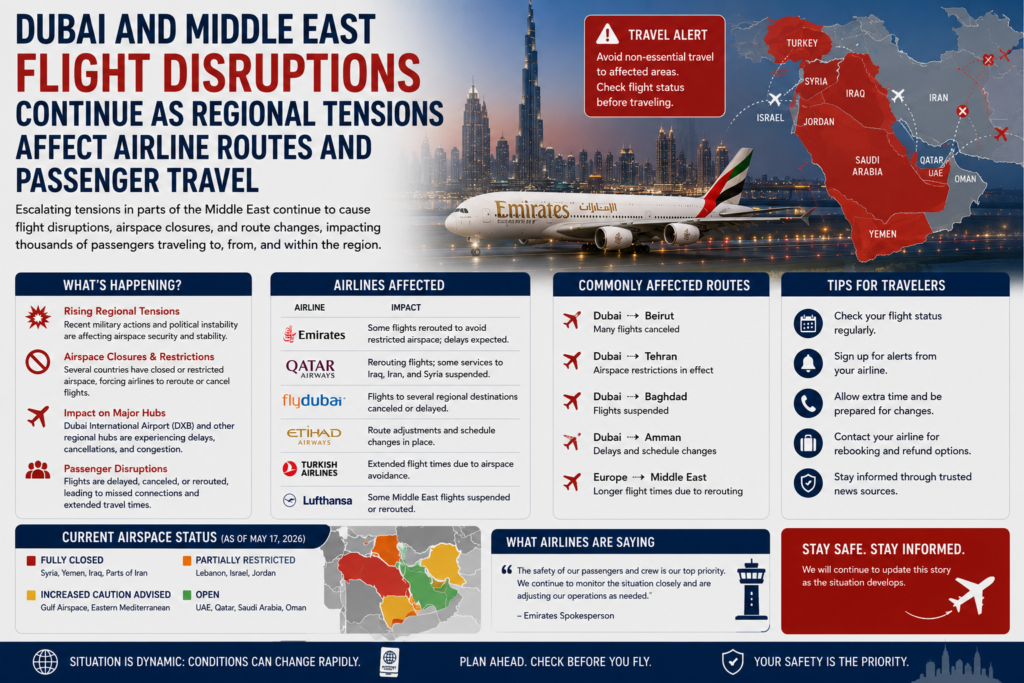
Dubai and Middle East Flight Disruptions Continue as Regional Tensions Affect Airline Routes and Passenger Travel
Air travelers across the Middle East are facing continued uncertainty as airlines adjust flight schedules, reroute aircraft and review operations following renewed tensions involving the United States and Iran.
Dubai, one of the world’s busiest international aviation hubs, has been among the key points affected by regional instability. Airlines operating through Gulf airports have continued updating schedules as they assess airspace conditions, security considerations and operational requirements.
The disruptions have affected passengers traveling through major Middle Eastern transit points, including Dubai, Doha, Abu Dhabi and other regional hubs that connect Europe, Asia, Africa and the Americas.
Why Middle East Flights Are Being Disrupted
Airlines operating in conflict-affected regions often make changes based on safety assessments, government guidance and airspace availability.
Recent tensions between the United States and Iran have resulted in increased security concerns across parts of the region. Aviation authorities and airlines have responded by reviewing flight paths, avoiding certain airspace areas and adjusting schedules where necessary.
Commercial aviation depends on predictable access to air routes. When sections of airspace become restricted or airlines decide that operating conditions require changes, flights may be delayed, canceled, diverted or operated on longer routes.
Dubai Remains a Key Focus for Travelers
Dubai International Airport (DXB) is one of the world’s busiest international airports and serves as a major connecting point for travelers between continents.
Because of its role as a global transit hub, disruptions affecting Dubai can have consequences beyond the United Arab Emirates. A change to one major route can affect connecting passengers, aircraft rotations and airline crew schedules across multiple regions.
Travelers using Dubai as a connection point have been advised to monitor airline updates closely because schedules may change quickly as conditions develop.
Airlines Adjust Routes and Operations
Airlines have responded to regional uncertainty by modifying flight operations.
Some carriers have temporarily suspended or adjusted services involving affected destinations, while others have resumed certain routes after reviewing safety conditions. Reuters reported that some airlines began restoring parts of their Middle East operations while disruption continued across the region.
Airline decisions can vary significantly. One carrier may resume a route while another continues a suspension depending on its own risk assessment, aircraft availability and operational planning.
Airspace Restrictions Affect Flight Planning
Airspace management is one of the most important factors affecting international aviation during periods of geopolitical tension.
The European Union Aviation Safety Agency (EASA) advised operators to avoid Iranian, Iraqi and Lebanese airspace through August 31, 2026, citing continuing security concerns.
When airlines cannot use their normal routes, aircraft may need to fly longer paths around restricted areas. These changes can increase flight times, fuel requirements and operational complexity.
Passengers Face Delays, Rebooking and Uncertainty
For travelers, the impact of regional disruptions is often felt through:
- Flight cancellations.
- Longer journey times.
- Missed connections.
- Airport waiting periods.
- Changes to departure and arrival schedules.
Passengers affected by disruptions are generally advised to contact their airline directly rather than relying only on airport information screens or third-party booking platforms.
Airlines typically handle rebooking options, refunds or travel credits according to their individual policies and the circumstances behind the disruption.
What Travelers Should Do Before Flying
Passengers traveling through the Middle East during periods of uncertainty should take several precautions.
Check flight status frequently
Flight information can change rapidly. Travelers should confirm their departure and connection details before heading to the airport.
Allow extra connection time
When schedules are disrupted, connecting flights may require additional flexibility.
Keep documents accessible
Passengers should keep passports, visas, booking information and travel insurance details available.
Avoid making assumptions about cancellations
A route suspension does not always mean every flight is canceled. Airlines update schedules based on changing conditions.
Travel Insurance and Disruption Coverage
Travel insurance may provide assistance in certain disruption situations, but coverage depends heavily on the policy.
Many policies have specific rules regarding geopolitical events, government warnings and cancellations caused by conflict.
Travelers should review policy terms carefully, especially when traveling to regions experiencing elevated security concerns.
Impact on Global Aviation Networks
Middle East disruptions have consequences beyond regional travel because Gulf airlines operate some of the world’s largest international networks.
Airports such as Dubai International, Hamad International Airport in Doha and Abu Dhabi International Airport serve as major connecting points between continents.
When flights are disrupted at these hubs, passengers traveling between Europe, Asia, Africa and the Americas may experience delays even if their journey does not begin or end in the Middle East.
Airlines Balance Safety and Reliability
For airlines, maintaining service during geopolitical uncertainty requires balancing passenger demand with safety considerations.
Operational teams evaluate:
- Airspace availability.
- Security conditions.
- Government advisories.
- Aircraft positioning.
- Crew availability.
- Airport operating conditions.
Aviation experts note that airlines may make conservative decisions because safety risks can change quickly during periods of regional tension.
Dubai and Gulf Aviation Recovery Efforts
Despite ongoing uncertainty, airlines and airports continue working to restore normal operations where conditions allow.
Recent reports indicate that some airlines have resumed portions of Middle East services after earlier disruptions, although schedules remain subject to change.
Recovery after a disruption can take time because airlines must reposition aircraft, manage delayed passengers and rebuild schedules.
Broader Implications for Middle East Travel
The latest disruption highlights the importance of the Middle East’s role in global aviation.
The region has invested heavily in airport infrastructure and airline networks, transforming cities such as Dubai and Doha into major international travel centers.
However, the same connectivity that makes these hubs valuable also means regional instability can quickly affect travelers worldwide.
What Travelers Need to Watch Next
Passengers planning trips through the Middle East should continue monitoring:
- Airline announcements.
- Airport updates.
- Government travel advisories.
- Aviation authority notices.
Conditions may change quickly depending on diplomatic developments and security assessments.
Final Thoughts
Renewed tensions involving the United States and Iran have created another period of uncertainty for Middle East aviation, with airlines adjusting operations and passengers facing possible delays and schedule changes.
Dubai and other Gulf aviation hubs remain central to international travel, making operational stability in the region important for millions of passengers worldwide.
For travelers, preparation remains essential: check updates regularly, allow additional flexibility and rely on official airline information when making decisions. As airlines continue adapting to changing conditions, the Middle East flight network will remain closely monitored by passengers, carriers and aviation authorities alike.